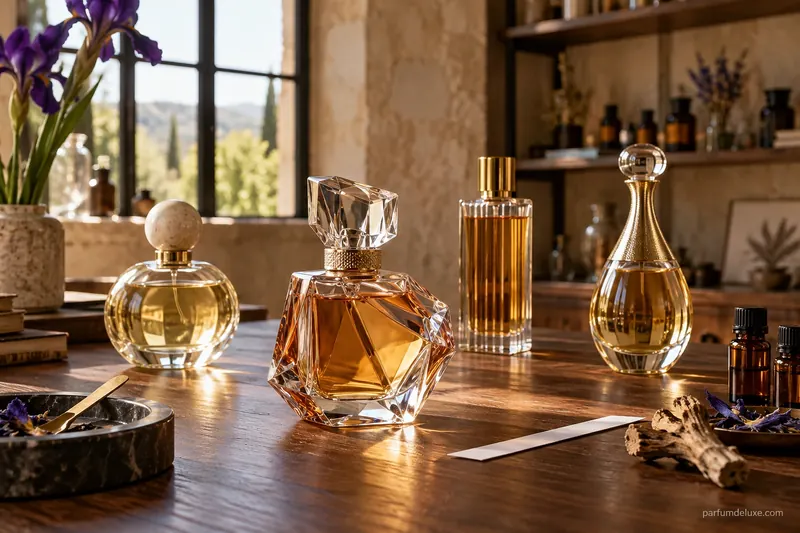
Types of luxury perfume: four ways of sorting that overlap
There is no official register of the types of luxury perfume. These groupings come from fragrance houses, the specialist press and collectors, which is why the same bottle can sit in several of them. It helps to separate four questions: who imagined the scent, what service surrounds it, how the bottle is built, and what commitment the brand claims.
Sorting the types of luxury perfume this way, who imagined it leads to designer and artisanal perfume. The service leads to bespoke work and personal signature scents. The build points to refillable bottles and alcohol-free formats, and the commitment to halal, organic or vegan claims. Each of the kinds of luxury perfume brings its own checks, so start from what matters most to you.
Among the different types of perfume, a shopper after a distinctive voice will look at the perfumer’s body of work. Someone worried about waste will look at the refill system. A wearer with religious or ethical requirements will look for a document tied to one specific reference rather than a general slogan.
Luxury perfume categories: designer and artisanal work, a point of view you can recognise
A designer perfume puts a person forward, often a perfumer or an artistic director, and the luxury lies in a consistent handwriting. You can tell the same hand across several releases even when the themes change. Many independent houses, working in this luxury perfume category, build their identity on this idea, in contrast with launches designed first for the widest possible market.
Artisanal perfume adds a manufacturing story: small batches, supervised maceration, filtration and bottling done in-house. The word is not defined by one legal text, though. The useful questions are where the liquid is blended, where it is bottled and who handles each step, rather than trusting the picture of a workshop.
Grasse is invoked constantly in this kind of storytelling. A town name tells you about a place, not about the quality of the raw materials. A serious house can explain what its mention covers: design, production or simply a registered office.
Bespoke perfume and the personal signature scent
Among luxury perfume categories, as in most different types of perfume, bespoke work asks for the most time: interviews, trials of accords, adjustments and finally a formula that exists for one client. The offers sold under that name are not equal. A workshop lasting a few hours is a very different service from a perfumer following a client over several appointments.
As an example, the Grasse house Galimard describes a white-label service on its website. Its in-house perfumers draw up formula proposals with the sales teams, the perfume is produced in the company’s laboratories, then macerated, chilled and filtered, and supplied in bulk or as a finished product. Eau de toilette, eau de parfum and parfum are all possible. That offer is aimed at brands rather than individuals, a reminder that one word can cover very different services.
A signature scent is less a service than a habit: wearing the same fragrance long enough that people link it with you. It can come from a regular catalogue. What matters is time on skin over several days before committing to a large bottle.
Different types of perfume: haute couture, collector and limited-edition bottles
Some types of luxury perfume are defined by their relationship to time and scarcity. A couture-linked fragrance extends the world of a fashion house, and many fashion houses also sell perfume whose bottle echoes the clothes. The link is one of branding. It says nothing about how the formula is built.
A collector’s perfume is a bottle kept for its history, its design or the fact that it has been discontinued. A limited edition is a run whose size or duration the house announces. In both cases the assumed value depends on genuine scarcity, which only the house or an identified retailer can document.
For anything sold as a collector’s item, ask precise questions: batch code, condition of the liquid, original box, seller’s track record. Counterfeits are illegal and can be risky for skin as well as for your budget, so buying from a recognised retailer remains the safest course.
Refillable luxury perfume bottles: a type built to last
A refillable bottle responds to a wish for durability and long-term savings. Le Labo offers a documented example. Its refill programme lets customers have a bottle of the same eau de parfum filled again, same scent and same bottle, for about 20 percent below the retail price, according to the house’s page. Online, it covers City Exclusive Collection eau de parfum in 50 ml and 100 ml; the customer sends back the empty bottle with a return label and receives it refilled within five to ten business days.
The page also lists limits. You cannot change the scent or the size when refilling, and refills ordered online cannot be collected in store. Each house sets its own rules: home refill, in-store filling or a cartridge system all exist, and they are not interchangeable.
Before buying one of these luxury perfume types, check three things: the mechanism, whether the refill is available in your country, and its price against a full bottle. A system that disappears in three years only looks sustainable.
Alcohol-free and molecular perfume: two readings of the formula
An alcohol-free perfume replaces ethanol with another carrier, such as water, oil, wax or a dedicated base. Dior, for instance, presents J’adore Parfum d’eau as an alcohol-free eau de parfum with a patented formula, in 30, 50 and 100 ml; its official page names neroli from Vallauris, jasmine sambac and Chinese magnolia. The format changes texture and the feel of application, which does not tell you in advance how long the scent lasts.
Molecular perfumery rests on a different idea: isolating one aroma molecule and placing it at the centre of the composition instead of stacking many accords. Minimalist perfume shares the taste for clarity without making it a rule, with few ingredients but a precise reading.
Both approaches carry the same advice, whichever of the types of luxury perfume you prefer. A label is no substitute for a test, and for reasons of skin or belief an alcohol-free claim should be confirmed against the exact reference you intend to buy, never against the name of a range.
Halal, organic and vegan luxury perfume: commitments you can verify
Halal, organic and vegan do not describe a style or a price level. They refer to standards or to brand statements, which is why the source matters. Alcohol-free is not enough to establish halal status. The word organic should be linked to a scheme such as COSMOS ORGANIC or COSMOS NATURAL, which signal different levels. Vegan means no animal-derived ingredients, which is not the same as no animal testing.
On that last point, the European Commission states that animal testing of finished cosmetic products has been prohibited since 2004 and of ingredients since 2009, with the marketing ban fully applying since March 2013. A perfume sold in the European Union already falls under that framework, so the vegan claim has to be checked on its own terms.
Choosing among luxury perfume types without mixing up the criteria
To avoid mixing up criteria, begin with what matters most to you and check the matching point: the creator’s signature for an author’s perfume, the refill mechanism for a durable bottle, a precise attestation for a halal, organic or vegan claim. Luxury perfume types can be layered on one another, and the kinds of luxury perfume described above rarely appear alone, but each one calls for a different kind of proof.
One caution applies to all of them: a natural or certified composition does not rule out allergens. Regulation (EU) 2023/1545 raises the number of fragrance allergens to be declared to 81, with compliant labelling expected for new products by 31 July 2026 and for all products by 31 July 2028. Read the ingredient list, patch-test on a small area of skin, and ask a health professional if you have doubts or a reaction.