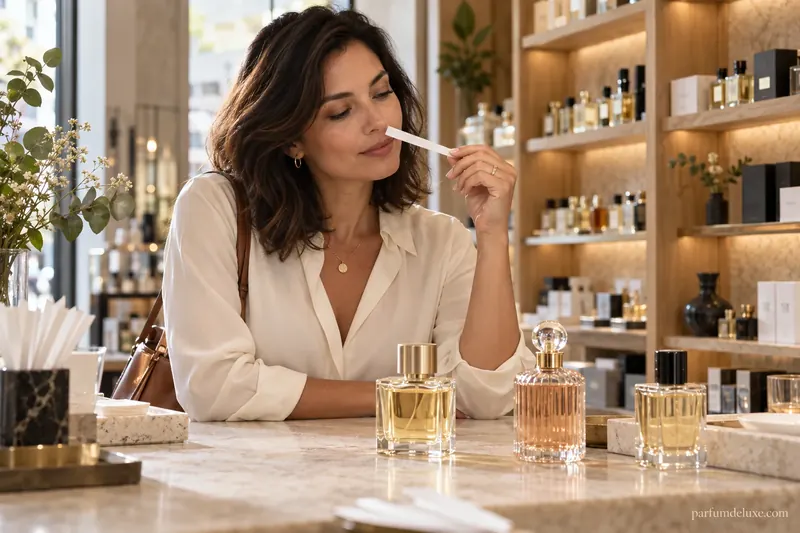
A perfume buying guide starts with the use, not the bottle
Before looking at any bottle, it helps to know why you are shopping. A scent for the office, an evening fragrance, a gift or a personal signature are not chosen on the same criteria. Writing two lines about the occasion, the season and what you tolerate badly, such as a very sweet note or an overwhelming trail, gives you a solid basis for comparing later.
That starting point also protects against fashion. A much-discussed fragrance may not suit your skin or your daily life, while a quieter creation might meet the need exactly. Good perfume buying guides therefore begin with you, not with the catalogue. A reliable perfume buying guide asks questions before it suggests names.
Concentration and scent family: two landmarks for how to buy perfume
Two details appear on almost every product page and steer a purchase: the concentration and the scent family. Sephora’s French guide, for instance, describes the eau de parfum as the best seller worldwide, with 10 to 15 per cent of essences, says an eau de cologne lasts about two hours, and presents the extrait as the most concentrated and longest lasting. Those are rough orders of magnitude: real staying power depends on the composition, your skin and the weather.
Scent families sort fragrances by dominant notes, for example citrus, floral, woody or amber. Sephora’s US site offers “Fragrance Type” and “Fragrance Family” filters. Using such filters to pick two or three families that speak to you is enough to know how to buy perfume with a clear field of search, without trying to smell everything.
Where to buy perfume: boutique, perfumery or the house’s own website
Each route answers a different need. A multi-brand perfumery lets you compare several houses on the same day. A house’s own website gives exact references and sometimes exclusive services. A niche boutique usually offers deeper advice. Where to buy perfume therefore depends on what you expect: discovery, advice, convenience or access to one particular edition.
Retailers set out their services on their pages. Nose Paris, a Paris concept store, highlights an online scent diagnostic, personalised appointments and a boutique at 20 rue Bachaumont. Jovoy, a Paris boutique for rare perfumes, offers in-store consultations by appointment and presents itself as an official retailer with certified provenance. Floris invites customers to test at 89 Jermyn Street in London. Delivery and returns terms change, so reread them before ordering.
Tips for buying perfume: a four-step trial method
In any serious perfume buying guide, most tips for buying perfume come down to one sequence. It limits the effect of a misleading first impression, because a fragrance develops from top to base over several hours.
- Smell on a paper strip first to rule out anything that does not appeal at all.
- Apply two or three finalists to skin in separate spots and note what you feel.
- Wait several hours while living normally: the heart and base reveal themselves gradually.
- Smell the spot again at the end of the day, and only then decide on a size.
Samples and discovery sets before the full-size bottle
A sample lets you repeat the test in several settings, which a paper strip cannot do. Terms vary from house to house. Essential Parfums sells a discovery set of twelve 2 ml sprays with a voucher equal to the set’s price, usable on a 100 ml eau de parfum or a 30 ml extrait for thirty days from the order date. Jovoy runs a Try Me service whose price is deducted if you later adopt the full bottle, under conditions. Nose Paris includes free samples with orders above certain amounts, and Floris sells 2 ml samples and discovery collections.
Before ordering, check three points: how many samples you get and in what volume, how long any voucher stays valid, and whether you can return the set if you are disappointed. A modestly priced set that spares you a badly chosen large bottle is a reasonable expense. This is one of the most useful steps in a perfume buying guide, because it replaces the impulse of a moment with lived experience. It also shows, over a full day, whether the dry-down still pleases you once the bright opening has faded and the skin has warmed the scent.
Buying a perfume online: the essential checks
On the internet, a serious product page names the house, the concentration, the volume and the seller responsible for the sale. Compare these before interpreting a price gap, and read the delivery, return and damaged-parcel terms. Never buy on the sole strength of a bottle photograph or a commercial badge. Perfume buying guides written for the web stress this habit, because a screen replaces neither the nose nor the skin. Seller identity, exact reference and written conditions are the three points to confirm before you pay.
For distance purchases in the European Union, the official Your Europe portal states a 14-day right to cancel, running from delivery for goods. It excludes made-to-order or clearly personalised goods, so an engraving or a bespoke blend may change your return rights. Reread the house’s terms before confirming.
Personalisation, engraving and gifts: decide before you order
An engraved bottle, a gift box or a personalised card turns a perfume into a present, but each comes with its own conditions. Sephora’s French site mentions custom engraving on some bottles and sets. Ask whether the option can be cancelled, whether it lengthens delivery and whether it limits exchange of the product.
For a gift, be careful about choosing a fragrance for someone else. Notes you love may displease the person who has to wear them. A discovery set, a travel size or an exchangeable voucher lets the recipient decide, which avoids a mistake of taste without losing the attention.
Watching for counterfeits and keeping a record of the purchase
French customs advise treating an unusually low price as a warning sign, checking spelling and print quality, and noting that cheap-looking packaging for a luxury product often points to a fake. It also states that counterfeiting is a customs offence carrying penalties, and that good faith does not remove the risks. It is better to buy from the house itself or from a recognised retailer.
Finally, keep the essentials: the exact fragrance name, concentration, volume, order date and number, and your exchanges with the seller. These make an exchange, refund or complaint easier, and they let you buy the right reference again when the bottle is empty. If the perfume is a gift, keep the proof of purchase until it has been handed over. A good perfume buying guide thus ends with a simple file rather than a list of brands. The same logic applies to every format, from a travel spray to a large bottle bought for the home.