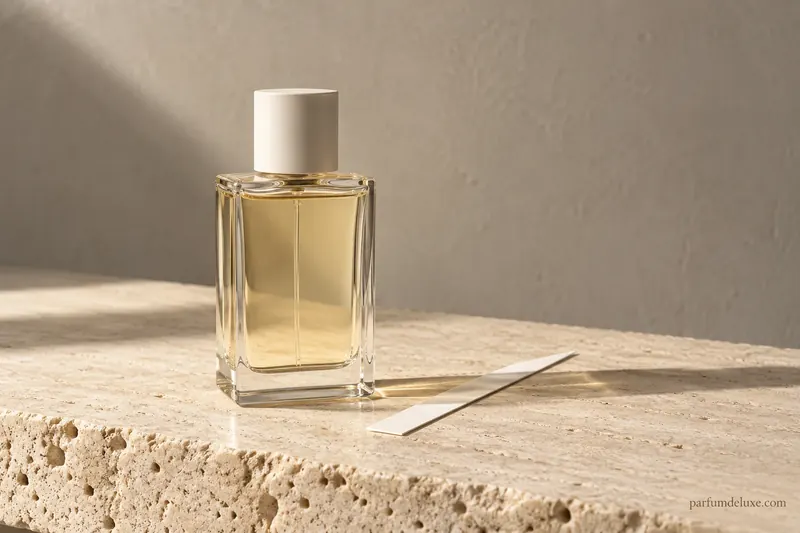
What counts as an alternative to luxury perfume
An alternative is not a copy. Among the alternatives to luxury perfume are creations that share a scent family, a texture or an atmosphere with a prestigious bottle while resting on a different formula written by different hands. Someone who loves vanilla-amber accords can find that pleasure at many houses and at very different price levels.
The word dupe, born on social media, blurs the distinction. It suggests an equivalence nobody demonstrates: no public study shows that a low-priced eau de parfum reproduces the composition of a luxury house's bottle. Talking about alternatives means sticking to what you feel and what you can check.
Looking for a similar perfume is often looking for a memory: an opening, a warmth, a base. The wish is legitimate, but it does not guarantee that another bottle will behave the same on your skin, because every creation develops differently with temperature, skin hydration and the amount sprayed.
The shapes that perfume alternatives take
In practice, alternatives to luxury perfume can be another creation in the same family from a lesser-known perfumer, a mainstream fragrance playing in the same register, a lighter version from the same brand, or a scent from a retailer's own line. Each case raises different questions.
There are also alternatives of format: a discovery set, a smaller bottle, a travel spray. They do not change the scent but lower the cost of entry and the risk of a wrong choice. For an undecided buyer this is often the best route before a bigger commitment. The safest perfume alternatives are the ones that stand on their own identity.
- Same scent family at another house
- Lighter concentration from the same brand
- Retailer-brand fragrance with a similar mood
- Small size or discovery set
- Pre-owned or end-of-run bottle, with provenance checked
How to compare two perfumes, step by step
To compare two perfumes, start with one rule: never test them side by side on the same wrist. Put one on skin and the other on a blotter, or try them on different days. Note the opening, the heart after an hour and the base after four to six hours. This is the habit that makes alternatives to luxury perfume easy to judge fairly.
Then watch projection and wear time, which depend on skin, temperature and the amount sprayed. Many online comparisons stop after the first minutes, precisely where the difference between two compositions shows up later. A sandalwood or musk base can separate two scents that their openings brought close. Doing this work on two or three bottles is enough to learn which notes really attract you, and to compare two perfumes without being steered by a ranking found online.
Reading notes without assuming a similar perfume
Two listings announcing bergamot, rose, amber do not describe the same perfume. Note lists are commercial summaries, sometimes simplified; they say nothing about proportions or the quality of materials. The Adopt page consulted, for example, gives notes on each product sheet and groups its perfumes by family: solar, gourmand, fruity, floral, woody, delicate and fresh.
That organisation helps target a family, not prove a resemblance. Read descriptions as signposts and trust a trial on skin. If a brand does not present its product as the equivalent of another, judge the product itself, not a comparison the seller does not claim. A similar perfume to the one you love remains another perfume: it may please you as much, or less, but that pleasure does not depend on a supposed equivalence.
Dupes, inspiration and counterfeits: the limits
A lawful alternative is sold under its own name and brand. A counterfeit copies a brand, a bottle or a pack to pass as the genuine item; it is illegal. Between the two, talk of inspiration touches comparative advertising rules and trade mark law, which vary case by case. Inspired perfumes that follow a family or an era, such as a classic cologne or a chypre, are not the issue; the problem begins when a product is presented as a replica of one particular brand.
Authorities treat these situations seriously. According to the French customs release, Operation Fragrance in November 2025 mobilised 1,324 customs agents and seized more than 82,000 counterfeit perfume items. Customs also reports intercepting more than 3.8 million counterfeit perfume-related items in 2024, counting bottles, caps, labels and packaging.
Inspired perfumes can therefore be legitimate when they stay within the register of a scent family without borrowing a brand's name, bottle or visuals. When in doubt, the seller should be able to say which brand is involved, who makes the product and under what name it is sold. Alternatives to luxury perfume bought without that information deserve caution.
Warning signs before buying any alternative
The customs release names a concrete clue: the 33 ml size does not exist in the legal range of major brands, so finding one is a known sign of counterfeiting. It also mentions possible substances such as phthalates and BHT in counterfeits, which may cause allergies. One more reason to prefer identified sellers.
Be wary of a price far below the official channel, a seller without clear contact details, generic photos and packaging without legible mentions. A genuine perfume, luxury or affordable, carries a complete label and a batch number.
Reading the label of a luxury perfume alternative
The DGCCRF factsheet on cosmetic labelling recalls what a product must show: legible characters in French, nominal content, precautions for use, the contact of a responsible person in the European Union, a batch number and the ingredient list. Fragrance may appear as PARFUM or AROMA, but the main allergens must be named.
With sensitive skin, that list becomes valuable: it lets you spot a substance you already tolerate badly before buying. It does not replace medical advice, but it avoids surprises. A test on a small area remains the simplest precaution before wearing a new bottle.
Check also whether the retailer publishes a clear returns policy and a physical or postal address. A seller who hides this information is hiding something about the product, and these perfume alternatives are not worth the risk of a counterfeit, however attractive the price.
Choosing a strategy: budget, pleasure and consistency
A good alternative is one you enjoy for itself. Define what you want: a mood, a wear time, a balance between quality and budget, an occasion. There is no shame in a more accessible perfume, nor in spending more on a signature. Alternatives to luxury perfume fit well into a scent wardrobe of several bottles.
Prices and promotions vary between retailers and from month to month; note them at the time of purchase. Remember that an alternative does not replace a luxury perfume; it answers a different expectation, the pleasure of wearing a scent without any claim of equivalence. In the end the best alternative is the one you will wear with pleasure after trying it on your skin for several hours.