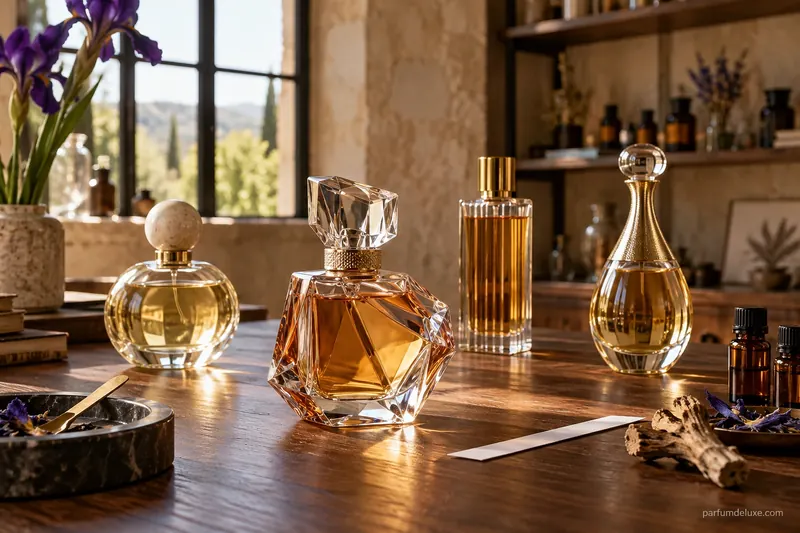
Why origin matters when comparing luxury perfume brands by country
Perfumery is far older than today's houses. A Mesopotamian cuneiform tablet from the second millennium BC names Tapputi, regarded as one of the earliest recorded chemists. In the ninth century the Arab scholar Al-Kindi wrote down more than a hundred recipes for scented oils and waters, and Ibn Sina, working in Persia, brought flower distillation into wide use, starting with the rose.
Today a brand's country points to a culture, favourite materials and a way of presenting the bottle. Two caveats apply. A house's nationality does not say where it manufactures or who owns it, since many fashion labels now sit inside large groups. And these tendencies are averages, never rules.
French perfume brands: Grasse, Paris and the legacy of the great houses
French perfume brands rest on a unique heritage. In Grasse the scented glove trade grew out of leather tanning, and the king recognised the glovers-perfumers' guild in 1614; the Galimard house dates from 1747. In 2018 UNESCO inscribed the skills related to perfume in the Pays de Grasse, covering plant cultivation, processing of natural raw materials and composition, on its list of intangible cultural heritage. About 27 tonnes of jasmine are harvested there each year.
Paris then became the stage for creation, and among luxury perfume brands by country France remains the reference. Guerlain, founded in 1828 by Pierre-François Pascal Guerlain, produced Jicky in 1889 and Shalimar in 1925. Chanel No. 5, composed by Ernest Beaux, appeared in 1921 on the rue Cambon. Hermès, started in 1837 by Thierry Hermès, makes all its perfumes in its own workshops at Le Vaudreuil in Normandy, and entrusted creation to Jean-Claude Ellena from 2004 to 2016, then to Christine Nagel. At Versailles the Osmothèque conserves vanished fragrances and brings some back to life.
Italian perfume brands: fashion, heritage and Milanese elegance
Italy perfumes mainly through its fashion. Acqua di Parma was born in Parma in 1916 with Colonia; it is now headquartered in Milan and LVMH has owned it since 2001. Prada, founded in Milan in 1913 by Mario Prada, makes its fragrances under licence with L'Oréal, as does Valentino, a Roman house of 1960, since 2018. Giorgio Armani, the company set up in Milan on 24 July 1975, signed an agreement with L'Oréal in the early 1980s for its perfumes.
Gucci, founded in Florence in 1921 by Guccio Gucci, has belonged to Kering since 1999; its fragrance licence moves from Coty to L'Oréal from 1 July 2027, subject to approvals. The picture reveals an Italian particularity: names rooted in a territory whose bottles are often designed and distributed by large foreign groups. For luxury perfume brands by country, Italy shows that among Italian perfume brands the prevailing style leans towards everyday elegance rather than display.
British perfume brands: Jermyn Street tradition and London heritage
British perfume brands cultivate a sense of institution. Floris, at 89 Jermyn Street, was founded in London in 1730 by Juan Famenias Floris, who came from Menorca; its first royal warrant dates from 1820. Penhaligon's takes its name from William Henry Penhaligon, a Cornish barber who became perfumer to Queen Victoria; its first scent, Hammam Bouquet, dates from 1872 and Blenheim Bouquet from 1902. Puig has owned the house since 2015.
Creed shows another face of the country. The house claims 1760 and James Henry Creed, at first a London tailor, but that date is disputed, because the earliest evidence points to the late 1960s or early 1970s. Aventus, released in 2010, made its name. L'Oréal completed its acquisition of Kering's beauty division, which included Creed, on 31 March 2026. What emerges is a taste for ferns, bouquets and classic colognes.
American luxury perfume brands: Tom Ford, Carolina Herrera and the US market
Among luxury perfume brands by country, the United States stands out: luxury perfumery is bound up with big groups and fashion designers. Tom Ford launched its label in 2005 and its Private Blend collection in 2007, more experimental and pricier; Estée Lauder completed its 2.8 billion dollar acquisition of the brand on 28 April 2023. Carolina Herrera showed her first collection in New York in 1981, Puig has produced her perfumes under licence since 1988 and bought the fashion business in 1995.
The American market weighs heavily: according to Circana, prestige fragrance sales rose 5 percent in 2025 and 6 percent in the first half of 2026. Dior Sauvage is reported as the leading men's franchise there, ahead of Valentino Uomo. The American style favours readable silhouettes, assertive sillage and highly visual campaigns, without forming one single olfactive school.
Japanese perfume brands: Shiseido, Comme des Garçons and the spirit of restraint
In Japan, Shiseido was founded on 17 September 1872 by Arinobu Fukuhara, a former chief pharmacist of the Imperial Japanese Navy. The company made floral perfumes early on, along with scented hair tonics designed to replace the heavy smell of traditional hair oils. That pharmaceutical origin partly explains a taste for clean compositions.
Comme des Garçons follows another path. Its perfume line was created in 1993 and the first bottle came out in 1994; Odeur 53, in 1998, was presented as an anti-perfume blending 53 non-traditional scents. The brand also opened short-lived guerrilla stores from 2004. Enthusiasts see a conceptual approach, far from the floral codes of Parisian luxury.
Middle Eastern perfume houses: Amouage, oud and the incense tradition
Among luxury perfume brands by country, the Middle East stands apart, since perfume has been worn and burned for centuries. Oud, or agarwood, is a dark resin that forms in the heartwood of Aquilaria trees after a fungal infection; its Arabic name means rod. Perfumers often use it as a base note, traditionally paired with rose, and quality varies widely: real oud is costly and potent, and many creations rely on synthetic accords.
Amouage was founded in 1983 in Muscat, Oman, by Prince Sayyid Hamad bin Hamoud Al Busaidi. The cap of the women's bottle recalls the dome of the Sultan Qaboos Grand Mosque, while the men's cap echoes the handle of a ceremonial khanjar dagger. The regional style often favours depth, concentration and trail over lightness, with precious materials in the foreground.
What a brand's home country really changes in its fragrance style
To sum up the tendencies without turning them into laws: France stresses noble materials and the signature of its perfumers; Italy, elegance tied to fashion; Britain, heritage and classic formulas; the United States, impact and marketing; Japan, restraint or concept; the Middle East, density and ritual. Any house can contradict these averages, and many perfume brands by country belong to international groups.
Before buying, try the fragrance on skin and let it develop for several hours. Regulated allergens appear on the packaging, and a patch test on a small area is a sensible precaution. Prices vary by retailer, so check with the retailer. Choose a recognised channel: counterfeits are illegal and risky.