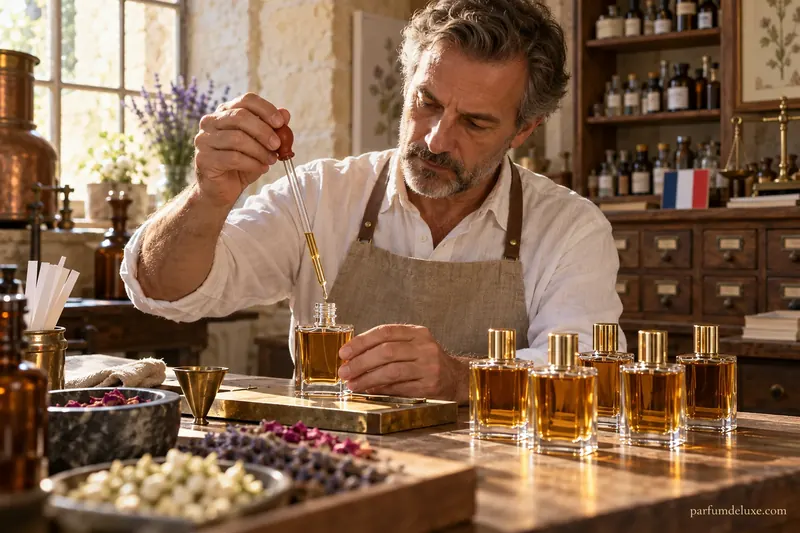
Many hands behind one fragrance
The lone genius mixing a masterpiece in a private lab makes a good story, but it flattens how fragrances actually come about. Between a seed in the ground and a bottle on a shelf, someone grows, harvests, extracts, composes, evaluates, fills and packs. Each stage leaves a mark on what your nose finally receives, and following that chain is the quickest way into perfumery craft.
Perfumery craft is also learned by repetition. Telling one harvest of jasmine absolute from another, noticing that a batch of wood has shifted, spotting a note that has turned too sweet in a trial: these skills take years and are usually passed on by experienced colleagues. That explains why houses talk about gestures and transmission more readily than about recipes. Anyone curious about perfumery culture will find that vocabulary — accord, absolute, maceration, trial — used with precision by professionals and loosely by marketing departments, so learning it pays off quickly.
Grasse and the UNESCO recognition of perfumery craft
In 2018 UNESCO added the skills related to perfume in the Pays de Grasse to its Representative List of the Intangible Cultural Heritage of Humanity. The listing does not honour a brand. It joins three linked areas: the cultivation of perfume plants, the knowledge and processing of natural raw materials, and the art of composing a perfume.
According to UNESCO’s file, these practices have existed around Grasse since at least the sixteenth century and grew inside a local craft economy long dominated by leather tanning. Knowledge has mostly travelled through long apprenticeships, still largely served in perfumeries, although more formal teaching has gained ground in recent decades. A local association, the Association du Patrimoine Vivant du Pays de Grasse, coordinates the communities involved.
Why “intangible” heritage matters
The listing protects practices rather than buildings or bottles: when to pick a flower, how to run a still, how to balance a formula. A gesture can vanish quietly if nobody learns it, and international recognition draws attention to that fragility.
The trades of perfumery, from field to laboratory
The perfumery trades extend well beyond the perfumer, often nicknamed the “nose”. Upstream, farmers and pickers supply flowers, leaves, bark or resins. Extraction houses such as Robertet, which says it was founded in 1850, turn those plants into essential oils, absolutes and CO2 extracts, and its site lists more than 10,000 raw-material references.
Downstream, other perfumery trades take over. You find evaluators who judge trials against a brief, regulatory and safety specialists, production engineers and packaging teams. In larger houses the perfumer also talks with creative directors and technical experts before a formula is approved. A single bottle on a counter can therefore represent dozens of people, from the farm that supplied a flower to the line operator who checks the label, and that spread of skills is the real substance of perfumery craft.
- Growers and pickers of fragrant plants
- Extractors of natural materials and makers of aroma molecules
- Perfumers, assistants and evaluators
- Regulatory and quality specialists
- Filling, inspection and packaging teams
Perfumer training: schools and workshops
Perfumer training follows several routes, all of them leading toward the art of perfumery. In Versailles, ISIPCA, founded in 1970 by the perfumer Jean-Jacques Guerlain, enrols more than 500 students in scientific and business programmes, mostly work-study. Students learn to identify hundreds of raw materials, yet graduating guarantees no creative post: the profession stays highly selective.
In Grasse, the Grasse Institute of Perfumery runs an eighteen-month international technical degree, 1,200 hours of which half are taught by accredited perfumers or technical experts, followed by a six-month internship; it admits twelve students. Perfumer training of that depth is not what a short workshop delivers; casual visitors can still try one without aiming at a career, simply to understand how an accord is built. Molinard says it has offered creation workshops since 1994, from 45 minutes to two hours, in which you blend essences with a graduated pipette under a perfumer-advisor’s guidance.
Museums and archives that explain perfumery culture
To place a scent in time, nothing beats the places that keep its memory. The Musée International de la Parfumerie in Grasse, founded in 1989, follows perfume from Antiquity to today, from Egypt to the industrial age, with raw materials, decorative objects, flacons and machines. A scent display lets visitors smell more than a hundred perfumes and flowers, and its gardens carry the “Jardin remarquable” label.
At Versailles the Osmothèque preserves perfumes that vanished or changed over time so that visitors can smell them as they were formulated. Back in Grasse, Fragonard’s historic factory, in operation since 1926 in a former tannery, shows copper stills, old enfleurage vessels and a maceration and filtering room. Such visits give you a working vocabulary before you read a fragrance pyramid, and they show where perfumery culture lives in objects, machines and smells rather than in slogans.
What French perfumery tells you, and what it leaves out
The French story is a strong one in perfumery culture: Grasse, haute couture, the great Parisian houses. It is partly true and far from complete. A house may compose in Paris, have materials extracted in Grasse, import a resin from Asia or Africa and fill its bottles elsewhere. The word “artisanal” says nothing about the industrial equipment actually used.
To tell technique, story and aesthetics apart, compare what a brand claims with what it can show: preserved formulas, archive objects, timelines, interviews with perfumers. In a conversation published by Penhaligon’s, perfumer Christian Provenzano traces his path from laboratory compounder to global perfumery director at a fragrance manufacturer, and explains how a sequel to a hit, Halfeti Leather, had to stay close to the original without copying it.
Questions worth asking a perfume house
A handful of plain questions reveals how deep a brand’s story goes: who composed the formula, against what brief, which natural materials sit in the accord, where are the bottles filled, what is known about traceability? A transparent house answers directly, or says what it cannot disclose.
Finally, remember that knowing perfumery craft is no prerequisite for enjoying a fragrance. Knowing it adds relief to the experience, but the essential part happens on skin, in the meeting with the scent. The bottle, the history and the maker’s career enrich that meeting without ever replacing it. The art of perfumery stays, in the end, an art of smelling, and every museum visit or workshop only sharpens attention to it.