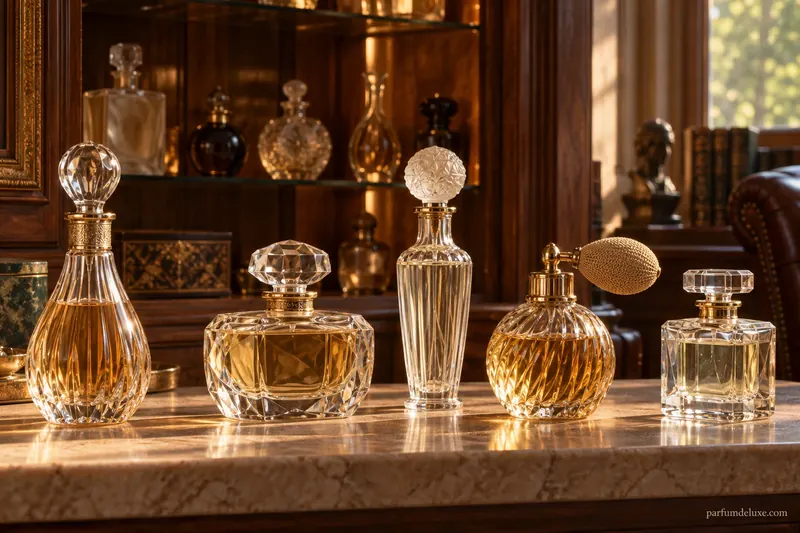
What makes a luxury perfume today
No legal definition exists for a luxury perfume. The phrase describes a positioning: carefully chosen ingredients, a named perfumer, a crafted bottle and a house that cultivates a recognisable signature. Price helps place a fragrance, but it proves nothing alone, because some costly bottles rest mostly on marketing.
Enthusiasts keep returning to three tests: the perceived quality of the formula, the way it develops on skin from top to heart to base notes, and how well it fits the world of the house. A good luxury perfume is therefore described in hours, not in seconds of spraying.
Sales figures confirm the appeal of the segment. Chanel reported 19.3 billion dollars of revenue in 2025, with a fragrance and beauty division driven by perfume, and the fragrance and cosmetics division of LVMH, which includes Dior and Guerlain, made 8.174 billion euros the same year. Those figures cover all of beauty, not perfume alone.
Types of luxury perfumes: designer, niche, Arabian and bespoke
Designer fragrances come first. They are signed by large fashion or leather-goods houses, distributed very widely and built around lasting pillars such as Chanel N°5 or Dior Sauvage. They offer a common reference point, sometimes easy to recognise in the street.
Niche perfumes are made by smaller brands, often devoted to fragrance, which take more creative risks and sell through a narrower network of shops. Arabian and oud perfumes lean on resins, precious woods, musks and ambers that feel more enveloping, and they are often worn in a high concentration.
At the most exclusive end sits the bespoke perfume, composed with a perfumer for one person alone. The project is built over several appointments, with successive trials and samples of formulas.
Concentrations and fragrance families: reading the label
Concentration describes how much aromatic material the bottle holds: eau de cologne, eau de toilette, eau de parfum, parfum or extract. Commonly quoted ranges run from roughly 2 to 3 percent for a cologne up to 15 to 30 percent for an extract, but the terms stay loose: each house sets its own levels, and one brand's eau de toilette can be richer than another's eau de parfum.
A higher concentration does not automatically mean a better fragrance. It mostly changes staying power and roundness, and sometimes the composition itself, since the same name in two concentrations is not always a simple dilution of one formula.
The main fragrance families
Fragrance families group perfumes by resemblance: citrus, floral, chypre, woody, oriental or amber, fougere and leather. Fans happily combine them, hence labels such as woody-spicy or floral-musky.
Knowing which ones you like prevents many disappointments, because two luxury perfumes from the same family often resemble each other more in structure than in price.
Luxury perfume for women, for men and unisex
The split between women's and men's scents is mostly marketing and habit, and many enthusiasts choose by the note they enjoy rather than by the label. Jicky by Guerlain, created in 1889 by Aimé Guerlain, was already presented as a scent combining so-called masculine and feminine qualities, and it paired natural materials with synthetic ingredients such as coumarin.
On the women's side, L'Oréal states that Yves Saint Laurent Libre was the top-selling women's fragrance worldwide in 2025, and also lists Lancôme La Vie Est Belle and Prada Paradoxe among the world's top fifteen. On the men's side, LVMH presents Dior Sauvage as the leading men's fragrance worldwide in 2025.
These rankings come from the groups themselves, not from one independent measure: they signal popularity, not quality. Unisex perfumes are multiplying, notably in niche, and let everyone choose without worrying about the gender on the box.
Famous perfume houses and brands by country
The map of the great perfume houses tells of different traditions. A house usually sits somewhere between craft, fashion and industry: some stay independent, others belong to groups such as LVMH, L'Oréal or Puig.
France and Italy
France holds many of the historic names: Chanel, whose N°5 was created in 1921 by Ernest Beaux at the request of Gabrielle Chanel, with, according to the house, aldehydes, rose, jasmine and vanilla; Dior, Guerlain, Hermès, Lancôme and Yves Saint Laurent.
Italy brings a sunnier elegance. Acqua di Parma began in 1916 in Parma with its Colonia and has belonged to LVMH since 2001; Armani, Prada, Valentino and Gucci are also names cited by L'Oréal or by industry analysts.
United Kingdom, United States, Middle East and Japan
In Britain, Floris dates its founding to 1730 in London by Juan Famenias Floris, on Jermyn Street, and Penhaligon's created Hammam Bouquet in 1872; these houses embody a perfumery of barbers and courts. In the United States, Carolina Herrera and Tom Ford are among the most visible luxury names.
In the Middle East, Amouage was founded in 1983 in Oman by the Albusaidi family and ties itself to the history of frankincense and myrrh. In Japan, the incense tradition of kōdō goes back to the arrival of agarwood in the sixth century and still feeds the imagination of perfumers.
Niche perfumes and rare perfumes: real exclusivity or a sales pitch
Niche perfumes appeal to people who want to step away from mass-market hits. Puig reports double-digit growth for niche, led in particular by Byredo, a sign that the segment weighs more and more in luxury perfume.
A perfume can be rare for genuine reasons: a limited run, a natural material that is hard to obtain, confidential production or withdrawal from the catalogue. But the word rare is also a sales argument, so it is worth asking what exactly makes a creation hard to find.
A sound habit is to compare the house's official description, the opinions of several enthusiasts and the seller's policy on production runs, rather than trusting a single story.
Niche perfumes also differ in how they are sold. Many are found in a handful of boutiques, in selected department stores or on the house's own shop, and some brands release a new fragrance only every few years. That slower rhythm is part of their charm, but it should never be mistaken for proof of quality.
Buying a luxury perfume: test, verify, compare
A luxury perfume is chosen on skin, not on paper. A blotter gives a first impression, but the development over several hours reveals the true character: test on a small area, wait for the heart and base, then come back the next day.
Gift sets and travel sizes let you explore a house without paying for a large bottle. Prices vary by size, concentration and retailer, so check them with the seller at the time of purchase.
Think about the occasion and the season as well. Fresh citrus and light florals tend to feel comfortable in warm weather, while amber, woods and spices often suit colder evenings. Wearing a fragrance a few times before deciding helps you judge whether it still pleases you after the first excitement has faded.
Buy from the house itself, from a recognised retailer or from an identified niche perfumery. Counterfeits are illegal and can carry risks, not least because their composition is uncontrolled. If you have sensitive skin or a history of allergy, glance at the ingredient list on the packaging; such pointers do not replace advice from a health professional.
Grasse, Versailles and the cities of perfume
Grasse, in the Alpes-Maritimes, is the emblematic city of raw materials: the skills related to perfume in Pays de Grasse, covering the cultivation of perfume plants, the processing of natural materials and the art of composing, were inscribed by UNESCO in 2018 on the Representative List of the Intangible Cultural Heritage of Humanity.
In Mouans-Sartoux, the gardens of the International Perfume Museum grow tuberose, iris, jasmine and cabbage rose among other plants. In Versailles, the Osmothèque, the international perfume conservatoire, works to keep the memory of scents and to revive certain lost perfumes.
Paris remains the showcase of the houses, Milan and London have their historic boutiques, while Muscat and Dubai embody Oriental perfumery. Visiting these places helps explain what hides behind a bottle.
The craft and culture of luxury perfumery
Behind a luxury perfume work perfumers, often called noses, evaluators, chemists, growers and bottle-design teams. The perfumer writes the formula, then the house arbitrates, adjusts and decides on the launch.
The trade went through a rupture with synthetic materials: Jicky, in 1889, mixes natural and synthetic ingredients, notably coumarin, and for many marks the start of modern perfumery. Synthetics are not second-rate substitutes: they also allow new accords and better stability.
Ingredient safety is followed by IFRA, the international fragrance industry association, which publishes standards for use and a transparency list of ingredients. That technical culture explains why a perfume is composed with as much science as sensitivity.