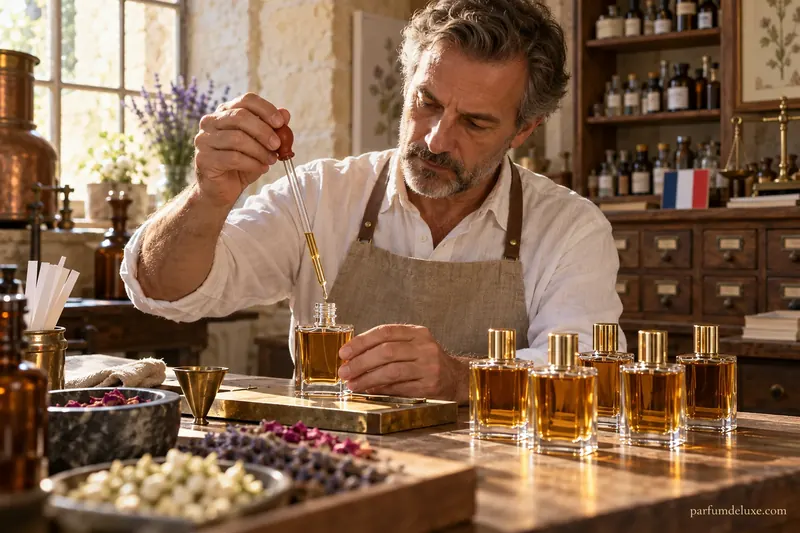
What a French artisanal perfume does and does not promise
The phrase pairs two ideas that nothing forces anyone to verify together. Artisanal evokes human scale, manual gestures and small batches. French evokes a place. For a perfume, neither word is a single certified label awarded after inspection, so each house has to explain what stands behind it.
To read the claim, split the journey into four steps: where the perfume is composed, where the concentrate is blended and left to macerate, where it is filtered and bottled, and who does the work. A house that does everything on one site is not making the same statement as one that composes in France and has its bottles filled elsewhere. Both can be honest if they say so.
Nor does a French artisanal perfume guarantee that you will like it. Proximity to a workshop helps you understand what you are buying, but it does not replace smelling the fragrance, wearing it and judging it on your own skin.
Grasse craft and its UNESCO recognition
When people mention perfume from Grasse, they refer to a specific chain of skills. On 28 November 2018, in Port Louis, UNESCO’s intergovernmental committee added the knowledge and skills related to perfume in Pays de Grasse to the Representative List of the Intangible Cultural Heritage of Humanity. They cover three strands: growing perfume plants, knowing and processing natural raw materials, and composing perfumes.
According to the nomination file, the practices go back to the sixteenth century at least. Transmission is mostly informal, through a long apprenticeship that still takes place mainly inside perfumeries, and the nomination was put forward by the association Patrimoine vivant du Pays de Grasse. That context explains why a workshop visit in Grasse has value: it shows a living tradition rather than a backdrop.
One nuance matters. The listed heritage is a body of know-how, not the production of every bottle sold with Grasse on the label. A French artisanal perfume can draw on that inheritance without every step taking place there.
Made in France perfume: why place of manufacture is not place of ingredients
The claim of a made in France perfume follows rules of origin. According to French customs documentation, it is allowed in two cases: the product is wholly obtained in France, or its last substantial transformation took place there, meaning a manufacturing process that produces a new product or an advanced stage of production. The rules vary with the customs classification, and the consumer-fraud authority DGCCRF checks the claim when goods are sold in France.
For perfume this means a product composed and prepared in France can legitimately claim that place of manufacture, even if not every raw material comes from there. Many perfumery ingredients, such as vanilla, oud or certain woods, do not grow in France. Origin of manufacture and origin of materials are therefore two questions to put separately.
What the origin claim leaves out
An origin statement does not describe the quality of materials, whether they are natural or synthetic, or the size of the batch. It names a place and nothing more. To learn more, ask the house about its supply chain.
Traceability that can be documented
Some large houses publish their commitments. Guerlain describes its Bee Respect platform, launched in 2019 and extended to perfume in 2021, which shows where ingredients come from and where products are made, and the TRASCE consortium, created in 2023 by fifteen cosmetics players. A small French artisanal perfume maker need not copy this, but it shows the level of information you can reasonably expect.
Molinard and Galimard: two Grasse houses, two ways of telling heritage
According to the encyclopedia, Molinard was founded in Grasse in 1849 by the family of the same name, which still runs it. It first made floral waters and eau de Cologne, then single-flower fragrances from 1860, and in 1900 it moved into an old factory whose distillery was designed by Gustave Eiffel. The house’s own site dates its first perfume creation workshops to 1994.
Galimard tells a different story. The encyclopedia says the company was founded in 1950 by Joseph Roux and that its name honours Jean de Galimard, Lord of Seranon, a perfumer in Grasse in 1747 who supplied the court of Louis XV. A perfume from Grasse may thus carry either kind of story. The comparison is useful: the name of a house can carry a memory far older than the present company. Read dates with that distinction in mind and prefer the ones a house documents.
Visiting a workshop to understand how accords are built
A French perfume workshop in Grasse is a concrete way into artisan perfume. At Galimard, according to the official page, you sit at a perfume organ with assistant perfumers who explain the principles of formulation, then compose a fragrance that is feminine, masculine or mixed and leave with a bottle carrying your name. Sessions are held in Grasse, Èze-Village and Paris.
At Molinard, four formats are listed, from forty-five minutes to two hours, with an introduction to the structure of a perfume and its raw materials followed by blending with a graduated pipette in the proportions the adviser recommends. You mainly learn to tell top, heart and base notes apart, which makes it easier to read any luxury fragrance afterwards. Whichever French perfume workshop you choose, check prices and availability with the house.
Questions to ask an artisan perfume house before you buy
A serious maker of French artisanal perfume answers plainly. Prepare a few simple questions and write down the replies instead of settling for an impression of tradition on the packaging.
- Where is the fragrance composed, blended, filtered and bottled?
- Who composes it, and is the perfumer’s name given?
- What share is natural material, and where do the main ingredients come from?
- Can the formula be traced, the same perfume reordered, and the customer followed up?
- Is the run truly limited, and how is it numbered?
Testing, checking and avoiding imitation Grasse perfume
Always try a fragrance on skin before deciding, and let it develop for several hours. As with any perfume, an allergy is possible: test a small patch, read the ingredient list on the packaging and, if you have doubts about your skin, ask a health professional.
Be wary of any perfume from Grasse, or French artisanal perfume, that borrows the reputation of Grasse without documenting it. Buying from the house, its shop or a recognised retailer limits the risk of counterfeits, which are illegal and may contain uncontrolled ingredients. A price far below a comparable house, a vague origin statement or no manufacturer contact details deserve attention.