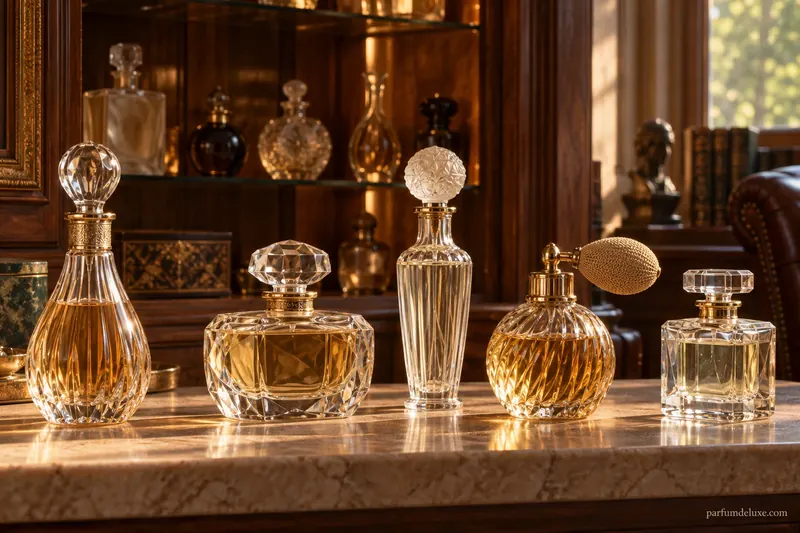
What collectible perfume really means
People collect perfume for three overlapping reasons. Some love wearing and comparing scents. Others are drawn to the object itself, with its glass, stopper, label and box. A third group keeps bottles as memories of a period, a trip or a fragrance that no longer exists. These motives call for different habits, so it helps to know which one leads your own perfume collection.
A reader who mainly wants to smell an old composition cares about the liquid. A reader who enjoys design looks at engraving and packaging. A sentimental collector may be content with a half-empty bottle. Knowing your priority prevents purchases that satisfy none of the three.
One caution belongs at the very start: no perfume is guaranteed to rise in value. A bottle that is sought after today can become ordinary tomorrow, and a damaged one loses most of its interest. The only dependable return on collectible perfume is the enjoyment it gives its owner.
Choosing a theme for your perfume collection
Without a theme, a perfume collection turns into a pile of whatever is scarce this month. A few simple axes bring order to collectible perfume: a house, a perfumer, a scent family, a raw material, a period or a bottle design.
A house with a compact, readable range shows how this works. Chanel’s official page lists 26 references under Les Exclusifs, counting eaux de parfum and scented body oils, grouped into four families: floral, amber, woody, and hesperidic and aromatic. Names include Sycomore, Coromandel, Cuir de Russie, 31 Rue Cambon and Bois des Îles. Working through such a range family by family gives a collection a shape that does not depend on resale prices.
By house or by perfumer
Following one house lets you trace how a style evolved and compare concentrations of the same name. Following a perfumer takes more digging, since credits differ between sources and eras; rely on the house’s own product page rather than a forum remark.
By material, era or bottle shape
Gathering scents built around rose, leather or incense creates a rich field for comparison. A collection organised by decade must separate versions, because one commercial name can cover several successive interpretations that smell quite different.
Collectible perfume bottles: glass, label, box and authenticity
When judging collectible perfume bottles, look at the glass for chips and cracks, the sharpness of engraving or printing, whether the stopper closes properly, whether the sprayer works, how legible the label is and how much liquid remains. The original box and papers matter if their story interests you, yet they never replace inspecting the bottle itself.
A batch number, printed or embossed on the packaging and sometimes on the bottle, is useful. European cosmetics rules require a batch reference for traceability. Matching it against a known genuine example proves nothing alone, but an obvious mismatch should make you pause.
If you are unsure, favour a seller who welcomes detailed questions and sends sharp photographs of the box, the base of the bottle and the label. A price far below the going rate is a warning, not a bargain.
Vintage perfume and old formulas: what time changes
Vintage perfume is not automatically better perfume. The formula behind an old name may have been adjusted over the years, notably because regulations on certain ingredients evolved. Even Galimard, which keeps customers’ workshop formulas in its archives, warns that some ingredients may be modified, removed or replaced by newer notes for regulatory reasons.
The liquid itself changes in a bottle that has been open for a long time: the colour may darken and the opening may seem drier or flatter. These are signs to watch rather than certainties; only a careful test on a small patch of skin, bearing in mind the possibility of an allergy, lets you judge.
To smell what some classics were like, there is a dedicated place. The Osmothèque, a perfume conservatory in Versailles, was set up by the Société Française des Parfumeurs, the Comité Français du Parfum and the CCI Paris Île-de-France. It aims to preserve the memory of scents and to bring back great perfumes that have disappeared, and it runs olfactory talks and guided visits. That can spare you from paying a premium for a tired bottle just to satisfy curiosity.
How to store perfume: light, heat, air and humidity
How to store perfume comes down to three words: dark, cool, dry. Sunlight can break down the essential oils in a fragrance, so a drawer, a closet or the original box is ideal. Bathrooms, where heat and humidity swing back and forth, are a poor choice. A major beauty house also advises against the refrigerator, since excessive cold can flatten the depth of a scent.
Air is the overlooked factor. Shaking a bottle or opening it needlessly exposes it to more oxygen. Le Labo’s refill programme likewise asks owners to keep bottles at room temperature and away from direct sunlight. These habits suit a mass-market bottle and a rare one alike.
Durability marks on packaging deserve a glance. Under European rules, a cosmetic with a minimum durability of 30 months or less carries a date, often with an hourglass symbol; beyond that, a period-after-opening symbol, an open jar followed by a figure such as 12M, is shown instead. These marks concern everyday use. They do not stop you keeping a bottle as an object, but they suggest wearing a very old one with caution.
Keeping a record of your perfume collection
A perfume collection improves when it is documented. For each bottle, write down the exact name, the concentration, the volume, the date and place of purchase, the batch number and the condition on arrival. Add a line about how it smelled when you tried it; that note will serve you long after you forget the price.
Some brands already leave a paper trail. At Le Labo, a refilled bottle receives a new label dated on the day of the refill, bearing a name or, by default, the words “For: You”. For a collector this is one more piece of a bottle’s history, as long as it stays with the bottle.
Photograph the bottle, box and label the day you buy them. If you sell, face an insurance question or need to identify a bottle, those pictures beat a description from memory.
Buying and selling without falling for fakes
The more sought-after a bottle becomes, the more copies appear. French Customs ran Operation Fragrance from 12 to 19 November 2025 against counterfeit perfume: more than 82,000 fake perfume items were seized, in physical markets and online. Tests mentioned unregulated solvents and substances such as phthalates, with risks of allergies or burns. Customs also describes a 33 ml size, which does not exist in the legal trade, as a clear sign of a fake.
Counterfeits are illegal and their contents come with no assurance. To reduce the risk, buy from the house, a recognised retailer or a reseller who states where the bottle came from and accepts returns for non-conformity. Treat platforms without traceability and unusually low prices with suspicion.
When selling, price from the real condition, the completeness of the box and demand seen in finished sales, never from asking prices alone. A past valuation promises nothing about the future.
Wearing your scents without losing the joy of collecting
Many owners of collectible perfume end up afraid to open their finest bottles. One answer is to keep two shelves: sealed bottles chosen for their value as objects or history, and bottles you wear freely. Small formats and discovery sets, such as Maison Francis Kurkdjian’s mini wardrobe of eight 2 ml vials, let you taste without touching the main bottle.
A good collection resembles its owner. It can hold three bottles or three hundred; what makes it sturdy is a clear theme, bottles in sound condition, traceable purchases and scents you actually want to smell.