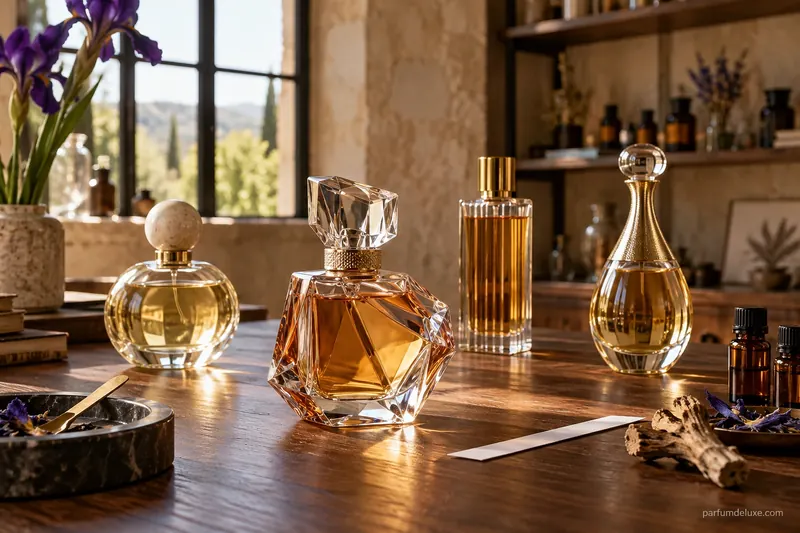
What haute perfumery covers when no one defines it
The French term haute parfumerie, which English speakers often borrow, is used for perfumes made with unusual creative and technical ambition: materials chosen with care, a formula that is not squeezed by budget, a perfumer who is named. Yet nothing protects the phrase, in French or in English, and haute parfumerie remains a claim rather than a category. One specialist guide points out that it is set by no decree, label or professional body, so any brand may print it on a box.
A perfume sold as high perfumery is therefore not a certified product; it is one whose house claims a particular standard. That does not make the idea empty. It gives you questions to ask. Who composed this? With which materials? How free was the formula? Luxury haute perfumery is worth what the answers are worth, whether checkable or not, and whether your own skin agrees.
Haute perfumery and haute couture: handle the comparison carefully
The couture analogy is everywhere. Haute couture has been a controlled title since 1945, managed by the Chambre Syndicale de la Couture Parisienne, the same guide notes, while perfume has no equivalent. The comparison conveys a spirit more than a status.
Dior leans into the dialogue with La Collection Privée Christian Dior, which, in the house's words, weaves a privileged link between couture and perfume through olfactory silhouettes inspired by Christian Dior's heritage. The page mentions gourmand, chypre, floral and woody families, and couture trunks and cases, some entirely hand-embroidered. That is the house's staging. Read it after you have smelled the perfume, so you do not confuse your sensation with the story around it.
The named perfumer: luxury perfume creation at Frédéric Malle
One concrete test is the perfumer's name. Éditions de Parfums Frédéric Malle presents itself as the avant-garde of perfume, with creations by the world's greatest perfumers in total freedom of composition. Its own pages tie each scent to its author: Dominique Ropion for Portrait of a Lady, Carnal Flower and The Night, Maurice Roucel for Musc Ravageur, Bruno Jovanovic for Northern Love and Dans Mon Lit, Carlos Benaïm for Eau de Magnolia and Café Society.
That changes how you read luxury perfume creation: you assess a hand, not just a brand. It lets you follow one perfumer from bottle to bottle, compare choices and notice that one author can sign very different worlds. A name is no guarantee of pleasure, though; it is a thread to follow. Each great perfumer has habits of materials and structure, and spotting them helps you choose.
Noble materials: reading what the houses announce
Featured materials matter mostly for what the perfumer does with them in the whole. Dior describes its Précieux Élixirs as highly concentrated perfume oils made from noble raw materials, and its eaux de parfum as a union of fine materials and singular signatures. Those are the house's adjectives: useful, but not measurable.
To keep perspective, look for things you can check: the name of the material, its announced origin, its role in the accord, the stated concentration. Ask what is natural and what is synthetic without treating it as a ranking, since a synthetic component can be essential to a formula and a natural extract is no guarantee of quality. Examine contrasts, the precision of the accords and the coherence between opening and base.
Traceability and transparency: Guerlain as an example
A house's seriousness also shows in how open it is about its supply chain. In 2019 Guerlain launched Bee Respect with the traceability firm Product DNA, a free platform on its website showing where ingredients come from, what packaging is made of and where products are manufactured. It began with skincare, extended to make-up in 2020 and to perfume in 2021, and runs in seven languages.
In 2023 the house also joined TRASCE, a consortium of fifteen cosmetics companies, supported by the Fédération des Entreprises de la Beauté, that aims to improve traceability of key formula and packaging components. These facts come from the house itself: they describe an effort, not a ranking. They do show that modern high perfumery is also judged on how clear its sources are.
Luxury, niche and price: do not mix them up
The same guide separates niche perfumery, a way of distributing, from haute perfumery, which it calls a formulation standard: a niche brand may use ordinary materials, and a high price is no reliable sign of formula quality. It proposes four criteria: identified raw materials, a named perfumer, extrait-level concentration and no budget compromise on the formula. Its publisher sells its own collection, so read this as a viewpoint, not a rule.
Above all, remember that a price, a numbered edition or a heavy bottle proves nothing. Compare what a haute perfumery house says about materials, perfumer and concentration, then test it. Be wary of famous bottles offered far below the usual price: counterfeit perfume is illegal and nothing guarantees what it contains.
The memory of creation: what the Osmothèque preserves
To grasp perfume creation across time, the Osmothèque in Versailles is a reference point. It was set up by an agreement signed on 13 October 1988 between the Société Française des Parfumeurs, the Comité Français du Parfum and ISIPCA. It keeps current and vanished perfumes in a cellar held at 12 °C, in smoked glass bottles filled with argon to limit oxidation.
According to an article from the institution, the collection held about 2,500 perfumes, 400 of them discontinued or in limited sale, and formulas are entrusted to the Osmothèque, not given away. The example is a reminder that an ambitious perfume is a work passed on and measured against history, not merely a seasonal product.
Judging high perfumery on your own skin
Read the house's explanation after a first encounter, so you can tell your own sensation from the story attached to it. Then ask for an extended trial or a sample if the service offers one, and wear the perfume for a whole day before concluding: the opening says very little about the base.
This dialogue between personal experience and concrete information helps you appreciate a demanding proposal without mistaking prestigious vocabulary for real preference. A work of high perfumery may leave you cold even when a great perfumer signed it, and a simpler perfume may move you. If your skin is sensitive, patch-test a small area and read the ingredient list.