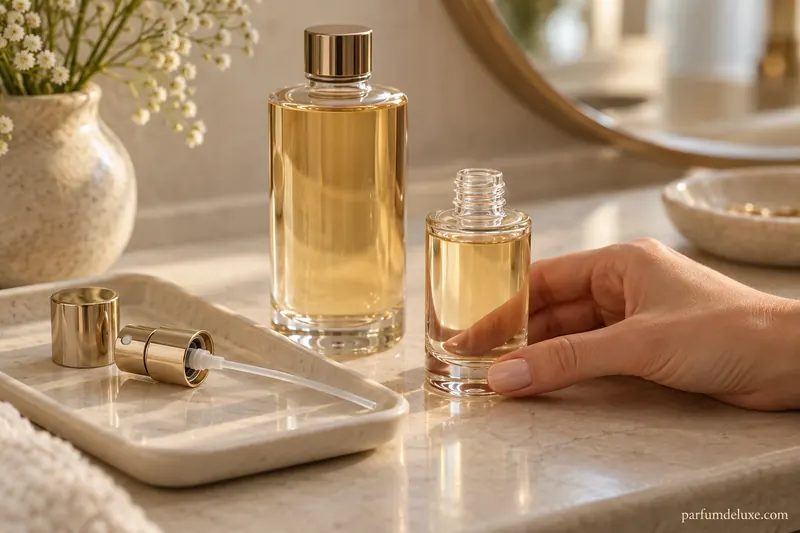
Why perfume care changes how a fragrance smells
A fragrance is a blend of alcohol, water and aromatic materials, natural or synthetic. Those molecules react to air, warmth and light: some oxidise, others evaporate faster than their neighbours. The most volatile notes, often the citrus in the opening, fade first, and the balance of the whole composition tilts.
Chanel names heat, air and light as the classic enemies of perfume. Diptyque adds that an alcohol-based fragrance can keep for many years if it is shielded from light and temperature swings, and that a slight change of colour can appear over time without affecting the scent. Perfume care therefore means limiting those three stresses, with no elaborate ritual.
Storing perfume: light, heat and humidity
The best home for a bottle is a closed cupboard or drawer in a room where the temperature stays steady. The bathroom, with its steam and sudden temperature swings after each shower, is the worst choice for storing perfume, along with a sunny windowsill or the top of a radiator. The original box is a handy screen against light, particularly for clear glass.
When storing perfume, consistency matters as much as coolness: a bottle that travels from cold to hot every day copes less well than one left in a temperate drawer. A car parked in the sun is a poor place to leave it. Always put the cap back, and keep the flacon upright so the liquid does not sit against the spray mechanism.
Applying perfume: where, how much and from what distance
Warmth helps a scent open up, which is why the base of the throat and the inner wrists and elbows are the best-known spots. Chanel suggests pulse points such as the wrists and neck to intensify the scent. Goldfield & Banks prefers places that do not rub against surfaces, such as the outer forearm or the crook of the elbow, plus the nape or the shoulders, which sit close to other people's noses and catch the air as you move.
Diptyque describes a broader gesture: spray an eau de toilette or eau de parfum from one shoulder to the other, passing over the head, so that the trail settles on the shoulders and spreads with the movement of your hair. The same house suggests applying body lotion or a solid perfume first, since well-moisturised skin holds the scent more strongly and for longer.
Rubbing the wrists together is a common habit, yet none of the houses consulted requires it. Starting with a modest amount leaves time to enjoy how the fragrance develops before adding more. Many wearers find that one or two sprays in different places read as more even than a single heavy cloud.
Skin, hair and clothes: where does perfume behave best?
On skin, a fragrance evolves with body warmth and the nature of each person's skin, so the same bottle never reads identically on two people. Fabric holds a trace of scent longer, but it can stain. Chanel warns that some fabrics are delicate and advises spraying the inside of a garment or its lining.
Goldfield & Banks recommends scenting fabric only with lighter fragrances, especially on white, avoiding silk and keeping the spray away from pearls. For hair, the house suggests spraying a brush, letting the alcohol evaporate, then brushing through, rather than aiming straight at the strands.
Refilling perfume: what the houses actually offer
Refilling perfume has moved well beyond novelty. Le Labo's refill programme refills your bottle with the same scent in the same size for roughly 20 per cent below retail. Online, it covers the 50 ml and 100 ml City Exclusive eaux de parfum; the empty bottle goes back by post and returns with a new dated label within about 5 to 10 business days. You cannot switch fragrance or size.
Mugler built its identity on the fountain: according to L'Oréal, Angel, launched in 1992, brought the industry's first refillable bottle, and the fountain stands in more than 10,500 perfumeries worldwide. Guerlain takes a jewellery approach with the Flacon Sac, which only works with crystal refills sold separately and slid into a sleeve once their cap is removed.
Each scheme for refilling perfume has its own rules and approved containers, so read the house instructions before emptying or filling anything.
Caring for perfume day to day: a simple routine
A realistic perfume care routine needs only a few reflexes. Cap the bottle after every use, avoid shaking it, keep it out of a bag that heats up, and never decant into a container that does not seal properly. When travelling, a small refillable atomiser spares the large, fragile flacon.
It also helps to remember when a bottle was opened and to keep stocks modest: one size you actually finish beats a stack of half-used bottles. To look after your perfume collection, keep it in a closed cabinet, away from daylight, rather than on display.
Caring for perfume is mostly about consistency rather than effort. If you look after your perfume in the same quiet way each time, with the cap on, the bottle upright and the box close by, most of the damage people blame on the fragrance itself never happens.
Spotting a perfume that has turned, without jumping to conclusions
A darker tint, a fading opening, or a sour or metallic smell all call for caution. Yet many perfumes are dark from the start, and a fragrance that mellows is not necessarily spoiled; the nose decides. If the smell has become unpleasant, it is wiser not to put it on skin.
On many bottles a small open-jar symbol followed by a number and the letter M, for example 12 M, gives the period in months during which the product can be used once opened. This regulatory marker is not a strict expiry date, and it is mandatory for cosmetics that last more than 30 months, while others carry a minimum durability date. A lingering doubt is best put to the brand's customer service.
Perfume care versus authenticity checks on a bottle
A perfume that smells slightly different from your memory is not necessarily counterfeit. Batches vary a little, formulas are occasionally reworked to meet regulations, and noses change with age or a cold. Conversely, a very low price, careless packaging or an unknown seller justifies a check, because fakes are illegal and risky for the skin.
To settle the question, compare with the official labelling, the batch code, the ingredient list and the brand's sales channels. Perfume care neither proves nor disproves a fake: the two topics should not be confused.