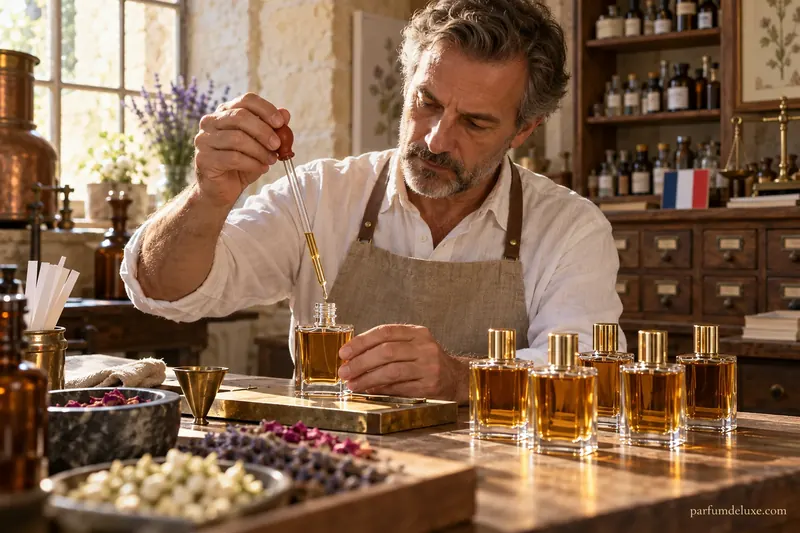
Perfume distribution sits at the end of a long chain
A bottle on a shop counter is the product of several activities that rarely share the same people. Composing a formula, producing the liquid, supplying glass, registering the product and stocking it are separate trades, often carried out by separate companies.
That split explains why perfume distribution is only one project among several, and why one project can lead to very different contacts. A brand planning its first fragrance has different needs from a retailer sourcing finished goods, or from someone hoping to train as a perfumer.
Perfume distribution is easiest to grasp once you identify which link concerns you. Each part below follows one link, using reference points checked with recognised players and without any promise about the outcome of a project.
Perfume trade professions: creation, evaluation, research and marketing
The perfume trade employs far more than perfumers. For its fine fragrance business, the fragrance company MANE describes creative studios in Paris, São Paulo, Milan, Dubai and New York, a page listing 17 perfumers, research teams developing new molecules and natural materials, evaluation teams and marketing teams.
Each role answers a need. The perfumer writes the formula, the evaluator judges it against the brief, the researcher supplies new ingredients and marketing ties the creation to a market. In a small structure one person may cover several of these jobs.
Suppliers of materials feed these professions. Robertet says it offers more than 10,000 raw material references, as essential oils, absolutes, CO2 extracts and infusions. In perfume distribution as elsewhere, knowing who makes what tells you whom to approach for a specific need.
Training for a career in the perfume trade
Several routes lead into these jobs. ISIPCA, based in Versailles on a 3,000 square metre campus with 14 laboratories, runs courses from baccalaureate level up to five years of higher education, taught in French and English, across perfume, cosmetics and flavours.
Its range includes a specialised laboratory technician course at two years of study, a creation and development process manager course from three to five years, a master’s in international marketing for perfume and cosmetics, plus continuing education, validation of prior experience and summer schools.
Those titles show that perfume trade professions recruit technical, regulatory and commercial profiles as much as creative ones. A professional project can therefore start with the training closest to the role you have in mind, before you look for an industrial partner.
White label perfume: what a Grasse workshop describes
To launch a fragrance under your own name, some companies offer white label perfume creation. Galimard, in Grasse, presents a four-step route: define the concept with its house perfumers, propose and validate formulas, make the juice in the laboratory, and, for a finished product, choose the bottle and package it in Grasse.
Its page says production includes maceration, chilling and filtering, that the fragrance can be delivered as eau de toilette, eau de parfum or parfum, in bulk or as a finished product under the client’s brand, and that products comply with European regulations and are not tested on animals.
The same page speaks of minimum quantities described as very reasonable, without giving a figure. It is a useful reminder: before comparing offers, ask in writing for minimums, the exact scope of the service and the documents supplied, rather than assuming one provider covers the whole chain.
Glass and packaging: industrial constraints
The container is a trade of its own. Verescence, a glass maker for perfume brands, lists 230 standard items and states that a custom mould needs a minimum order of 50,000 pieces per capacity. An exclusive bottle therefore implies a volume few small projects can absorb.
Standard containers that can be customised are the logical entry point for a first launch. At that stage the cap, pump, label and carton matter as much as the look of the glass, because each has its own suppliers and lead times.
Good perfume distribution begins with sound packaging, so always ask which decorations are included, what tolerances are accepted and how parts are inspected before filling. A leaking bottle or a poorly fitted cap undermines a fragrance, whatever the quality of the liquid.
Compliance: the link nobody can skip
In Europe a fragrance is a cosmetic product governed by Regulation (EC) No 1223/2009. Responsible persons notify their products through the Cosmetic Products Notification Portal, a free online system, and once a product is notified no further national notification is needed in the Union.
The European Commission adds that distributors must also notify in certain circumstances. A company that imports or sells under its own name should therefore check who acts as responsible person, rather than assume the supplier handles it.
This concern has its own profession, regulatory affairs, taught in specialised programmes such as those at ISIPCA. For a professional fragrance project, planning for that skill, in-house or outsourced, avoids discovering late that a launch is blocked.
Perfume retail channels: selective, online and wholesale
Perfume retail channels are not equal, and perfume distribution rules differ from one brand to another. Many luxury houses sell through selected networks. In the Coty case, on 6 December 2017, the Court of Justice of the European Union held that a luxury supplier may prohibit authorised distributors from visibly using third-party platforms, if the clause protects the luxury image, applies without discrimination and stays proportionate.
In practice an authorised retailer may be bound by brand-specific selling rules. A trader who wants to stock prestige fragrances should find out whether the counterpart is an authorised network or a wholesaler, and what each allows in a shop or online.
A brand name in a catalogue does not prove distribution rights. Ask for written confirmation of the permitted sales scope, the original invoice and the claims terms. French customs also state that they can hold goods suspected of counterfeiting, which makes stock traceability essential.
Scoping a professional fragrance project before asking for a quote
Before requesting a proposal, describe your market, the formats you want, the level of customisation and the quantities you expect. With those four items a supplier can answer precisely and you can compare like with like.
Then say whether you are buying finished goods, having a product made under your brand or creating a formula. Each is a different professional fragrance project with its own timelines, documents and responsibilities.
Finally, ask for the exact scope of the service, the documents handed over and who is responsible for what: manufacturing, notification, labelling, transport. Whether the aim is perfume distribution or manufacturing, a project defined clearly on paper reduces misunderstandings and surprise costs, whether you sell in a shop, online or in bulk.