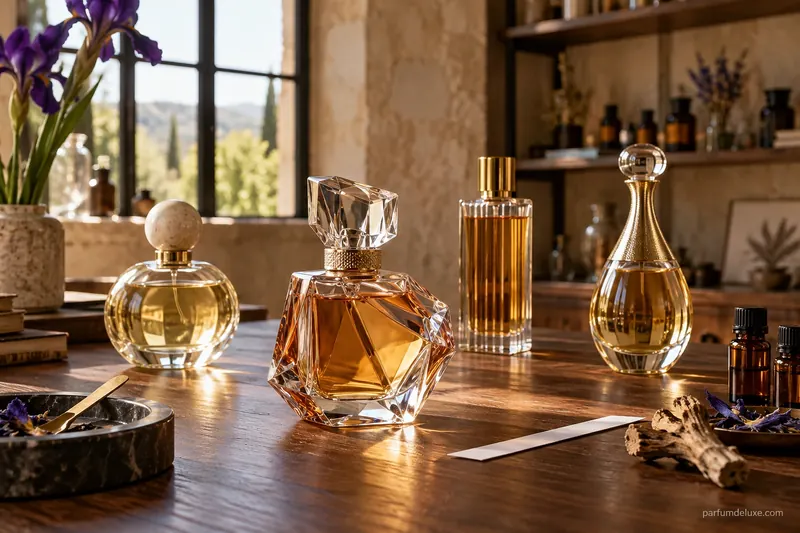
What people mean by Arabian perfumes
The phrase gathers three separate ideas. One is geographic: brands based in the Gulf and the Arabian Peninsula, such as Amouage, which describes itself as high perfumery from the Sultanate of Oman, founded in 1983. Another is stylistic, a taste for rich, resinous, floral or woody compositions that tend to feel fuller than the average Western eau de toilette. The last is a material, oud, which turns up in bottles made in Paris, Florence or New York just as often as in bottles from Muscat or Riyadh.
Keeping them apart avoids two common mistakes. An Arabian perfume does not necessarily contain oud, and a perfume with oud is not necessarily Arabian. A Dubai eau de parfum can revolve around vanilla and orange blossom, while a French niche creation can build its whole signature on a wood from Southeast Asia. Many shoppers who search for Arabic perfume expect a single style, yet the category is closer to a family of traditions.
How oud forms: resin as a response to infection
Oud, also called agarwood, comes from the heartwood of trees in the genus Aquilaria. According to the Wikipedia entry on agarwood, the wood only becomes fragrant after a mould infects the tree, which reacts by producing a resin that turns the wood dense and dark. In natural forests, the same entry says, only about 7 trees in 100 end up producing it, which goes a long way toward explaining its reputation for scarcity.
The article adds that steam distillation of the wood gives very little oud oil: no more than 20 millilitres from 70 kilograms of wood. It also notes that few perfume houses use real oud in large amounts, many relying on synthetic accords or on dilution with patchouli. A bottle that says oud on the label therefore reveals nothing about quantity or origin; only what the brand actually publishes can help. Pure oud oil is therefore judged by its stated provenance, not by its name alone.
Agarwood trade rules and the question of sustainability
International trade in agarwood falls under CITES, the convention on endangered species. A working document prepared for the 2022 conference of the parties records that Aquilaria malaccensis entered Appendix II effective 16 February 1995, and that the genera Aquilaria and Gyrinops as a whole followed on 12 January 2005. Of the twenty Aquilaria species assessed by the IUCN, the document says thirteen are regarded as threatened.
For a shopper, this means plantation sourcing and traceability matter. Plantations exist in South Asia, but the Wikipedia entry warns that artificially inoculated wood is sometimes sold as natural agarwood. A serious seller says where the material comes from and in what form it is used: oil, chips or a reconstructed accord.
Rose, saffron and amber around the oud
Oud has traditionally been paired with rose, a duo found in many Gulf bottles, but Arabian perfumes are not limited to it. Saffron brings a spiced, slightly leathery facet, resins and incense add depth, vanilla and amber round off the base, and musk stretches the trail on skin.
Western houses play with the same codes. Guerlain's Oud Nude, part of the L'Art & la Matière collection and credited to Delphine Jelk, pairs oud from Bangladesh with white almond, raspberry, rose petals, sandalwood and Madagascar vanilla, according to the house. Set beside a Gulf-made perfume, it shows how one ingredient can lead to opposite moods: gourmand, smoky, floral or dry.
- Oud can read woody, animalic or smoky depending on its quality and dose.
- Rose softens and rounds the edges of the wood.
- Saffron adds spiced warmth.
- Resins and amber build a long-lasting base.
- Vanilla and musk carry the sensation on skin.
Spray, attar or bakhoor: three different ways to wear Arabian perfume
Arabian perfumes come in three forms that call for different habits. An eau de parfum is sprayed on skin or fabric like any luxury fragrance. An attar, or alcohol-free perfume oil, is dabbed on in small touches: Wikipedia describes attars as traditionally distilled onto a sandalwood base and aged from one to ten years, with Kannauj in India among the production centres. Amouage states that its attars are pure fragrance oils, sold in 12 ml bottles and worn close to the skin.
Bakhoor is a paste incense shaped into balls or small pastilles, bound with something sticky such as honey, dried fruit or soft resin. It burns in a traditional censer called a mabkhara and is passed around the majlis, the reception room, as a gesture of hospitality. It scents a space rather than a person, and the smoke calls for ventilation, since burning incense releases fine particles and volatile organic compounds.
Gulf houses and Western readings of oud
Amouage is the best-known name in this field. Its attar collection lists eight oils, from Tonka Misfah to Santal Sohar by way of Oud Ulya. Arabian Oud, whose Saudi online shop lists perfumes for women, men and unisex, oils, oud, incense and home fragrance, shows the other model: a house that covers the whole scented everyday.
Beside them, European and American brands have built ranges around the same wood, sometimes with a lighter touch. Comparing a Gulf house with a Western high-perfumery label on the same theme is a good way to train the nose and to see what Arabian perfumes and oud share despite their different roots.
How to test and choose Arabian perfumes
Start from a sensation rather than a name: floral, resinous, smoky, sweet or spiced. A sample worn for a full day reveals staying power and development in a way a blotter cannot. Rich, resinous and vanilla-heavy compositions often feel stronger indoors than outdoors, and a few sprays can be plenty. With Arabic perfume, as with any oil-rich style, that patience pays off.
When ordering online, copy the complete product name: two bottles with similar names can hold different compositions. Check the volume, the concentration when stated, the ingredient list and the seller. A famous brand at a price far below normal, sloppy packaging or a missing batch code are warning signs, because counterfeit perfumes are illegal and may contain uncontrolled substances.
Skin, air and storage precautions
Oils and eau de parfum contain compounds that can trigger reactions in sensitive people. Regulated allergens must appear on the label; if in doubt, trying a small patch of skin before regular use is a simple precaution, and not medical advice.
As for storage, resin-rich perfumes and oils dislike heat and direct light. A tightly closed bottle kept in the dark holds its nuances longer. Incense should never burn unattended or within reach of children and pets.