Halal perfume: what the label says and what it cannot prove
In everyday use, a halal perfume is one whose composition is considered compatible with Islamic rules as they apply to personal care. No single definition applies worldwide. Each certifying body, each religious authority and each brand sets its own criteria, and they do not always agree.
That is why two bottles carrying the same word may rest on different reasoning. One relies on the complete absence of ethanol, another on the origin of the alcohol used, a third on a certificate issued to the company. The word halal on a flacon therefore raises a plain question: according to whom, and for exactly which product?
Many readers simply ask is perfume halal, as if the answer were a yes or no printed on the box. In practice the real question is whether this perfume is halal under the ruling you follow, and the honest reply is documented rather than assumed. Luxury branding does not answer it. What counts is precision: a complete ingredient list, the name of the certifier, the reference concerned and a validity date.
Is perfume halal? Two scholarly readings of alcohol
Alcohol is where most of the debate sits. A fatwa published by the Office of the Mufti of the Federal Territory of Malaysia sets out two opinions. The majority of scholars treat alcohol as impure because it is intoxicating. A minority holds that it is forbidden to drink but not physically impure, citing the Companions who poured alcoholic drinks into the streets of Medina.
The same text separates alcohol produced in beverage-making, regarded as impure and forbidden, from alcohol obtained by other processes, which is not impure although still forbidden to consume. It advises caution, recommending that believers avoid alcohol in daily life to stay out of disagreement and doubt, especially when the source of the alcohol in a perfume is uncertain. It also notes that guidelines of Malaysia’s National Fatwa Council consider perfumes containing alcohol permissible.
Other institutions lean the same way. According to a CosmeticsDesign article, the halal research institute at Universiti Putra Malaysia accepts alcohol in perfumes, and Singapore’s MUIS has approved alcoholic perfumes for Muslim use. The key distinction is origin: industrial ethanol that does not come from an intoxicating drink is not treated as khamr by these bodies. Each person remains free to follow the authority they trust.
Animal-derived materials: the second point to question
Alcohol is not the only issue. Several perfumery materials come from animals: natural musk from the musk deer, ambergris from sperm whales, civet from civet cats and castoreum from beavers. PETA lists these in an article on vegan perfume, and they matter to a halal-conscious buyer too.
Many such materials are now replaced by synthetic molecules, yet a brand is under no obligation to itemise every component of a blend labelled parfum. The sensible move is to ask the maker, reference by reference.
Some brands build the point into their own definition. Iba, for example, writes that a halal perfume must be alcohol-free and free of animal-derived ingredients considered haram. That is the brand’s definition, not a universal rule.
Halal perfume oil or eau de parfum: reading the carrier
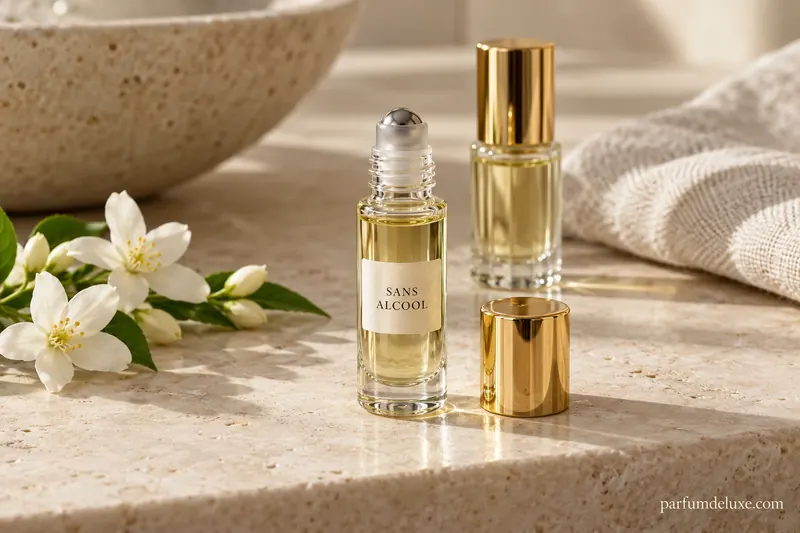
A halal perfume oil normally contains no ethanol: the aromatic concentrate is diluted in an oil or a neutral base. It wears differently from an eau de parfum, with spot application, a scent that sits closer to the skin and staying power that depends on the oil chosen.
An eau de parfum is generally diluted in ethanol. Swiss Arabian says in its FAQ that its eaux de parfum use denatured alcohol derived from natural sources such as sugar cane, unfit for human consumption, and that its perfume oils contain no alcohol from dates, grapes, wheat or raisins. It also explains that the word alcohol on packaging can refer to benzyl alcohol, an aromatic compound distinct from ethanol.
That last point clears up a common muddle: an ingredient with alcohol in its name is not proof that the product contains ethanol. Equally, the FAQ is not presented as an attestation and does not mention a halal certificate.
Halal certified perfume: read the document, not just the logo
For a halal certified perfume, three details are enough to judge seriousness: the name of the body that issued the certificate, the list of products it covers and its validity date. A logo on a homepage does not automatically extend to a whole catalogue, especially when a brand reformulates.
Iba states on its perfume collection page that its fragrances are halal-certified, alcohol-free, vegan and cruelty-free, with natural oil-based formulas. The page does not, however, name a certifying body or link to a certificate, so the claim rests on the brand’s word, which means nobody can settle the is perfume halal question for a whole catalogue on that basis alone. It is a starting point for questions, not proof.
To confirm halal certification of a perfume, ask customer service for the certificate, check that it names the exact reference you are buying and confirm that the issuing body is recognised by the authority you follow. Serious brands answer such requests.
A short checklist for an alcohol-free halal perfume
A few questions turn an impression into a check. Anyone looking for an alcohol-free halal perfume should run through them for each reference, because a brand can sell both alcoholic and alcohol-free versions under one name. They apply equally to a luxury flacon and to a more modest oil.
Remember that a luxury perfume sold as halal is not better or longer-lasting for that reason: certification concerns compliance, not scent quality.
- Which body issued the certification, and for which exact reference?
- Is the certificate dated and available to read?
- Does the formula contain ethanol, and of what origin?
- Are the musk, amber or civet notes animal-derived or synthetic?
- Does the formula change from one country of sale to another?
Allergens and skin care with a halal perfume
Even an alcohol-free halal perfume is still a fragranced product and can contain allergenic substances, natural or not. Regulation (EU) 2023/1545 raises the number of fragrance allergens to be declared to 81, with compliant labelling expected by 31 July 2026 for new products and 31 July 2028 for all products.
Read the ingredient list, test the scent on a small patch of skin before regular use and stop if redness or discomfort appears. For medical advice, speak to a health professional. If a religious point remains unclear after reading the maker’s information, put it to the religious authority you choose: the ruling is theirs to give, not the seller’s.