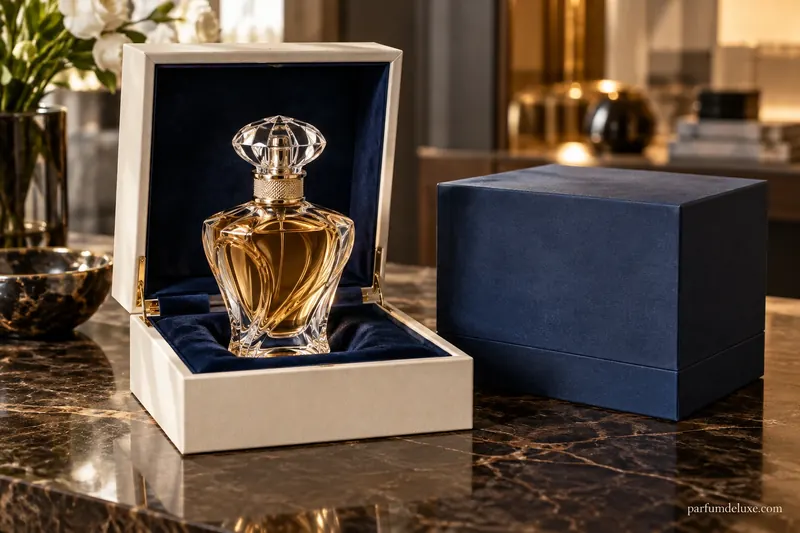
Why perfume bottle design matters as much as the juice
The bottle is the first thing anyone meets of a fragrance. Before a single spray, a buyer reads proportions, transparency, weight in the hand and the sound of a stopper closing. That first impression tells you what the house wants to say: a plain geometric block promises something different from an ornate sculpture.
Yet a container is more than decoration. It has to protect the liquid, deliver a regular spray and survive daily handling. Good perfume bottle design is therefore the point where looks and function are tuned together, with neither one sacrificed to the other.
That tension explains why flacons vary so much: the pocket travel spray, the counter atomiser, the collector's piece that is never meant to leave its display case. Each answers a different brief.
Perfume bottle shape: proportions, silhouette and grip
A perfume bottle shape is read first through its proportions: height against width, wall thickness, the balance between body and stopper. A slim vertical flacon suggests elegance and lift, while a wide, low volume suggests stability. These choices have practical consequences, because a tall object tips over more easily and a wide neck complicates fitting the pump.
Grip matters as much as outline. Sharp edges, facets or smooth faces change how you hold the bottle and how you press the atomiser, which is why designers test mock-ups in the hand long before any mould is cut.
Weight is a separate question. Thick glass feels solid and valuable, but it makes a travel bag heavier. The house settles that trade-off according to how the bottle will be used.
A silhouette that becomes a signature
Some shapes stay tied to a fragrance for generations. Guerlain says the original Tortue flacon was sculpted for its Champs-Élysées boutique, opened in 1914, and it now offers an anniversary edition made by Baccarat. According to the house, glassmakers hand-engrave 88 facets and fuse 24-carat gold powder into the crystal to obtain Baccarat red.
Glass or crystal: two materials, two effects
A glass perfume bottle is the standard container of the industry. The material is transparent, easy to decorate and adapts to a very wide range of forms. Specialist glassmakers sell catalogue models held in stock as well as tailor-made shapes.
Crystal is recognised by its brilliance and its ring. It tends to be used for limited series and prestige flacons, often shaped and finished by hand. For its 2026 annual collector's flacon, Rêverie, Lalique describes crystal that is melted and fused at 1,200 °C, then shaped and finished by hand in its workshops at Wingen-sur-Moder.
For the buyer the gap is not only about prestige. A crystal flacon is often heavier, less forgiving in daily use and designed to be displayed. A well-made glass perfume bottle remains the sensible choice for a fragrance you carry around.
The perfume bottle stopper: where character concentrates
The perfume bottle stopper is the one element that combines function and ornament. It seals the fragrance from the air, and it is also the easiest place to carry a graphic idea: a sphere, a metallised cap, a sculpture, a relief motif.
On Rêverie, Lalique's press release describes a sculpted cloud inspired by the Japanese kumo motif. The example shows how a stopper can become the central subject of the flacon, whereas many creations reduce it to a simple volume.
On the manufacturing side, component suppliers usually sort their ranges into three families: bottles, closures, and pumps with pump covers. Coverpla, for instance, lists cap models with finishes such as colouring, flocking, engraving, laser engraving, hot stamping, metallising and screen printing. For a luxury piece, the stopper therefore fixes a large share of the visual and tactile result.
Decoration and finishing: engraving, screen printing, metallising
Once the form is chosen, decoration turns a stock flacon into something recognisable. The finishes manufacturers describe include frosting, flocking, glitter, engraving, lacquering, hot stamping, metallising, screen printing and pad printing. Each has its own look, cost and constraints.
The glassmaker Verescence says its Abbeville site is its centre of excellence for decoration. That split between making the glass and decorating it is a reminder that a bottle passes through several workshops before reaching a perfumery.
Decoration is never neutral in practice. A dense screen print can hide the liquid level, and a metallised surface needs care when cleaning. Before choosing, look at the finish, but also at how it will age with use.
Who makes a luxury perfume bottle? Glassmakers, crystal works and houses
A luxury perfume bottle is rarely the work of one company. Glassmakers, crystal workshops, decorators and component suppliers collaborate with the house and its design studio.
Verescence recounts that its story goes back to 1896, when Henri Desjonquères took over the Verrerie du Tréport, and that the group adopted its present name in 2016. It reports seven factories and offers stock models as well as custom moulds, the latter with a minimum order of 50,000 pieces per capacity. Coverpla, in business since 1946 according to its website, provides a configurator for combining a bottle, a cap and a pump.
One useful lesson follows: many flacons that look unique start from existing models, personalised through decoration, stopper or colour. A wholly new perfume bottle design means a dedicated mould, and therefore large volumes.
René Lalique and Coty: when the flacon became a creation in its own right
The history of luxury perfume bottle design owes a great deal to one partnership. According to the Lalique museum, L'Effleurt, created in 1908 and 1911, was René Lalique's first work in perfume bottle design. It opened a productive period in which he designed roughly twenty or more bottles for François Coty.
That collaboration planted a lasting idea: a flacon can be signed and conceived as a piece of art glass rather than mere packaging. The museum also notes that Lalique worked on the Coty Building in New York, with poppy-motif wall panels and a monumental three-floor window in white pressed glass.
A century later the house continues the tradition. By its own account, Marie-Claude Lalique began the limited-edition crystal flacon series in 1994, and it has been annual since. Rêverie, second chapter of the Air de Lalique collection, is limited to 500 signed and numbered pieces and is due to launch on 1 November 2026.
Telling a catalogue model, a customisation and an edition piece apart
Three cases occur in practice. A catalogue model is an existing flacon that several brands may use. A customisation alters one through colour, decoration or stopper. An edition piece needs a dedicated mould or process, and the house's documentation usually says so.
Official presentations offer four clues: the manufacturer's name, the number of copies, any mention of hand finishing and whether the series is numbered. A numbered edition should be verifiable with the house itself.
Be wary of vague words as well. A bottle called artisanal or rare is not so because the label repeats it. Specific information, such as a run of 500 pieces, is worth more than an adjective.
Choosing by use: collection, daily wear or travel
Choosing a flacon starts with asking where it will live. A display piece can favour solid crystal, sculpture and a delicate stopper. An everyday fragrance needs a regular atomiser, resistant glass and a stable base.
For travel, a smaller size, a firmly seated cap and a grippy surface count for more than ornament. Some makers offer refillable bottles, lightweight glass or caps in recycled or natural materials; those claims are best checked in technical sheets rather than judged by appearance.
One last caution concerns storage. A handsome transparent flacon remains sensitive to light and heat, and its shape does not protect the fragrance. Keep it out of direct sun with the cap closed.
The best perfume bottle design is one whose form you enjoy as much as its use: beautiful on day one and still practical on day one hundred.