The origins of perfume: Mesopotamia, Cyprus and Egypt
The earliest named perfume maker appears on a cuneiform tablet from the second millennium BC. Her name was Tapputi, and she is regarded as one of the first recorded chemists because she distilled flowers, oil and calamus. The origins of perfume therefore lie in Mesopotamia, alongside Egypt and the Indus Valley.
On Cyprus, archaeologists announced in 2003 the discovery at Pyrgos of what are believed to be the oldest surviving perfumes, more than 4,000 years old. In Egypt, according to the Musée International de la Parfumerie in Grasse, priests are considered the first perfumers, composing ritual blends and scents for the royal court.
Greeks, Romans and the still: raw materials get refined
Greeks and Romans drew perfumes from flowers, woods, seeds, roots, saps and gums. In Rome, use peaked under Julius Caesar, says the Grasse museum, and each deity was linked to a scent. Even so, perfume remained largely a matter of oils and ointments, far from the alcohol-based waters we know today.
A technical leap is credited to Avicenna (Ibn Sina), associated with extracting flower oils by distillation, a method still widely used, with rose as his first experiment. The sources consulted give no firm date, so it is wiser to call it a medieval advance than to put a year on it. That caution applies to the whole history of luxury perfume: until a date rests on a dated document, it remains a tradition.
Imagining the habits of the time helps too. For centuries people scented rooms, clothes, offerings and bodies for ritual or social reasons, long before perfume was thought of as a personal signature. The idea of creation tied to a perfumer’s name is recent set against that long span.
Alcohol enters perfume history: Hungary Water and eau de Cologne
Around 1370, Hungarians are said to have made, at the request of Queen Elizabeth of Hungary, a perfume of scented oils dissolved in an alcohol solution, known as Hungary Water. The history of perfume changes character at that point: the liquid becomes lighter, easier to apply and easier to keep in a bottle.
In 1693 an Italian barber, Giovanni Paolo Feminis, is credited with a perfumed water called Aqua Admirabilis, now best known as eau de Cologne. Anyone reading the history of perfume should treat these founding tales with care. Dates often come from later texts, and the original formulas are gone.
Grasse in perfume history: leather and fragrant plants
According to UNESCO, growing perfume plants and processing their materials have been practised in the Pays de Grasse since at least the sixteenth century, inside a local craft long dominated by leather tanning. Grasse residents adapted and improved the techniques over time, which helps explain why the region stayed tied to natural materials.
At the Renaissance, perfume also became a tool of seduction, and containers of alabaster, enamelled earthenware, ceramic or blown glass turned into jewellery worn as pendants, says the Grasse museum. By the eighteenth century the town was growing aromatic plants for the trade, and industrialisation extended its role. Knowledge long passed on informally, through apprenticeship in perfumeries, which is why Grasse matters, without being the only source of great creations.
The nineteenth century: synthetics reshape the history of luxury perfume
In the late nineteenth century, the commercial synthesis of aroma compounds such as vanillin and coumarin made smells possible that natural materials alone could not give. This chapter is decisive in the history of luxury perfume, because perfumers now worked with molecules as well as extracts, opening the road to the modern fragrance, more abstract and easier to reproduce.
Against that background, Guerlain launched Jicky in 1889, often cited as a milestone of modern perfumery. In Britain, the Crown Perfumery, founded in 1872 according to Clive Christian, which draws on its archives, was granted the right to use Queen Victoria’s crown; the emblem still appears on every bottle of the Original Collection launched in 1999.
A vintage perfume bottle is not a preserved scent
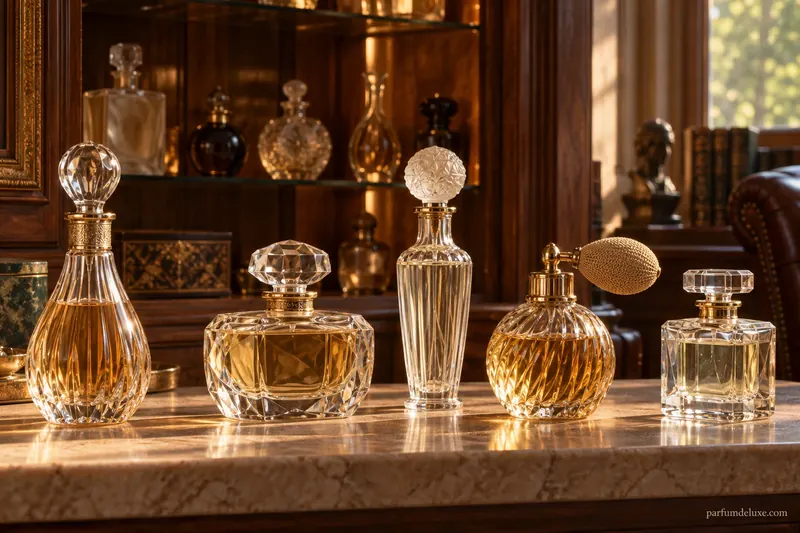
Period flacons inspire reissues, such as the Victorian-style bottles of Clive Christian, but a vintage perfume bottle cannot hand back the formula: the liquid degrades, materials have changed and so have safety rules. For a lover of beautiful objects, the flacon stays a precious document of an era's taste, but not a guarantee about what was inside. A collector can enjoy the object as a record of taste without taking its contents as proof of the original smell.
The twentieth century: houses, factories and wider access
In the twentieth century, the Grasse museum explains, perfume became an industrial, global product available to every social class. Houses organised their ranges, factories welcomed visitors and schools appeared: ISIPCA in Versailles opened in 1970 under the impulse of perfumer Jean-Jacques Guerlain.
In Grasse, the Fragonard historic factory, installed since 1926 in a building that was once a tannery, now holds a museum and copper stills. The visit illustrates a period when production, memory and shop window sit side by side. The Musée International de la Parfumerie, created in 1989, devotes its account to about five centuries of history.
What changed most across that century was the audience. A fragrance once reserved for courts and wealthy households now sits in department stores and travel retail, yet the language of luxury, with limited runs, fine materials and a named perfumer, still draws on the older courtly image. Knowing that lineage lets you read marketing claims with a calmer eye and judge a bottle by its composition rather than its legend.
How to check the perfume history a house tells you
When a brand tells you its past, look for documents: preserved formulas, archive objects, timelines, exhibitions. The Osmothèque in Versailles keeps perfumes that disappeared or changed so visitors can smell them as originally formulated, which tests stories against the scent itself. Reading the history of luxury perfume this way, with a museum, an archive and a nose, is more reliable than any single brand narrative.
Each great period leaves a layer in the history of luxury perfume, from the earliest tablets to the latest launch: ancient materials, medieval alcohol, nineteenth-century chemistry, twentieth-century industry. None replaces the others; they stack in the pyramid of a current fragrance.
Keep a healthy suspicion of superlatives too. “Oldest”, “first” or “unchanged since” need a source. To follow perfume history properly, cross a museum, a house archive and a reference book rather than relying on a single legend, however attractive.