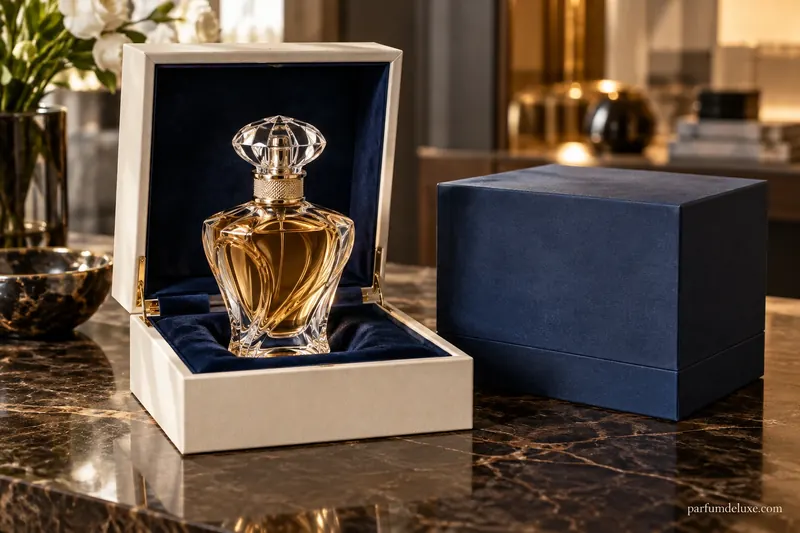
What perfume packaging actually includes
Ask most people about perfume packaging and they picture a box. In practice there are several layers: the flacon itself, its closure, the pump and pump cover, sometimes a protective film, then the carton, the internal wedge and the shipping case that travels to the customer.
Each layer of perfume packaging has its own job. The bottle contains, the pump doses, the carton protects and presents, the insert holds the object still in transit. When one is badly thought out, the others cannot make up for it: a beautiful flacon in a loose box arrives scratched, and a rigid box with a soft insert achieves nothing.
Component makers reason in separate families for that reason. Coverpla, for example, arranges its catalogue into bottles, closures, and pumps with pump covers, and serves perfumery, skincare and home fragrance.
The perfume box: protection before decoration
The perfume box is the first defence against knocks, dust and light. Its size should match the bottle, with enough clearance to slide the flacon in without force and little enough that it cannot rattle.
Its design is a matter of ergonomics. Openings let the bottle come out without scraping its edges, and the closure keeps the box from popping open inside a bag. On a luxury perfume box, a magnetic lid charms on opening, but the magnet and the wrapping say nothing about how well the contents are held.
A quick test helps when judging a box: shake it lightly with the bottle inside and listen. A sharp knock points to poor wedging, while a soft resistance suggests a correct fit.
Inserts, cut-outs and legibility in fragrance packaging: details that do the work
The internal insert, often moulded pulp, paper or foam, immobilises the flacon in three directions. It prevents glass touching the walls during the handling a product is expected to undergo, such as transport and shelf placement.
Cut-outs need the same attention: a window that is too wide exposes the bottle to light, while a notch too narrow forces you to pull the neck. Legibility covers the name, volume, concentration and ingredient list, which must stay readable despite artwork, colour or gold foil.
Heavily decorated fragrance packaging can fail on a basic point: finding the volume or the reference in two seconds. Useful information comes before visual effect, which is a good reason to read the back of a box as carefully as the front.
Why premium perfume packaging is not about a bulky box
Premium perfume packaging shows itself through precision more than size. A large box is not automatically better suited to the product: it can take up shelf space, complicate storage and be mostly air.
Serious criteria are humbler: even creases, aligned printing, sturdy corners, foil that holds and a visual link with the flacon. A metallised or embossed finish does not replace a carton that warps.
For the consumer, the telling question is use. Does the box get thrown away, reused, stored easily? A box built for the journey to the shop window does not necessarily serve the buyer at home.
Developing a luxury perfume box with its bottle: glass, closure and carton from day one
For a brand creating its own fragrance, fragrance packaging is prepared together with the bottle, never afterwards. Glass, closure and carton choices need to be matched during development, because every component has its own dimensions and tolerances.
Suppliers make this stage easier. Coverpla offers a configurator, Mix & Match, for combining a bottle, a cap and a pump, and its website links an ISO 9001 (2015) certificate. The glassmaker Verescence shows stock models alongside custom bottles, the latter starting from 50,000 pieces per capacity for dedicated moulds.
Those figures show that run size steers the decision. For a small batch, a customised existing model is often the realistic option; an exclusive mould makes sense for large volumes.
Tolerances and samples: test with real objects
A drawing on a screen is not enough. Dimensions and tolerances for bottle, cap and carton should be checked on physical samples, since glass varies slightly between production runs and a box that fits perfectly on paper can turn out too tight or too loose.
In practice four points are checked: inserting and removing the flacon, how the cap sits, whether the pump lines up with its opening, and how the board stands up to repeated handling. A transport trial on a few units avoids discovering a defect across a whole series.
This checking, central to fragrance packaging, is invisible to the end consumer, yet it explains why some boxes simply feel well made.
Collector editions: presentation designed around the object
A collector edition can justify specific presentation, closer to a case than to a carton. Guerlain describes the Red Edition of its Tortue, made by Baccarat to mark 110 years since the original creation in 1914, with 88 hand-engraved facets.
At Lalique, the annual flacon Rêverie is limited to 500 signed and numbered pieces. For an item of this kind the presentation is part of the object: it accompanies the numbering, any certificate and the conservation of the piece.
Caution is still wise with superlatives. A precious box proves nothing about the quality of the fragrance, and run sizes are best confirmed with the house rather than from the label alone.
Environmental claims: what can be documented
A kraft-coloured box or a natural look guarantees nothing environmentally. Claims should rest on documented elements: the material used, the share of recycled content, the process, or a certification or third-party assessment.
Manufacturers sometimes publish such details. Coverpla presents what it calls a responsible range, with caps in recycled or natural materials, lightweight glass and refillable bottles. Verescence reports a score of 90 out of 100 in the EcoVadis assessment and a Platinum medal in July 2026, according to its website.
These are makers' statements and should be read as such. A buyer is better off looking for the precise material and the proof attached than trusting a pictogram or a shade of brown.
After purchase: opening, keeping and reusing the box
Perfume packaging has a second life once opened. The box protects the bottle on a trip, keeps it out of the light and preserves the product reference, which helps if a question arises about a batch number.
Keeping the box is not essential for a fragrance in regular use, but it becomes valuable for a collectible bottle or a gift that may be resold. The original insert then lets the bottle be shipped or moved safely.
A final habit: remove the protective film and discard inserts according to local sorting rules, without throwing out items that still serve a purpose, such as the inner tray of a gift set.