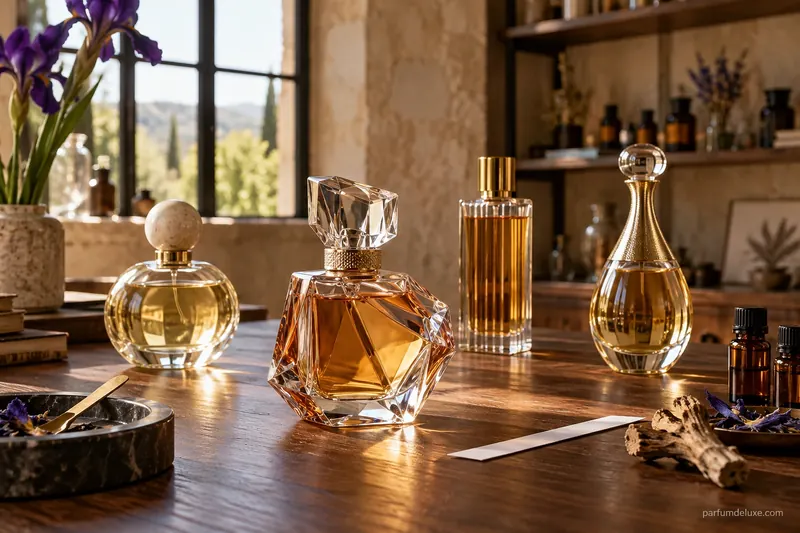
The cost of luxury perfume is not the cost of the liquid
Ask anyone why luxury perfume is expensive and the answer usually starts with ingredients. Yet a bottle on a counter holds a fragrance, a container, packaging, regulatory paperwork and a retail concept. No single item explains the whole price tag.
Fragrance houses do not publish how they split their costs. Any claim that a bottle is so many percent ingredients and so many percent marketing therefore lacks a source, and the figures that circulate online should be read as guesses. What can be done is to follow the product from idea to shelf and look at each stage in turn.
That route reveals real expenses, such as development, sourcing, glass and compliance, and some perceived value, such as heritage and image. Keeping the two apart is the most useful habit when judging the cost of luxury perfume.
Why luxury perfume is expensive before a bottle even exists
The cost of making perfume starts with the work of a perfumer, who drafts a formula, has it evaluated, adjusts it and compares it with other directions. That stage ties up scarce skills, laboratory time and evaluation panels. No house puts a figure on it, but it is a genuine line in the budget.
The palette is vast. Robertet says it offers more than 10,000 raw material references, which hints at how many choices a creator faces. A wider palette means more trials and a harder final selection.
Not every project survives. A draft judged too close to an existing perfume, unstable over time or too costly to make in volume is dropped. Nobody sees those versions, yet the house still pays for them, and the expense is absorbed by the fragrances that do reach stores. That hidden share of the cost of luxury perfume is real, even if nobody prints it on the box.
Trials the customer never smells
Only the final formula reaches the shopper. Discarded versions, dosage tweaks and stability tests in alcohol stay out of sight, which is one reason why comparing a bottle with a simple list of ingredients tends to mislead.
Luxury perfume ingredients and the price of a bottle
Natural materials come from parts of plants: flowers, leaves, woods, spices and fruit. They are turned into essential oils, absolutes, CO2 extracts or infusions, and each form has its own yield and price. That is why two compositions that smell similar can cost very different amounts to produce.
Rose shows how much a single material matters. According to Robertet, about 98 percent of women’s fragrances and 46 percent of men’s fragrances contain rose. The same source counts more than 3,000 rose cultivars, but Rosa damascena makes up 99 percent of world production and Rosa centifolia just 1 percent. A scarce or demanding crop weighs more in a formula than an abundant one.
Natural does not automatically mean costlier or nobler. Synthetic molecules do things nature cannot, keep quality steady from year to year and ease pressure on some resources, so luxury perfume ingredients usually mix both families.
Concentration matters too. A richly loaded extrait holds more fragrance per millilitre than a light eau de toilette, and the price of a perfume bottle often follows, though no fixed rule predicts it.
Glass, decoration and minimum runs: the price of a perfume bottle
The container is part of the bill. Verescence, which makes glass for leading perfume and cosmetics brands, lists 230 standard items and says a custom mould requires a minimum order of 50,000 pieces per capacity. An exclusive bottle therefore commits a house to a serious industrial order.
The cost of making perfume also includes the cap, the pump, the label, any decoration, the carton and the wedging. A heavy bottle, a metallised collar or a rigid gift box raises production and shipping costs. Those items shape how the product is perceived, which is their purpose, but they say nothing about the quality of the juice.
A handsome bottle proves nothing about the fragrance inside. Enjoying the object is legitimate, as long as you know the money spent on it does not improve the smell. Refillable formats exist precisely to separate the pleasure of the object from the cost of the liquid.
Safety rules nobody sees on the shelf
In Europe a fragrance is a cosmetic product governed by Regulation (EC) No 1223/2009. The responsible person must notify it through the Cosmetic Products Notification Portal, a free online system, and keep safety information available. The portal costs nothing to use, but building the file takes expertise and time.
Perfumers also work within the standards published by IFRA, the international fragrance association, which sets rules for the safe use of materials. IFRA signals a 51st Amendment to its standards, a reminder that the framework keeps moving and that formulas sometimes need adjusting.
These obligations are not unique to luxury, but they apply to it fully. They explain why a launch cannot happen overnight and why a reformulation means extra work. Allergies remain possible despite the rules, so patch-testing on a small area of skin is sensible when in doubt, and it adds to the cost of luxury perfume that compliance is never free.
Selective retail and the price of image
Many prestige houses sell through selected networks. In the Coty case, decided on 6 December 2017, the Court of Justice of the European Union held that a luxury supplier may forbid authorised distributors from using third-party platforms visibly, provided the aim is to preserve the luxury image, the rule is applied without discrimination and it stays proportionate.
The ruling sheds light on one reason prices stay high: image is built in the point of sale, in trained advisers, in samples and in staging. Those means carry a cost that is passed on, and they reflect a strategic choice rather than a technical need.
Advertising, ambassadors and heavily publicised launches follow the same logic. They do not alter the formula, but they build the awareness that supports a high positioning. Without published figures nobody can say how much of a price goes to communication, only that some of it does.
Heritage, scarcity and the perception gap
Part of the price reflects positioning. An old house, a celebrated perfumer, a numbered edition or a hard-to-source material can justify a tariff above that of a technically similar product. That value is real for the buyer who appreciates it, yet it cannot be measured like the price of a glass bottle.
Treat promotional words with care. Rare, precious and exclusive are claims, not evidence. Ask what is documented: where a material comes from, how large a run is, who composed the scent. Precise communication is worth more than flattering vocabulary.
So the question has two halves: concrete costs and symbolic value. Separating them lets you buy knowingly, paying for a signature, an object or an experience without assuming that a high price guarantees a better smell.
How to decide whether a price is worth it to you
To judge the cost of luxury perfume for yourself, start by wearing it. Test the fragrance on skin for several hours, because the way notes develop reveals what the first spray hides. A sample or a travel size costs far less than a full bottle and lowers the risk of a poor choice.
Then compare the price per millilitre rather than the sticker price, allowing for concentration and how often you wear it. A scent worn twice a week lasts much longer than a daily one, and cost per wear changes the picture completely.
Finally, be wary of unusually low prices on highly sought-after references. Counterfeits and badly stored stock exist, and fakes are illegal and risky. Recognised retailers, brand boutiques and authorised distributors give a traceability that anonymous listings cannot.