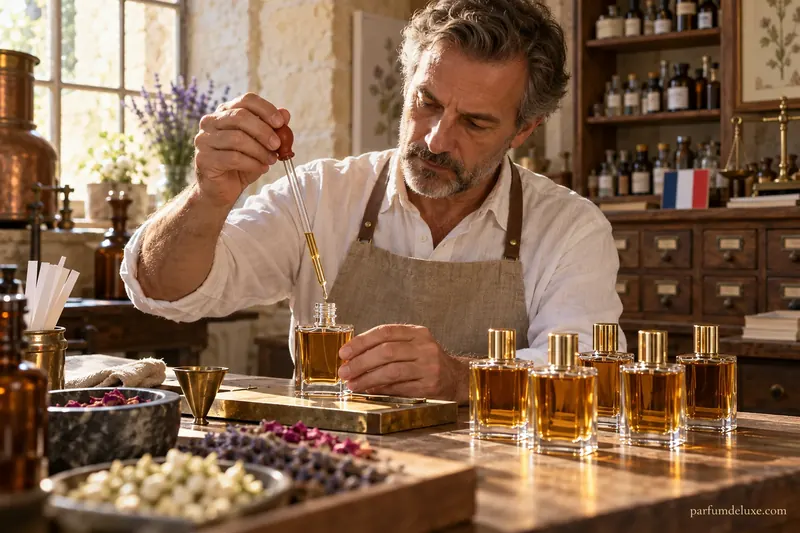
From formula to finished object: the perfume making process
A formula arranges aromatic materials around an olfactive idea. Turning it into a product takes several very different operations: sourcing the ingredients, weighing and blending them, letting the mixture stabilise, filtering it, filling it and packing it. The perfume making process is therefore a chain of separate stages, often spread over several sites and companies.
Exact methods depend on the composition and the industrial equipment. An eau de parfum rich in synthetic molecules is not prepared like an extract built around delicate naturals. Talking about general steps is safer than promising a single recipe, and any account that claims to explain how perfume is made in three easy gestures should be read with suspicion.
The sequence also explains why a luxury fragrance cannot be rushed. Materials must be obtained and checked before blending, blending must be followed by rest, and rest by filtration. Skipping a stage may save time, but the resulting liquid is no longer the one the perfumer approved.
Extracting natural materials: distillation, CO2 and expression
Several techniques capture the smell of a plant. Steam distillation passes steam through the material; the condensate separates in a Florentine flask into oil on one side and scented water, called hydrosol, on the other. Expression, which means pressing the peel, applies only to citrus. Solvent extraction produces a concrete, and alcohol then yields an absolute. Ethanol is also used to pull fragrant compounds out of dry materials or out of impure oily products. Dry, or destructive, distillation heats material directly without water; it can create burnt or toasted notes and is used for fossil amber and some woods.
Supercritical CO2 extraction is newer: its low heat and non-reactive solvent tend to keep the scent close to the original material. Enfleurage, in which fat absorbs the fragrance of flowers, is rarely used today because of its cost. Any of these methods can alter a scent through heat, harsh solvents or oxygen, which explains why two extracts from the same flower can differ. Fractionation offers one more tool: a column removes unwanted fractions from a material to modify its scent. It costs more, yet it gives the perfumer extra control over the result, which shows that choosing a method is already a creative act rather than a mere technical formality.
What raw-material suppliers say about their work
Robertet, which says it was founded in 1850, states that it turns flowers, leaves, wood, spices and fruit into essential oils, absolutes, CO2 extracts and infusions, with more than 10,000 references. It also mentions a range using more environmentally friendly solvents, a sign that the choice of process has become a subject in its own right.
Synthetic molecules: the other half of the palette
Synthetic odorants are made by organic synthesis and then purified, whereas natural ones come from the extractions described above. Depending on the wax content, an extract is called an essential oil, an absolute, a concrete or a butter.
Only absolutes, essential oils and tinctures go directly into a formula. Synthetic molecules are no sign of lesser quality: they provide smells that natural materials alone could not, which is why most modern compositions contain them.
Blending the concentrate and choosing a strength
The perfumer weighs and mixes materials into a concentrate, also called perfume oil. The share of that concentrate in alcohol defines the product category. According to an encyclopedic summary, a parfum or extrait holds 15 to 30 percent aromatic compounds, an eau de parfum 15 to 20, an eau de toilette 5 to 15 and an eau de Cologne 2 to 3.
Understanding how perfume is made includes this choice of strength. Those figures are only indicative, because every house assigns its own proportions to each strength. Two bottles of the same category can therefore behave differently on skin.
Perfume maceration: alcohol, rest and cold
Once the oils have been blended with ethyl alcohol and water, the liquid is kept in tanks for several weeks. This perfume maceration lets the ingredients stabilise before filtering removes sediment and particles ahead of bottling. For every batch, that waiting time is part of how perfume is made.
At the historic Fragonard factory in Grasse, a maceration and filtering room holds large stainless-steel vats where concentrates macerate in alcohol, then are chilled to -5°C and filtered. Luxury brands tell the harvest story more readily than the tank time, yet that time is what lets ingredients settle. Rest, cold and filtering are discreet steps, and advertising rarely mentions them although they come before any filling.
Filling, inspection and packaging: perfume manufacturing at the end of the line
The last stage of perfume manufacturing is conditioning. On a semi-automatic line, bottles are filled, coded, labelled and checked, and Fragonard opens that room to visitors. The carton, the case and the leaflet follow, together with the ingredient list that regulations require; the perfume manufacturing chain only ends once the product is ready to ship.
Checks go beyond the liquid: marking, label and the look of the finished product are verified before departure for retailers. A luxury bottle implies high standards on such details, although the exact methods vary from one site to another.
Artisanal or industrial? Questions to ask about perfume production
The word “artisanal” does not describe every step actually done by hand. A house may compose its formula internally, have materials extracted in Grasse and subcontract the filling. Asking how perfume is made in a given workshop is a fair question. Ask what is done on site, what is subcontracted and what the label means by “made in”.
Anyone planning perfume production for a business should ask the manufacturer for its exact scope: formula development, sourcing, filling or the complete presentation. Validation samples and a clear specification avoid misunderstandings before a run starts.
Seeing and smelling the way perfume is made
To move beyond theory, a visit helps. In Grasse, Fragonard shows copper stills, old enfleurage vessels and a perfumer’s laboratory, with free guided tours. Molinard’s workshops, offered since 1994, let you blend with a graduated pipette and, according to the house, later order 100 ml of your creation.
Such experiences do not replace a full production site, but they give concrete markers: you smell the difference between a raw material and a finished accord, and you see how much time, cold and filters contribute to how perfume is made.