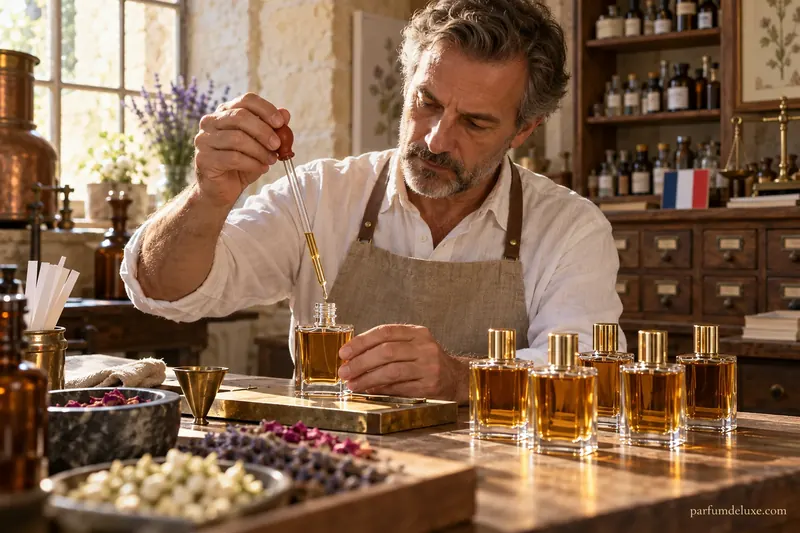
Three projects, three kinds of luxury perfume supplier
Before collecting contacts, name the project. First case: you want to resell fragrances from known brands, in a shop or online. Second case: you want a perfume under your own name, developed with a laboratory or manufacturer. Third case: you want to assemble a particular presentation, such as a set that brings existing products together.
Each case calls for a different counterpart, and the search to find a perfume supplier starts from that choice. For resale you approach a distributor or wholesaler. For a creation you approach a manufacturer, a fragrance compounder or a contract filler. For a set you also need a supplier of containers and cartons.
Mixing up these trades wastes time: a distributor does not formulate perfume, and a manufacturer does not necessarily hold stock of major brands. Starting from one plain sentence, “I want to resell” or “I want to create”, steers the whole search.
Distributor versus manufacturer: what each can offer
A distributor sells goods it bought from houses or other intermediaries. Beauty Fort, a Manchester company presenting itself as a beauty supplies business, advertises for example a catalogue of more than 8,000 branded products for trade customers who open a free account, including fragrances from houses such as Guerlain, Tom Ford or Givenchy.
A manufacturer produces. The French group Arthes describes a private-label department offering eaux de parfum, eaux de toilette and cosmetics, with fragrances developed, it says, by Grasse perfumers, and states 75 maceration tanks for 220,000 litres and five filling lines for 120,000 bottles a day.
These figures come from the companies themselves. They indicate the scale each says it works at, which helps you judge whether your volume fits, but they replace neither a visit nor customer references.
Find a perfume supplier for resale of established brands
With established brands, the first questions concern where the stock comes from. Ask how the supplier sources it, whether it is official stock or consignments, and what each reference contains. Look at lot traceability, the state of the packaging and any resale conditions the brands impose.
State the sales channel you have in mind too. A perfume supplier that agrees to serve a physical shop does not necessarily allow online sales or marketplace listings. Get the scope that concerns you confirmed in writing before building stock. A distributor’s catalogue is a starting point for conversation, not proof that every house can be supplied.
If you want a luxury perfume supplier for specific houses, contact the house or its authorised retailers first: some open trade accounts, others work only through chosen networks. A refusal from the house is useful information, not a failure.
Private label fragrance supplier: describe the creation you expect
A creation under your name needs a richer brief. Specify the scent direction (family, intensity, target customer), the components (bottle, cap, box), packaging, starting quantities and timetable. The supplier should say what it does itself and what it subcontracts. A private label fragrance supplier that cannot explain its own process is a warning sign, however polished the brochure.
The Arthes group describes support in stages: project study, concept creation with 3D modelling, component sourcing and technical development, production, then quality and regulatory services. It mentions ISO 22716 certification, the standard for good manufacturing practice in cosmetics. It is one example of a route among several.
Finally ask which minimum quantities apply, who owns the formula and on what terms you may switch manufacturer. These contractual points weigh more than the price of the first bottle.
Fragrance supplier for gift sets and bespoke presentations
Assembling a presentation means combining elements not designed by the same company: perfumes, box, inserts, labels, leaflets. The project works when one person is named to coordinate everything and each stage has a date.
Specify who supplies the perfume, who supplies the container and who assembles; the luxury perfume supplier you retain should accept that division in writing. A set containing third-party brands also raises the question of the right to use those names; clear it before manufacturing starts, in writing and with the owners concerned.
Ask for a mock-up or prototype before the run, and keep the approved sample as the reference against which the delivery is checked. A serious fragrance supplier accepts to show an approved sample and to state tolerances for colour, size and finish.
What the cosmetics industry expects from a perfume supplier
In France, FEBEA describes itself as the trade body of cosmetic product manufacturers and brings together more than 300 companies, 82 per cent of them very small, small or medium-sized. It offers members regulatory, export and legal services and manages, among other things, free-sale certificates.
For a buyer, this is a reminder that a perfume is a regulated cosmetic product. The supplier should be able to say who takes responsibility for conformity, who keeps the product file and which documents accompany a possible export.
If a perfume supplier stays vague on these topics, or answers that “everything is in order” without showing anything, move on. Documentary transparency is the first sign of seriousness.
Reading a written proposal: who does what, and how far
A supplier’s proposal should be read as a split of responsibilities. For each line, check who takes the task: design, component purchase, filling, quality control, packing, transport, insurance, customs clearance if needed.
Spot what remains for you to organise and the approvals expected before production or delivery: proof sign-off, reference sample, formula approval. A quote with no intermediate approval protects neither party.
Compare at least three proposals written from the same brief, and ask each private label fragrance supplier to list what its price excludes. Price gaps often come from services not included, not from a difference in quality.
Steps to choose a luxury perfume supplier with little risk
To choose a luxury perfume supplier, move by stages: introductory call, brief sent, proposals received, sample, pilot order. At each stage, note what was promised and what was delivered.
A small pilot order lets you test lead times, bottle quality, customer service reactions and the accuracy of the documents. It costs slightly more per unit but sharply reduces the risk of the first run.
- Name the project: resale, private label or set.
- Write a one-page brief.
- Ask three suppliers for the same proposal.
- Require sample, timetable and written approvals.
- Test with a pilot order before the full run.