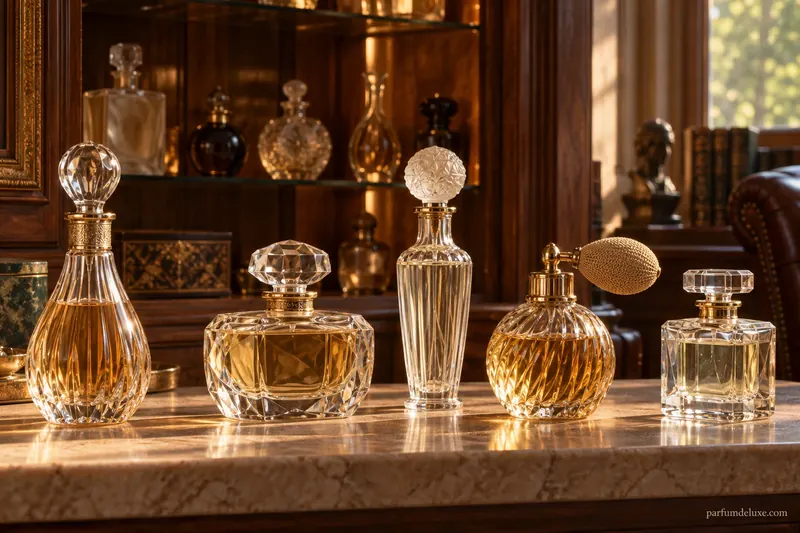
Perfume display stand: what the furniture really has to do
A perfume display stand is more than a shelf. It directs the eye, sets the reading order of the range and shapes the customer's gesture: pick up a bottle, put it back, move to the next. A good one makes the selection legible within seconds: where the collection starts, which bottles are new, where to try.
It must also serve the sales assistant. A layout where a reference is found quickly, restocking needs no rearrangement and every bottle has its place prevents mistakes and visible gaps. Before drawing anything, watch how customers move through the shop and what they ask for most often.
A good perfume display stand also cuts needless handling: a bottle within reach, an identifiable tester and a legible label are often enough to stop assistants moving ten products to find one. Perfume displays for shops work best when the layout mirrors how people actually browse.
Perfume shop display: measure the space before choosing a shape
For any perfume shop display, measuring comes first: counter or gondola width, ceiling height, clearance in front of the unit and power sockets if it is lit. A unit that is too deep blocks circulation; one that is too tall hides the rear of the shop or neighbouring products.
Consider the kind of shop as well: perfume displays for shops in a department-store counter differ from those of a designer boutique. A multi-brand perfumery, a department-store counter and a designer boutique have different constraints and product density. In a narrow room, a wall unit or a corner shelf may suit better than a central island.
Bottle dimensions, weight and stability
A hundred-millilitre eau de parfum in thick glass weighs noticeably more than a travel size. Give the maker the dimensions of each bottle, cap height, weight and the number of units to show per level. A shelf that sags, a base that tips or a lip set too low cannot be fixed once the series is made.
Leave margins: bottles in one collection are rarely identical, and the next launch may be wider or heavier. A modular perfume display stand, with movable levels or adjustable inserts, accompanies a growing range better than furniture fixed to the millimetre.
Check fixings too: a unit placed in a passage zone should withstand light knocks without bottles sliding.
Perfume tester display: room to try without clutter
The tester is the bottle customers handle most, so it is the most exposed to knocks, fingerprints and leaks. A perfume tester display should give it a separate zone that is easy to clean and clearly distinguishes the demonstration product from the one for sale.
Allow space for scent strips and their replacement, plus a small area to rest the bottle during the trial. If customers must hunt for somewhere to put down a tester or discard a used strip, the experience degrades quickly. Discreet storage for strips and tissues, out of sight, keeps everything tidy. Staff should also know where spare testers are kept, so a leaking or empty bottle can be swapped in a moment rather than left on show.
Bottles exposed to direct light or heat keep less well, so avoid placing a display against a sunny window or beside a heat source.
Lighting, materials and cleaning: what shapes appearance over time
Lighting shows off the transparency of the glass, the colour of the liquid and the relief of the cap, but it can also generate heat. Favour cool sources and, if the unit is enclosed, temperature checks. Materials matter equally: a matt shelf shows fewer fingerprints than a mirror, and gloss glass needs frequent cleaning.
Ask how shelves come apart, how corners are cleaned and how a damaged part is replaced. A sumptuous unit becomes expensive if every scratch needs the maker's visit. Think about renewal as well: perfume displays for shops should absorb a new launch, a limited edition or a seasonal gift box without a full redesign.
Perfume merchandising: staging the range without overloading it
Perfume merchandising means putting the right product in the right place with a readable message. A successful composition helps choice without so many objects that handling becomes awkward: a few well-chosen decorative elements beat accessories that compete with the bottles.
Merchandising specialists can study these elements together. DIAM, which presents itself under the heading “Retail & Merchandising”, says it designs, creates, develops and installs merchandising, shopfitting and point-of-sale solutions for beauty and luxury brands and retailers, and states a footprint of 20 countries.
Cosfibel Group, a luxury packaging specialist, lists packs, bags and merchandising accessories, together with design, sourcing and quality-control services. A bottle maker does not necessarily offer a shop-fitting service, so check what each supplier actually does.
Questions to ask the maker before signing the quote
Ask for the exact materials, available finishes, production lead times, warranty and the price of replacing a single part. Clarify who is responsible if a bottle falls because of a design flaw, and what happens if the delivered unit departs from the approved prototype. Written into the quote, these points prevent late arguments.
Ask too whether the supplier can deliver several identical units over time. For a perfume display stand intended for several shops, consistency of colour, wood or metal from one batch to the next matters as much as the first piece. Compare at least two proposals on the same basis: same dimensions, same materials, same level of finish. Ask also for care instructions in writing, so shop staff know which cleaning products are safe for each surface.
Prototype, transport and installation: approve before the series
Always ask for a prototype or a technical validation before manufacture, whatever the size of the order, because a perfume display stand is hard to correct once produced. Place the real bottles and testers on it and watch how a customer takes them. A proportion error invisible on a drawing shows up at once with real objects.
Then settle transport and installation: delivered assembled or flat-packed, protective packaging, shop access, who fits it and lead times. If several shops must receive the same model, check that each location accepts the dimensions. Keep a copy of the approved drawings and the materials list; it will help for a restocking order or later replacement. Photograph the finished installation with the bottles in place, so a future team can restore the same arrangement after cleaning or a seasonal change.