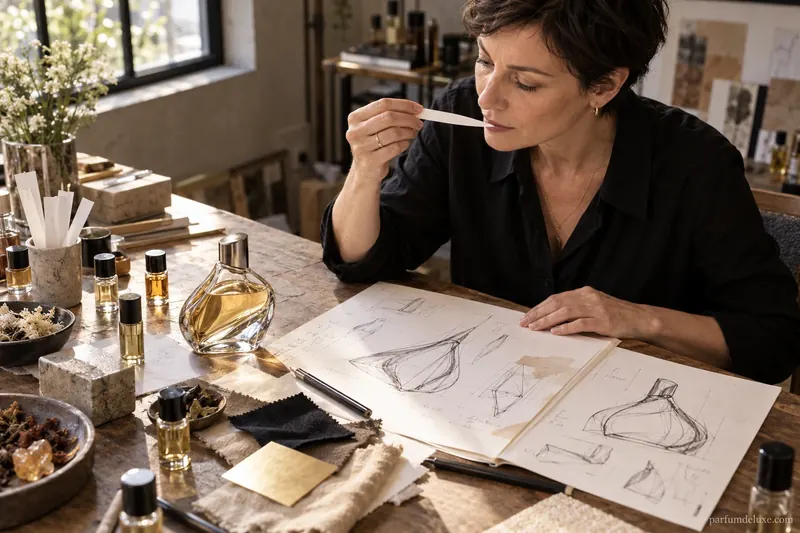
Launch a perfume brand with a concept you can explain in two sentences
Before approaching any laboratory or manufacturer, answer three plain questions. What mood or imaginary world does the brand carry? Who is it for? And how do its compositions differ from what already sits on the shelf? Established houses tell stories built on facts: a perfumer, a region, a raw material, a bottle-making technique. A young label does not need a century of history, but its story must match choices it has really made.
A short collection of three to five coherent fragrances is easier to present than a catalogue of twenty. It concentrates the creative budget, makes staff training simpler and gives customers time to grasp the world you are building. To launch a perfume brand with a manageable budget, most newcomers begin with a single bottle size plus a small discovery format rather than a wide range of volumes.
Start a perfume brand: name, identity and trademark protection
If you want to start a perfume brand, the name comes first. It should be available, easy to read in several languages and protectable. In France, trademarks are registered with the INPI, and a prior-rights search shows whether a similar name already exists in the relevant classes. A striking name that another house already uses can stop a launch after months of work.
Fragrance names deserve the same care when you start a perfume brand, because they are what customers remember and type into a search bar. Visual identity, typography, glass colour and tone of voice should form one whole. Your intended audience guides these decisions: someone hunting for confidential creations expects a different presentation than a shopper buying a gift set.
A luxury perfume brand is judged on consistency, not on price tags
A luxury perfume brand earns the word through coherent choices: quality of raw materials, work on the composition, care given to the bottle, cap and box, and the welcome offered to the customer. Using luxury as the only argument while the product is still vague promises something not yet built.
Positioning also drives quantities and timing, so before you launch a perfume brand, settle what kind of luxury you are aiming for. A very limited run, a numbered series or a seasonal collection is managed differently from a permanent range. Decide early whether the brand aims at chosen scarcity or steady availability, since this shapes production, storage and the retailers you approach.
Private label perfume or bespoke formula: choosing how to manufacture
There are two main routes to build a perfume brand with real products on the shelf. The first is private label in the usual trade sense: you select a composition a manufacturer has already developed and personalise it with your name, bottle and packaging. The second is to commission a perfumer to create an exclusive formula, which takes more time, approvals and budget but gives a sharper identity.
Grasse hosts several companies that offer these services. Groupe Arthes, for instance, describes on its private-label page a turnkey offer running from market study and formulation to manufacturing, with ISO 22716 certification (good manufacturing practice for cosmetics) and a dedicated project manager for each client. The page lists no minimum order quantity, so that has to be asked directly.
Whichever partner you choose, get minimum quantities, lead times, ownership of the formula, validation samples and each party's responsibilities in writing before any purchase order.
EU rules when you launch a perfume brand: responsible person, safety report, notification
In the European Union, perfume falls under Regulation (EC) No 1223/2009 on cosmetic products, which the European Commission describes as the main framework for finished products. A product can be marketed only if an EU-based legal or natural person is named as its responsible person.
Before sale, a product safety report must be prepared, and each product is notified once through the EU cosmetic products notification portal, known as CPNP. Labelling, the ingredient list and declarable allergens belong on the checklist as well. FEBEA, the French cosmetics federation, describes a regulatory watch service for its members covering ingredients, claims and labelling.
Have these points checked by a regulatory professional: a labelling error or an incomplete file can delay a perfume brand launch by weeks.
Bottle, box and calendar: linking development, packaging and production
To launch a perfume brand on schedule, remember that bottles and boxes come from different suppliers than the fragrance itself, each with its own lead times. A shared calendar in which every step is approved before the next prevents a glass colour, a pump system or a printed box from arriving after the scheduled filling date.
Some packaging groups also work with smaller labels. Cosfibel Group, for example, states that it offers secondary packaging, bags and tailor-made solutions for emerging brands, with design, sourcing and quality-control services. Always request a prototype or mock-up before the full run.
Plan logistics too: shipping cartons, bottle protection, moderate-temperature storage and transport labels suited to fragranced products.
Sales channels: online shop, partner boutiques, wider distribution
When you launch a perfume brand online, selling direct from a shop gives you control over price, tone and the customer relationship, but you must handle traffic, shipping, after-sales service and the legal right of withdrawal. Partner boutiques bring visibility at the cost of a shared margin and regular restocking.
Pick channels according to your capacity to supply and support customers, not their apparent prestige. Starting with an online shop and a few selected stockists lets you test the product before opening wider. Trade fairs and industry networks help you meet buyers and suppliers; Cosmetic Valley, the French perfume and cosmetics competitiveness cluster, brings together companies, research centres and schools, and keeps a directory of members.
Perfume brand launch: budget, first run and customer feedback
To keep a perfume brand launch free of nasty surprises, cost each item separately: formula creation or adaptation, bottles, packaging, regulatory file, photography, website and initial stock. A reasonable first run beats a warehouse full of unsold bottles: fragrances keep well, but tied-up cash does not.
After release, note what early customers tell you about the legibility of the name, perceived longevity, ease of opening the box and delivery times. These observations feed the second batch and the decision to widen the collection. A lasting brand grows through small verified steps, not one spectacular launch. Anyone who wants to build a perfume brand should budget time for patience as much as for money: reformulations, packaging corrections and regulatory questions are normal parts of the journey, and they are far cheaper to solve before the first pallet ships than after customers have already received the product.