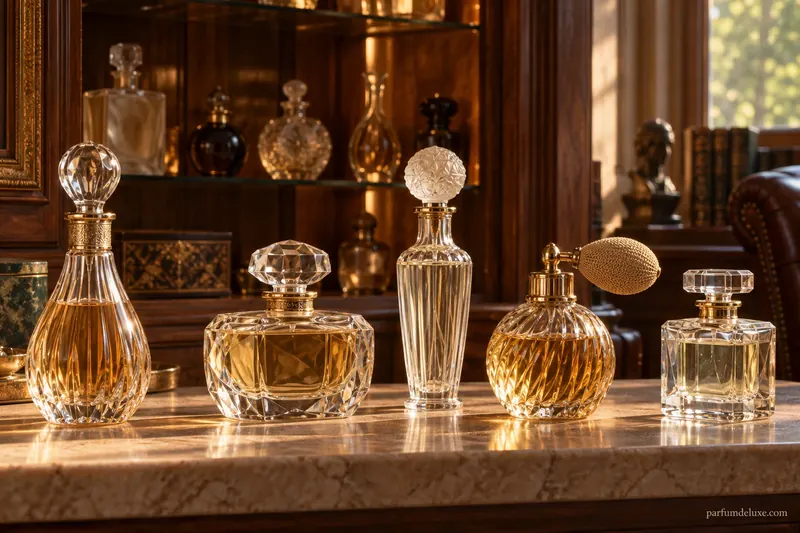
What makes an eau de parfum a luxury one?
Eau de parfum is the middle presentation of perfumery, sitting between the lighter eau de toilette and the denser extrait. Eau de parfum concentration is tied by reference sources to roughly 15 to 20% aromatic material in the bottle, which is above the range quoted for eau de toilette, 5 to 15%. DermNet NZ even calls it the most common type, which explains its central place in the ranges of major houses.
Calling an eau de parfum luxurious does not change that definition. The word points instead to the quality of materials, the care taken over the formula and the craft of the bottle, three things no percentage can summarise. A luxury eau de parfum is therefore judged as a composition, by its opening, heart and base, and not only as a level of dilution.
Eau de parfum concentration: what the name announces and what it leaves open
Wikipedia points out that the terminology of extrait, eau de parfum and eau de toilette is imprecise about exact oil content: one house’s eau de toilette can contain more aromatic material than another’s eau de parfum. No legal threshold fixes what each name guarantees. The label is a commercial marker, to be cross-checked against the rest of the sheet, including for the luxury eaux de parfum of the biggest houses.
Nor does it predict perceived power. The writer of the Bois de Jasmin blog advises disregarding the assurance that eau de parfum must last longer than eau de toilette, since duration depends on the formula, and she cites a case where both versions last about the same on her skin. The idea to keep fits in one sentence: the name classifies, it promises nothing, not even for a luxury eau de parfum.
Dior Sauvage: one name, two different stories
Dior allows an instructive comparison. The official sheet of Sauvage Eau de Parfum speaks of citrus and vanilla notes, with Calabrian bergamot at the top and vanilla absolute from Papua New Guinea in the base, patchouli also being mentioned. The house describes the whole as the olfactory interpretation of a moment tinted with deep blue, inspired by the desert at dusk.
The sheet of Sauvage Eau de Toilette instead announces citrus and peppery notes: Calabrian bergamot, Sichuan pepper, ambroxan, elemi resin and binding woods. The two bottles share a name, not an orientation. Moving from one to the other changes the vanilla, the pepper and the base as much as the strength. On this pair, choosing the eau de parfum means choosing a style, not merely a less diluted version.
Guerlain Aqua Allegoria Forte: a high-end eau de parfum built on intensity
Guerlain files its Aqua Allegoria Forte collection among its eaux de parfum and labels each one with high intensity. The house presents it as a collection of eaux de parfum capturing the intense beauty of nature. The variants named on the page announce their direction through their names: Florabloom, Mandarine Basilic, Rosa Rossa, Nerolia Vetiver, Bosca Vanilla and Rosa Palissandro.
Across luxury eaux de parfum, intensity wording varies. The page does not define the word Forte or list the notes, so it would be unwise to infer a percentage or a duration from it. What it shows is that a single collection can line up florals, aromatic citrus and vanilla woods, all under the eau de parfum banner. For a high-end eau de parfum like this, the useful question is the style you want, well before the intensity.
Acqua di Parma Yuzu: a citrus that does not need to be heavy
Yuzu Eau de Parfum, from Acqua di Parma’s Signatures of the Sun collection, proves that an eau de parfum is not necessarily heavy or sweet. The house calls it an effervescent, energising eau de parfum and presents yuzu as a rare and highly fragrant Eastern citrus. The notes listed at the top are yuzu, Calabrian bergamot and Sichuan pepper.
The heart combines lotus, mimosa, violet leaves and jasmine, over a base of musk, liquorice and sandalwood. The sheet gives neither a creation year nor any link to other Yuzu versions, and none should be invented. The example is enough to show the range of a category in which a luxury eau de parfum can be a bright citrus just as easily as an enveloping vanilla.
Choosing an eau de parfum by family, occasion and trial
When choosing an eau de parfum, start from the olfactory family you enjoy, whether citrus, floral, woody or ambery, rather than from the prestige of a name. Then comes the occasion: a brisk citrus suits daytime, a thick vanilla a cool evening. Finally the trial, on skin and over several hours, settles the matter. The product tested must be exactly the one you plan to buy.
When several versions share a name, the sheet specific to the eau de parfum is what counts. The label alone cannot compare two bottles: read the notes, watch the development and check that you are not mixing up a set, a travel size and the main bottle. That reading prevents buying a version you like less than the one tried in the shop.
Wear time and sillage of a luxury eau de parfum: keep expectations modest
A luxury eau de parfum is often expected to last long and be noticed. Reality depends on skin, temperature, the dominant material and the nose’s habituation, which stops registering a scent worn for hours. None of the houses cited here puts a number of hours on the pages consulted, which is a good reason not to promise one.
A trail that feels discreet to the wearer can remain clearly present for those nearby, and the reverse also happens. To judge without being misled, spray once and note the impression after one hour, after four hours and at the end of the day. That personal observation is worth more than a promise of staying power, which cannot be checked from one face to another.
Refills, sizes and storage of the bottle
Some houses now offer refills. The sheet for Sauvage Eau de Parfum says the 30 and 100 ml sizes are refillable, with reusable packaging and a mostly recyclable case. For anyone who wears an eau de parfum daily, this detail changes the purchase: the bottle stays, the refill renews the contents, and the comparison then rests on the formula more than on the object.
Whatever the size, store a bottle away from heat and light, cap closed, so the composition is not altered. A small size lets you test for a long time before committing to a large one. And as with any scented product, sensitive skin justifies reading the ingredient list and the declared allergens, then trying on a small area first.