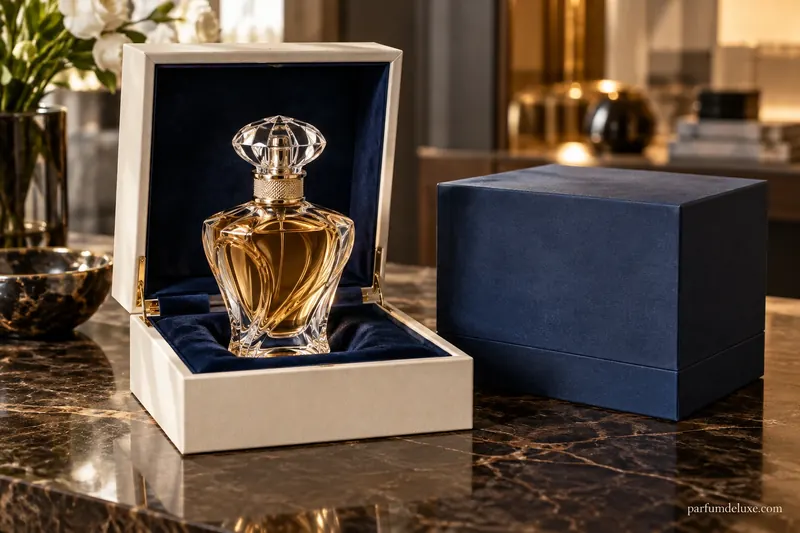
What “extrait” means on a luxury perfume bottle
In perfumery, extrait is the most concentrated form of a fragrance. It is also sold as parfum or as a pure perfume extract, and it carries a higher share of aromatic oils and less alcohol than an eau de parfum. A widely used reference gives a range of roughly 15 to 30 per cent aromatic compounds for extraits, with about 20 per cent often quoted as typical.
That range is a convention, not a law. The same reference stresses that the terms extrait, eau de parfum, eau de toilette and eau de cologne are imprecise about real concentration, so an eau de toilette from one house can hold more fragrance material than an eau de parfum from another. Treat the word as a positioning signal rather than a measurement.
What a luxury extrait de parfum usually adds is a sense of craft: smaller bottles, longer maceration, and a price well above lighter versions of the same scent. None of this is guaranteed, which is why the sections below look at what real houses publish.
Same label, very different percentages
Two product pages show how wide the gap can be inside the luxury extrait de parfum segment. Maison Crivelli states a concentration of 32 per cent for Hibiscus Mahajád, an extrait de parfum made in collaboration with Quentin Bisch. Amouage lists 53 per cent oil concentration for Interlude 53 Man, a 100 ml extrait aged for 24 weeks, 16 of them in maceration and 8 in maturation.
Both are called extrait, yet the figures are far apart. Neither number tells you which will suit you better, and a higher percentage does not automatically mean a bigger trail or longer wear. The nature of the materials, how they fix on skin and the structure of the accord matter just as much.
Many houses publish no figure at all. Dior’s product pages leave the intensity field empty, and Guerlain’s extrait page simply files each item under extrait de parfum. Without a number, you compare by reading what the house describes, such as maturation time, featured materials and bottle size, and then by testing.
Three houses, three ways of writing an extrait
Extraits do not form one uniform family. Guerlain’s dedicated page lists seven references: six extraits from the L’Art & La Matière series, each built around one raw material (Vanille Planifolia, Tonka Sarrapia, Iris Pallida, Rose Centifolia, Bergamote Fantastico and Jasmin Grandiflorum), plus Shalimar Extrait. The six are marked as exclusives and can be paired with a personalised bottle.
The single-material approach
A series that puts one ingredient at the centre reads almost like a lesson. You judge how a rose, an iris or a vanilla has been handled, not a complicated bouquet. For a newcomer, that is a way to find out whether you like the material before worrying about the strength.
An extrait as a variation on a famous signature
Shalimar dates from 1925 and Jacques Guerlain, who according to the LVMH account of its centenary added ethylvanillin to Jicky, created in 1889. Its extrait extends that story. At Dior, Sauvage Extrait, a pure perfume extract, is presented by the house as the first extrait for men in the line, created with Francis Kurkdjian and macerated for 42 days.
How a luxury perfume extract feels on skin
A luxury perfume extract tends to read differently from an eau de toilette. With less alcohol, many wearers describe a more enveloping, skin-close effect, though that depends on the composition: an extrait can be discreet and an eau de parfum can be loud. Reviewers often mention a slower development with a gentler step between opening and drydown, without it being a rule.
The base notes show how this works. According to its official page, Sauvage Extrait opens with bergamot and Provence lavender, moves to Vietnamese oud with leather facets, and rests on Indonesian patchouli, Madagascar vetiver and Virginia cedar. Amouage lists bergamot, oregano and pimento berry on top, amber, frankincense, cistus and opoponax in the heart, and leather, agarwood, patchouli and sandalwood underneath. Heavy, resinous materials like these suit high concentrations, though they are not exclusive to them.
Hibiscus Mahajád goes the other way, towards the fruity-floral and gourmand: Damask rose, vanilla, leather, spearmint, cassis, ambrette seeds and cinnamon, according to the Crivelli page. Three extraits, three worlds. The word describes the format of the product, not its style.
Extrait vs eau de parfum: what to compare
Asking whether a luxury extrait de parfum beats an eau de parfum often means asking the wrong question. A well-built eau de parfum can show more relief than a linear extrait, and the opposite is just as possible. To decide, compare the same scent in two strengths when a house offers both, using the same patch of skin at the same time of day.
Write down three things: what you smell in the first ten minutes, how the fragrance behaves through your usual activities, and what remains at the end of the day. If the gap between extrait vs eau de parfum is not obvious, the price difference may not be worth it for you. If it is, the formula simply suits you better, whatever percentage is printed.
Remember too that wear time depends on skin, climate and application. No extrait can promise a number of hours, and claims of that kind deserve some distance.
- Compare two strengths of the same scent, not two different perfumes.
- Apply to the same area, a few days apart.
- Wait for the drydown before deciding.
- Note comfort, not only intensity.
- Ask for a sample before buying a large bottle.
Testing a high-end extrait de parfum properly
A high-end extrait de parfum is applied sparingly. One or two touches on the wrist or the side of the neck are usually enough to read the composition. Rubbing wrists together flattens the top notes and muddies what you smell. Then let the scent evolve for several hours before you judge it.
Choose your setting with care. A well-ventilated place away from the crowded air of a shop gives a truer picture. If you try several references, limit yourself to two or three per session and reset your nose with fresh air rather than stacking blotters.
Many houses also sell discovery sizes. Hibiscus Mahajád, for example, is listed in 5 ml, 50 ml and 100 ml on the Crivelli page, so you can live with it for a few weeks before committing to the large bottle. Prices change, so check them with the retailer.
What the price of a luxury extrait de parfum covers
The price of a luxury extrait de parfum reflects raw materials, maturation time, bottle design, production volume and the house’s positioning all at once. When consulted, Guerlain listed 550 euros for its L’Art & La Matière extraits and 355 euros for Shalimar Extrait; Crivelli showed 350 euros for 100 ml and Amouage 550 US dollars for 100 ml. Treat these as reference points, not fixed prices.
A small, costly bottle is not proof of excellence either. Sauvage Extrait comes only in 50 ml on the Dior page, which is part of its positioning. What matters is the cost per millilitre weighed against how you will use it: a scent worn rarely and in small amounts suits a small format, while an everyday fragrance calls for a different calculation.
Some houses add refillable or personalised bottles. Guerlain mentions a bottle personalisation service for its L’Art & La Matière series. That is a pleasure of the object and leaves the liquid unchanged.
Safety points to know before wearing an extrait
A more concentrated fragrance holds more aromatic material, and so potentially more substances that can trigger a reaction in sensitive people. Allergy is possible at any strength: try a small area of skin before regular use, and read the ingredient list, where the word parfum or fragrance stands for the composition.
In Europe, Regulation 2023/1545 expands the list of fragrance allergens that must be declared individually on cosmetic packaging to more than 80. Products placed on the market after 31 July 2026 must comply, with legacy stock allowed until 31 July 2028. For anyone who knows their sensitivities, labels become easier to read.
On storage, a luxury extrait de parfum tolerates time better than a fragile composition, but heat, light and temperature swings damage it just the same. Keep the bottle in its box, out of the sun and away from a humid bathroom. None of this is medical advice: if a skin reaction worries you, ask a health professional.