What halal perfume means: a status about formula and production
Halal is an Arabic word meaning permitted. Applied to a fragrance, it says nothing about scent, family or mood. It describes a product whose ingredients, manufacturing process and equipment meet a rulebook judged compatible with Islamic rules. The halal perfume definition is therefore documentary first: it is checked against a formula, a supply chain and a production site, not against a bottle held in the hand.
In practice, the rulebook comes from a certification body or from a national standard, and those requirements do not line up exactly from one country to another. That is why the same question always comes back: halal according to which reference? Any halal perfume definition quoted without its source should be read with that in mind.
Halal and alcohol-free are two different claims
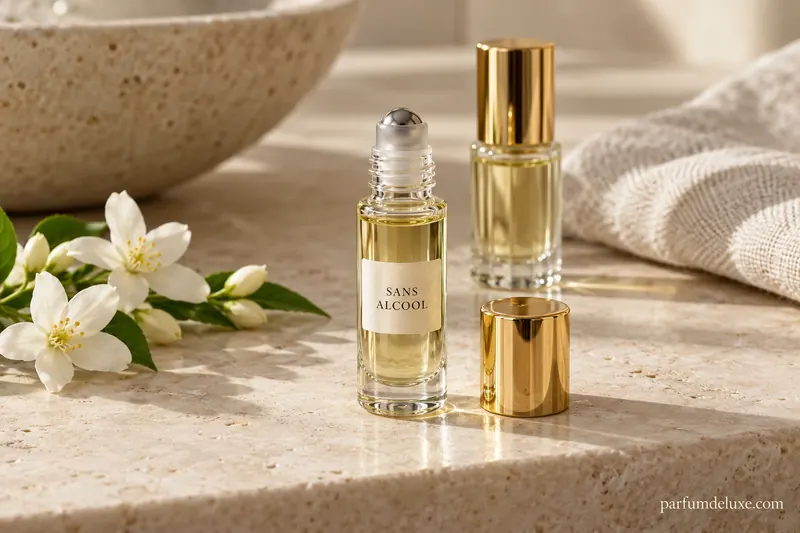
Anyone asking what is halal perfume meets this confusion first. Alcohol-free describes a formulation: the fragrance concentrate is diluted in oil, water or wax instead of ethanol. Halal describes a status. One does not guarantee the other, since an ethanol-free bottle can still contain an animal-derived material nobody has checked, while an alcoholic perfume is accepted by some authorities.
On ethanol for external use, opinions differ. According to the Halal Products Research Institute at Universiti Putra Malaysia, quoted by CosmeticsDesign, not all alcohol is khamr, and alcohol that does not come from an intoxicating source can be used in cosmetics. Singapore's MUIS has said Muslims may use perfumes that contain alcohol. Other scholars advise avoiding it as a precaution. Readers should follow the religious authority they trust.
The standards behind the halal fragrance definition
Two documents come up again and again. The first is the Malaysian standard MS 2634:2019, Halal Cosmetics, General Requirements, which JAKIM lists among the additional requirements applicants must meet. The second is OIC/SMIIC 4:2018, listed in the SMIIC catalogue under the same kind of title, Halal Cosmetics, General Requirements; SMIIC is the standards institute of the Organisation of Islamic Cooperation member states.
Both titles speak of cosmetics in general, so a halal perfume definition built on them cannot be assumed to settle every case, and the halal fragrance definition they support is only as precise as the certificate that applies them. The sources consulted do not say how each standard treats an alcoholic perfume or a perfume oil, so that question goes to the certifier issuing the document, not to the product page.
What certifiers actually check before issuing a certificate
The checklist published by the American Halal Foundation gives a concrete picture. Ingredients must not come from pork or from humans and need traceable documentation. Equipment is dedicated or cleaned through a validated procedure, with controls against cross-contamination. Suppliers provide halal certificates or halal suitability statements.
JAKIM stresses neighbouring points. When certified raw materials are not available, it expects safety data sheets, specifications, process flowcharts and a full ingredient breakdown. It also lists shared production between halal and non-halal lines as a common pitfall, especially for factories abroad.
Indonesia shows how a halal perfume definition becomes law
In some markets the definition turns into an obligation. According to an article from LPPOM published on 20 January 2026, cosmetics fall under mandatory halal certification in Indonesia, with a relaxation period running to October 2026. The agency BPJPH is preparing guidelines specific to cosmetics, built around a halal product assurance system: business commitment, control of raw materials, compliant production and ongoing evaluation.
The same source adds that a product name must not conflict with Islamic values or custom. It does not mention perfumes, so no perfume-specific rule should be read into it before the final guidelines are consulted.
Certified halal luxury perfume: what luxury adds and what it does not
In luxury perfumery, quality is judged on materials, concentration of aromatic oils, the care put into the bottle and the house behind it. None of those criteria says anything about halal status. A certified halal luxury perfume combines two separate efforts: a standard of craft the house claims, and a conformity that only a document can establish.
For a house, that means mastering its supply chain: the fragrance bought from a compounder, the precious natural materials, the solvent, the bottle and its cap. The more complex the formula, the longer the list of suppliers to document. The price or rarity of a raw material never replaces a supporting paper, and a halal perfume definition applied to luxury still ends with documents.
Third-party certified or self-declared: two levels of proof
A brand can write that every fragrance respects halal principles without naming any certifier. That is what the retailer Riwaya says on its collection of alcohol-free perfumes, where no logo or certifying body appears for the fragrances concerned. The claim engages the brand; it is not third-party certification.
Certification, by contrast, rests on an audit; the halal fragrance definition a certifier applies is then tied to a named site and a named list of products. The American Halal Foundation says its certificate typically lasts one to three years and gives the right to use its logo on products, packaging and marketing materials, while annual surveillance audits are also required, so the dates printed on a certificate deserve a careful read. The British fragrance maker Seven Scent had its entire portfolio certified by The Halal Trust, with an audit covering cleaning and manufacturing systems, laboratory testing of randomly chosen fragrances and checks on the suppliers of every raw material, renewed each year. The gap in proof is plain: on one side a sentence, on the other an inspection.
Reading the halal perfume meaning on a label before you buy
A few wording habits help answer the question what is halal perfume when two labels say different things. Certified by points to a third party, complies with halal principles points to the brand, and alcohol-free points to the formula. Each statement answers a different question about the halal perfume meaning on offer.
The halal perfume definition that applies can depend on the country of sale, the exact reference and the date. If a religious doubt remains after reading the documents, the authority you follow decides, not the seller. For skin, patch testing on a small area before regular use is the usual precaution with any scented product.
- Who issued the attestation, and against which standard?
- Is the exact reference you are buying named on it?
- Is it dated, with a readable validity period?
- Does it cover the formula, the factory, or only the brand?
- Are materials of possible animal origin documented?