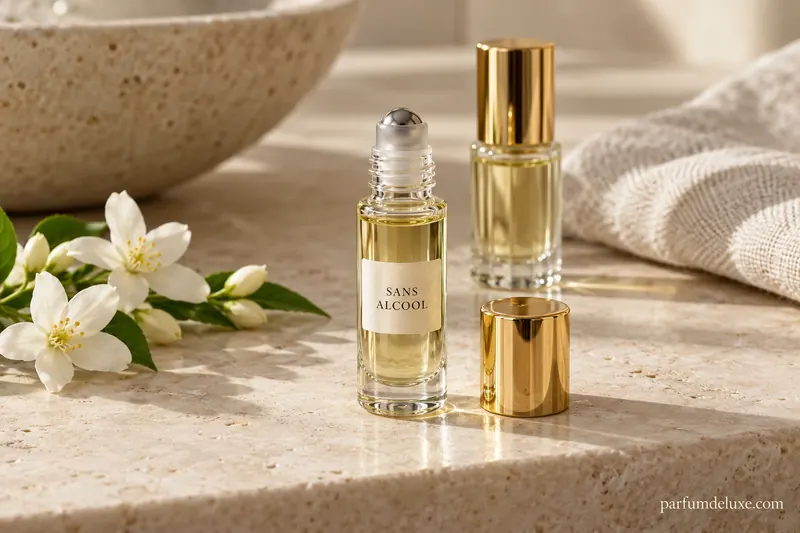
Halal perfume without alcohol: a formula, not a status
Calling a perfume alcohol-free describes its carrier: the fragrance concentrate is diluted in oil, water or wax rather than ethanol. Calling it halal asserts a status that also covers animal-derived materials, equipment and suppliers. A halal perfume without alcohol therefore has to answer two questions, and answer them separately.
Luxury does not change that logic: a halal perfume without alcohol from a prestigious house is read on the same evidence as a simple oil. A house working with precious materials, a high concentration and a carefully made bottle can offer an ethanol-free oil without saying anything about whether the composition was audited by a third party. Reputation is not an attestation.
Why the word alcohol on a label settles less than expected
In an ingredient list, alcohol covers several realities. According to the Swiss Arabian FAQ, its eaux de parfum use a denatured alcohol from natural sources such as sugar cane, while its perfume oils contain no alcohol derived from dates, grapes, wheat or raisins. The same page notes that the word alcohol on packaging can refer to benzyl alcohol or amyl cinnamyl alcohol, aromatic compounds unrelated to ethanol.
The reverse also holds: a bottle described as alcohol-free is not automatically free of every questionable material. The American Halal Foundation checklist rules out ethanol derived from khamr, but it also deals with animal-derived ingredients, which must come from halal-slaughtered sources, and with cross-contamination on production lines.
Reading an ingredient list when the claim is no alcohol
Ethanol-based perfumes usually show a denatured ethyl alcohol near the top of the INCI list, often written as Alcohol Denat. An oil or wax product starts instead with a carrier such as a plant oil, a wax or water. Spotting the first lines tells you more about the carrier than any front-label slogan, and it is the quickest way to check that a halal perfume without alcohol is what the box says. Compare the order of ingredients with the description, note any alcohol other than ethanol, and keep a photo of the box and batch code so that a later question to the maker refers to the exact version you bought.
Two cautions apply. First, the word fragrance usually hides the individual aromatic materials, so the list cannot tell you whether a musk or an amber is natural or synthetic. Second, a short list is not proof of purity. That is why a halal fragrance without alcohol is best checked through a manufacturer statement, and why the certifier's own checklist asks suppliers for halal certificates or halal suitability statements for each material.
Ethanol for external use: what the authorities quoted say
The debate has no single answer. According to the Halal Products Research Institute at Universiti Putra Malaysia, quoted by CosmeticsDesign, not all alcohol is khamr, and alcohol that does not come from an intoxicating source can be used in cosmetics. Singapore's MUIS has said Muslims may use perfumes containing alcohol, noting that most contemporary scholars do not treat industrially produced alcohol from a chemical process as impure.
From the Hanafi fatwa tradition, Shaykh Faraz Rabbani on SeekersGuidance allows external use of alcohol that is not wine, while describing it as more precautionary to avoid it because of scholarly disagreement. That disagreement is why many people look for alcohol-free perfume for Muslims in oil or water-based form: it lets them step outside the debate, and it explains why a halal perfume without alcohol sells as a category of its own. Each reader remains free to follow the authority they consider most competent.
Alcohol-free halal luxury perfume: oil, water or wax as the carrier
The usual formats of an alcohol-free perfume for Muslims differ by carrier. Perfume oil, of which the attar is the traditional form, is applied to pulse points and stays closer to the skin. A water base gives a spray without ethanol. Wax or balm makes a solid perfume taken up with a fingertip.
In the oil category, Ajmal writes on its blog that most attars and perfume oils are crafted without alcohol; the word most is a reminder to check reference by reference. The retailer Riwaya says of its collection for Muslim shoppers that its scents deliver richness and longevity without a drop of alcohol and respect halal principles, though the page names no certifying body.
What no ethanol changes on skin and in the sillage
Without ethanol, a perfume does not evaporate the same way, and a no alcohol halal perfume in oil form behaves differently from a spray. An oil spreads slowly, leaves a more intimate trail and depends on the amount applied. These are effects of formulation that most wearers describe in similar terms, not a rule: wear time varies with skin, materials and dose.
Trying a halal perfume without alcohol on your own skin before buying a large format is sensible. A small sample is enough to judge texture, diffusion and how it sits with your skin chemistry, and a patch test on a small area helps spot irritation; for a skin concern, a health professional is the right person to ask.
Does an alcohol-free halal luxury perfume need a certificate?
If the aim is conformity and not only preference, yes: a brand sentence is not a document. Malaysia's JAKIM says it prefers ingredients of non-animal and non-alcohol origin to protect halal integrity, and it asks for specific documents when materials are not certified: safety data sheets, specifications, process flowcharts.
For a no alcohol halal perfume, or any alcohol-free halal luxury perfume, whether oil, paste or water-based spray, ask the house for a certificate naming the body, the exact reference and a validity period. Without it, treat the wording as a declaration by the brand: useful, but unverified.
Questions to ask before buying a halal fragrance without alcohol
The list below turns an impression into a check, whether the product is an alcohol-free halal luxury perfume from a large house or an oil from a family perfumer. Each item targets a different angle: carrier, ingredients, proof, animal materials and consistency of the formula. If the seller cannot answer, the question can be passed on to the manufacturer.
- Is the carrier an oil, water or wax, and which one?
- Which alcohols appear in the ingredient list, and of what origin?
- Does a certificate exist for this exact reference?
- Are animal materials replaced or documented?
- Is the formula the same in every country of sale?