What a halal attar is, and what the word attar promises
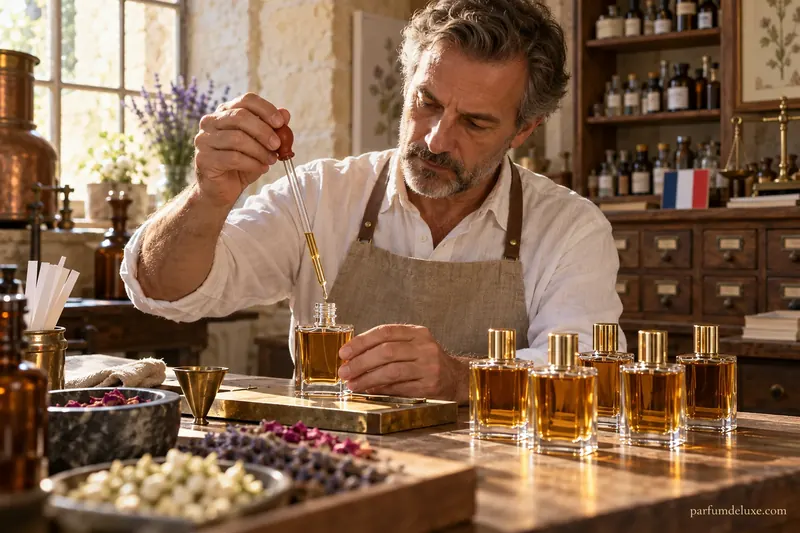
Attar is an oil-based, alcohol-free fragrance made by distilling aromatic flowers, herbs or spices. That is how a recent story from the Australian National University frames it, quoting Datt, founder of the Sydney company Guna, who says attar is not a product but a process. The same article warns that many bottles sold as attar are synthetic approximations or ordinary commercial perfumes.
Calling an attar halal puts a second question on top of the first. Halal is a status, not a texture. A halal attar needs someone to say that the oil, its base and its making conform to a stated standard, and the reader needs to see who says so. Without that, an oil is simply alcohol-free, which is a useful fact but a different one.
How traditional attars are made: deg-bhapka, wood bases and long rest
According to the university feature, the purest attars are distilled with the deg-bhapka method, which relies on specific traditional equipment. The aromatic raw materials are typically distilled onto a wood base, with sandalwood given as an example, and attars can be aged for up to ten years. Kannauj in India is described as the country's attar capital, and the article notes that the artisans behind it are often invisible.
For a traditional attar sold at a luxury level, these details are a useful checklist. A serious maker can say where the distillation took place, what the base is and how long the oil rested. The article also stresses that artisanal output is hand-made, varied and slow, which explains why a refined attar rarely resembles a mass-market product. None of this proves halal status; it documents craft.
Alcohol-free attar versus halal attar
The absence of alcohol is the first thing most buyers notice. Ajmal, a perfume house, states in its FAQ that attar is a concentrated perfume oil made without alcohol and applied directly to the skin. Its Jannatul Firdaus attar, a 10 ml bottle, carries the words non-alcoholic in its title, with green herbal top notes, a floral and lightly spiced heart and a base of earthy woods and soft musk. The page makes no halal certification claim.
On external ethanol, scholarly opinion is not uniform. Singapore's religious council, MUIS, says many scholars accept an alcohol-containing perfume that is not at intoxicating levels and not intended for consumption, while noting that others hold reservations. Readers should follow their own religious authority. What matters for this topic is that an alcohol-free attar answers one question by its recipe, and halal answers another by its status.
Musk, civet and other animal materials in a halal-certified attar
Old attar recipes used animal secretions for musk and civet effects. A question put to Mufti Ebrahim Salejee of Isipingo Beach, published on Muftionline, shows how the issue appears in trade: a seller of non-alcoholic attars from an Indian supplier asked about synthetic animal derivatives such as civet oil, supplied with a halal declaration but no certificate. The mufti reasoned that a synthetic material cannot come from an animal and so the sale was permissible.
The caveat sits in the premise. The answer does not check that the material really is synthetic, and it does not address the missing certificate. A halal-certified attar is meant to close that gap: the maker should state the origin of every sensitive note, musk, civet, ambergris or castoreum, and back it with documents. A dedicated standard, OIC/SMIIC 37:2022 on animal bone, skin and hair in halal products, shows the subject is treated in standardisation too.
Halal attars at luxury level: what the word luxury can mean
For halal attars described as luxury, the term is best tested against concrete points: the quality and rarity of materials such as oud, rose, sandalwood, saffron or amber, the time spent maturing, the concentration of fragrance, the craft of the bottle and consistency between batches. Ajmal lists, among its attar gift selections, Magnificent Oudh built on oud, warm amber and woody nuances, and several musk attars such as Ruby Musk and Misk Al Emirate.
A heavy gift box is not information. A bottle with a vague ingredient list raises more questions than a plain bottle with a complete data sheet. Three ideas should stay apart: the artisan value of the attar, its lack of alcohol and its halal status. A house may deliver the first two without the third, and an honest reading notes that instead of inferring it.
Reading an attar listing: notes, base and halal wording
A useful listing gives the olfactory family, top, heart and base notes, the bottle size, the nature of the base and an ingredient list. The Ajmal page reviewed gives notes but no ingredient list and no halal wording. That is neither a hidden flaw nor proof of the opposite; it is missing information that a buyer can request from the house.
Three levels of claim are worth telling apart. A description such as alcohol-free oil is a statement about formulation. A manufacturer's declaration of halal conformity is a commitment by the maker. A certificate is a third-party document naming the product, the site and a validity period. The most reassuring halal attar is one where all three agree.
Halal certified attar: the file a certifier asks for
The American Halal Foundation describes a seven-stage route for cosmetics: application and agreement, technical review with an ingredient spreadsheet, a halal manual, audit preparation, an on-site audit, a certificate valid for one to three years, then renewal. Documents requested include full ingredient lists, certificates of analysis, supplier halal certificates and label mock-ups.
For fragrances, the same body says they must be verified halal or synthetic and free from animal or musk derivatives and ethanol-based solvents. It adds that cross-contamination, even in trace amounts, can make a product non-compliant. So a halal certified attar depends on the production site as much as on the formula, which is why a buyer should ask for the certifier's name and the exact product reference covered.
Wearing a halal luxury attar: dose, fabrics and skin
An attar goes on in tiny amounts at warm points such as wrists or neck, since the oil is concentrated. Some oils can mark fabric, so let the skin dry before dressing. Anyone prone to allergies may test a small area first and read the allergens on the packaging; this is general caution, not medical advice.
A traditional attar keeps best closed, away from heat and light. When choosing between bottles, a simple routine works: write down for each the maker, the stated base, any halal wording, the certifier's name and the batch number, and compare those facts rather than the claims printed on the box.