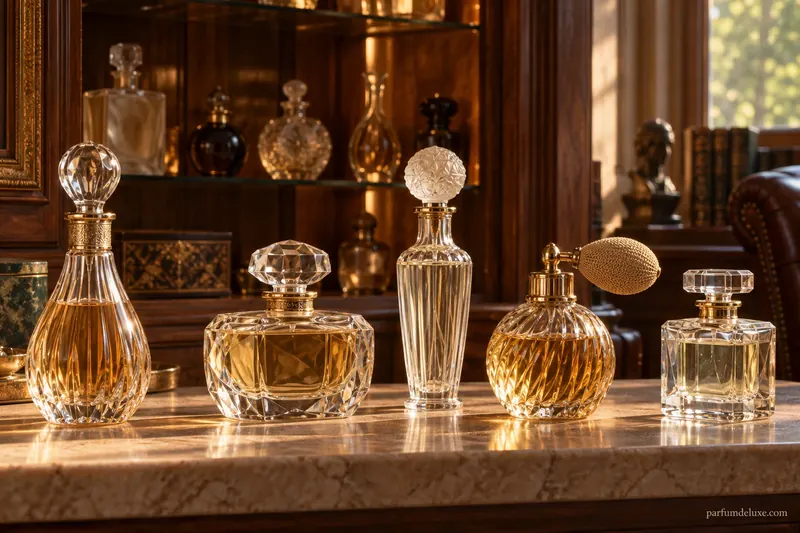
Why a halal saffron perfume is read differently from a saffron spice jar
Saffron is the dried stigma of Crocus sativus, so the spice is plant material. A perfume is another matter: depending on how its saffron note is built, the halal question concerns a solvent, a carrier or an isolated component more than the crocus.
No religious ruling is given here. Certifiers, a standards institute and a scholar are quoted for what they publish, their positions may differ, notably on alcohol, and readers are free to consult their own religious authority.
Harvest, monda and toasting: what the La Mancha rules describe
The specification of the Azafrán de La Mancha protected designation of origin is unusually precise. Flowers are picked daily over roughly thirty days in October and November. The stigmas are separated, a step called monda, on the day of picking and within twelve hours, without washing the flowers, then toasted over gentle heat for 20 to 45 minutes. The zone covers about 1,500 hectares, with a maximum yield of 15 kg of toasted stigmas per hectare.
The Quintessence site adds that 150,000 to 200,000 flowers are needed for a kilo and that Iran leads production ahead of Spain and India. Such figures explain the cost of natural saffron and the scarcity of natural extracts. They do not say whether a given halal saffron perfume meets a halal reference, since that depends on the blend and on the documents behind it. A saffron attar halal buyer meets the same limit: rare spice, same open questions on carrier and companions.
What ISO 3632 covers, and what it does not
ISO 3632-1:2025, third edition, published in July 2025, sets requirements for dried saffron made from the pistils of Crocus sativus, sold as whole filaments, cut filaments or powder, with an annex on storage and transport. The ISO page does not list the quality parameters, which sit behind the purchase of the standard.
For a halal saffron perfume, the standard speaks for the spice, not for the bottle, and a saffron attar halal label does not turn a quality grade into a religious status. The La Mancha document sets its own thresholds: colouring strength above 200 at 440 nm, aroma above 20 at 330 nm, bitterness above 70 at 257 nm, and safranal above 65 percent of volatile components. These are culinary quality markers and say nothing about a fragrance's status.
Natural extract or safranal: where a halal saffron fragrance comes from
Quintessence describes the perfumery note as leathery, honeyed and slightly smoky, usually a heart note. It says perfumers rely on synthetic materials, safranal and safreine, developed in laboratories such as Givaudan. A reseller listing for Givaudan's safranal, published by The Fragrance Foundry, which states it is not affiliated with Givaudan, gives an IFRA limit of 0.0130 percent in category 4 under the 51st Amendment and calls it very restricted. That figure should be checked against IFRA itself.
For a halal saffron fragrance, the natural versus synthetic distinction therefore matters. The American Halal Foundation writes that fragrances must be verified halal or synthetic. A South African Hanafi mufti, asked about synthetic civet, answered that a synthetic substance cannot come from an animal. Both statements concern specific cases, and other authorities may be stricter or looser. In practice, a halal saffron perfume built on a synthetic saffron note can answer one question, the animal origin of the main note, while leaving open the carrier, the musk and the solvents used elsewhere in the blend.
Saffron perfume oil and the alcohol-free claim
Saffron perfume oil, often sold as an attar, is the format most associated with an alcohol-free claim. An alcohol-free saffron perfume describes a formula. It does not show that the musk, the fixative or the extraction solvent would pass a given halal reference, and certifiers themselves differ on external-use ethyl alcohol.
A saffron perfume oil is dabbed in small amounts on pulse points and warms with the skin, and a 10 to 20 ml bottle travels easily. Wearers of saffron perfume oil can layer it under a lighter spray from the same house, which also lets them compare the two formats side by side. A spray spreads wider and calls for a lighter hand. A trial on a small patch of skin is a simple precaution, and not medical advice.
Reading Rasasi's Hamasaat Azafron Legacy
Rasasi's official store lists Hamasaat Azafron Legacy as a 100 ml unisex eau de parfum, an oriental led by saffron. Saffron opens; tobacco, patchouli and labdanum form the heart; amber and vanilla sit in the base. The house suggests it for autumn and winter and for formal gatherings, Ramadan, Eid and weddings.
The page carries no mention of alcohol or halal and no full ingredient list. The description is precise about scent and silent about status. No safranal level, no carrier and no certifier are named. Neither an alcohol-free saffron perfume nor a halal one can be inferred from it.
Supplier declarations and solvents behind a halal saffron fragrance
Merck Millipore notes in a technical article that cosmetic makers should obtain supplier statements covering raw materials, solvents, enzymes and cleaning agents, and that some consumers prefer alcohol-free perfume because fragrance can be inhaled. It lists JAKIM, MUI and the UAE Halal Certification Scheme as recognised certifiers.
Applied to a halal saffron fragrance, the checklist is short, and it can be sent to a house by email before ordering. Was the saffron extract obtained with a solvent, and which? Is the safranal natural or synthetic? Is there musk, and of what origin? A serious house answers in writing with a third-party certificate, a manufacturer's declaration, a technical sheet and a batch number.
Wearing a luxury saffron: occasion, season and restraint
A luxury saffron is judged on stated concentration, the quality of materials, the bottle's finish and the house, not on a price tag. Warm and spiced, it suits cooler seasons, and Rasasi's listing ties it to celebrations. A halal saffron perfume for a wedding or for Eid is chosen the same way as any other: by trying it on skin, by asking for the documents, and by keeping a restrained hand with the dose, since saffron notes are strong and the room should not be filled before the guests have arrived.
Halal status depends neither on gender nor on occasion: only the product's file counts. When a house cannot supply its documents, abstaining is wiser than assuming.