Which resin sits inside a halal frankincense perfume?
In perfumery, frankincense means olibanum, the gum resin of several trees of the genus Boswellia, family Burseraceae. Ingredient makers mostly name two species. According to the Environment Society of Oman, Boswellia sacra is native to Oman, Yemen and northern Somalia. Biolandes says its Boswellia carterii gum is gathered in dedicated zones of northern Somalia and that it also handles wild sacra gum collected in Salalah, southern Oman.
This resin differs from the incense burned as grains or bakhoor. In a bottle it arrives as an extract, a material worked by a manufacturer. For a halal frankincense perfume the inquiry therefore concerns the tree, the supply chain, the process and the liquid that carries the extract, not the smoke from a burner.
Oman's Land of Frankincense and the trees of Wadi Dawkah
UNESCO lists the Land of Frankincense as a World Heritage property made up of 4 separate locations: the frankincense trees of Wadi Dawkah, the caravan oasis of Shisr/Wubar about 170 kilometres inland, and the ports of Khor Rori and Al-Baleed. Its entry says Boswellia sacra still grows there, that resin is still harvested, and that the trade was among the most important of the ancient and medieval world.
The newspaper Oman Observer reports that Wadi Dawkah has been a UNESCO site since 2000. It ranks Omani grades, placing Hojari, light and greenish, first and the most sought after worldwide, ahead of Najdi, Shathari and Shaabi. It also describes tree-by-tree geotagging, protective fencing and supplementary irrigation. That is what a controlled origin can concretely mean for a luxury halal frankincense perfume: a place, a grade, a monitoring system. For an Omani frankincense halal claim, such detail separates a stated origin from a documented one.
A fragile tree: origin has an ecological side too
The Environment Society of Oman states that the IUCN Red List classes Boswellia sacra as Near Threatened. It lists overgrazing, over-harvesting of resin, insect attacks, mining and wind and flood damage among the pressures, and its Frankincense Programme, begun in 2010, studies tree health, distribution, flowering and sustainable harvesting.
The Oman Observer adds that over-tapping during the 1970s aromatherapy boom damaged the ecosystem, that Oman is moving towards designated tapping zones and trained harvesters, and that only a few thousand wild trees are estimated to remain, an estimate to treat as such.
This question is separate from halal status. A resin can be well documented ecologically while nothing is known about its extract or carrier, and the reverse is equally possible. The two files are requested separately. Anyone seeking an Omani frankincense halal product should also check that the extract named matches Omani resin and not Somali gum.
Resinoid, absolute, essential oil: how frankincense is extracted
One resin yields materials of different character. A dsm-firmenich sheet for an olibanum resinoid describes a primary extraction with a volatile solvent that gives the resinoid, then a purification step that gives the absolute; compared with the essential oil, the resinoid is warmer, more resinous and more balsamic. Biolandes adds that the resinoid is the extract whose smell stays closest to the raw gum.
For steam-distilled oil, the fragrance database Parfumo describes a fresher, terpenic, citrus-leaning profile, while resinous extracts are balsamic, warm and resinous. The same site lists an Omani frankincense CO2 note, classed as balsamic, resinous and smoky and, according to Parfumo, often found in the heart of a perfume.
A halal frankincense perfume might therefore contain an oil, a resinoid, an absolute or a CO2 extract, each tied to different processes and processing aids. A halal olibanum perfume is judged on the same basis, whatever name the house gives the resin.
Frankincense resin halal: solvents, diluents and catalogue codes
Catalogues carry abbreviations that puzzle buyers. The dsm-firmenich olibanum resinoid is named 50 DIPG and the Biolandes one 50%/TEC. Neither page defines the codes, so their meaning has to come from the supplier. For frankincense resin halal enquiries, the sound approach is to ask exactly what the delivered material contains and what was used to dissolve it. Sold as a halal olibanum perfume or a halal frankincense perfume, it is still judged on its full formula.
Ingredient certificates are not always visible either. Biolandes shows its certification field as unavailable for its olibanum sheets and says allergen, IFRA, purity and origin certificates sit behind a customer login. None of this indicates a status; it only shows where to look.
The reference standards for cosmetics remain OIC/SMIIC 4:2018 from the Standards and Metrology Institute for Islamic Countries and Malaysia's MS 2634:2019. They should be read directly, because supplier sheets do not detail how they apply to each solvent.
Halal oriental perfume: olibanum inside an ambery accord
Biolandes writes that olibanum is very often used in oriental and chypre accords, where it brings a mineral, mystical quality with woody and spicy touches. In a halal oriental perfume it often sits beside other resins, woods and ambers. Each companion has its own origin, and it is the complete formula that goes before a certifier. A documented olibanum says nothing about the rest of the composition.
On ethanol in the finished product, scholarly sources differ. The Al-Azhar House of Fatwa considers perfumes containing alcohol permissible to use, while Darul Uloom Azaadville in South Africa, following the Hanafi school, advises as a precaution avoiding alcohol-based perfumes and choosing alcohol-free ones. Each reader consults their own religious authority, and the words alcohol-free describe a formulation, not a halal status. For a halal frankincense perfume, that link between resin and batch matters more than a prestigious place name.
Luxury and frankincense: resin grade, harvest and finish
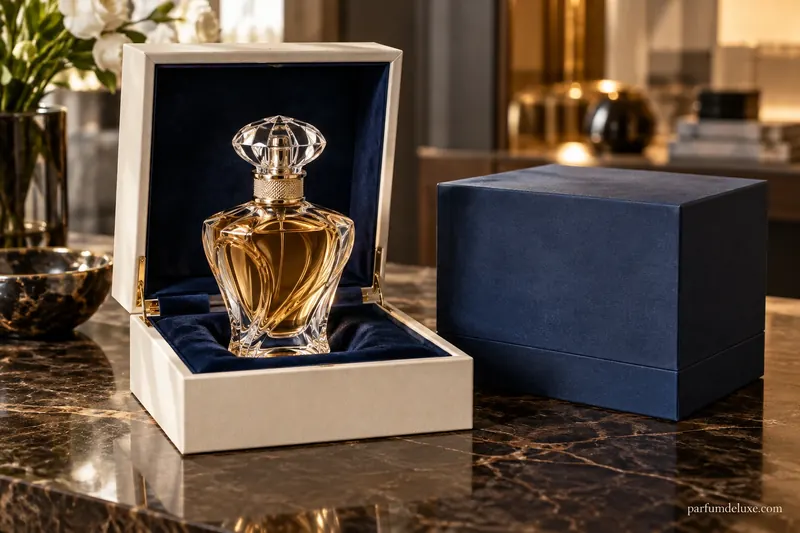
High-end quality is first read in the material. A house can name the tree, the region, the grade of resin, such as Omani Hojari, and the way the extract is prepared. It can also invest in the composition, the concentration, the bottle and the case, none of which proves halal status or contradicts it.
Prices vary by house and should be checked with the retailer. What marks serious work is the ability to answer supply-chain questions plainly, in writing, and to tie the frankincense in the formula to a specific batch.
Questions to ask before buying a halal frankincense perfume
These plain questions bring the discussion back to facts and can be sent by email to the house or retailer:
- Which Boswellia species, and which country or region of harvest?
- Which extract: essential oil, resinoid, absolute or CO2?
- Which solvents and diluents are in the material delivered?
- What carries the fragrance: alcohol, oil, water-based support?
- Which third-party body certifies the finished product, valid until when?
Skin precautions with a concentrated resin
Resin extracts are highly concentrated materials and can bother sensitive skin. A test on a small area and a read of the allergens on the label are reasonable precautions; when in doubt, a health professional is the right person to consult.