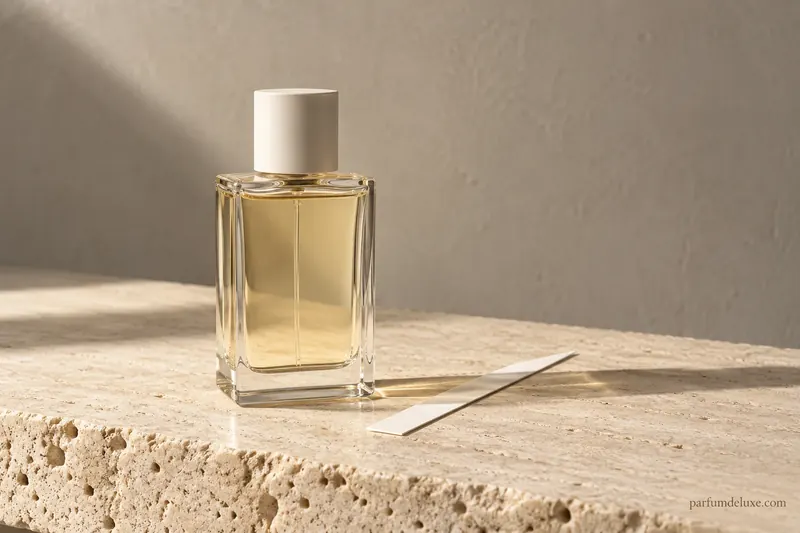
Why a perfume that smells clean is a feeling, not a fragrance family
Perfumery sorts its creations into citrus, floral, woody, amber and similar groups. None is called clean. When a shopper asks for a perfume that smells clean, they are describing an impression: laundry just out of the dryer, a bathroom with the window open, skin washed in warm water. Several very different recipes can produce that impression, and two bottles that evoke it may share almost no ingredients.
Memory complicates things further. To one person clean means the soap their grandmother used; to another, faint cotton after a shower; to a third, a cold wind off the sea. Before buying anything, decide which scene you want to relive, because the answer steers the whole search. A good adviser will ask you to describe a place or a moment, because a perfume that smells clean for you may read as plain or sterile to your neighbour.
Clean laundry perfume, soapy perfume and skin scents compared
A clean laundry perfume is the most requested effect. It tends to feel bright, smooth and airy, sometimes with a trace of powder. A soapy perfume is rounder and creamier, closer to lather and hot water. The skin version is the most intimate: a quiet musk that seems to come from the body rather than from a bottle.
These three paths do not overlap neatly. Lumping all musks or all fresh scents under one label makes you miss the nuance that matters. A laundry effect can be strong and flattering in a heated room, while a bare-skin effect asks people to lean in before they notice it. Whichever you prefer, test the fragrance in the weather and room where you will wear it, since a soapy perfume that feels cosy in autumn can turn heavy on a hot afternoon.
A fresh linen perfume in practice: Replica Lazy Sunday Morning
Maison Margiela describes its Replica Lazy Sunday Morning eau de toilette as the soft sensation of fresh linen sheets on a sunny morning. The notes on the official page are a pear accord, a lily of the valley accord and aldehydes at the top; an iris accord, rose absolute and an orange flower accord in the middle; and Indonesian patchouli oil, ambrette seeds absolute and white musks at the base.
It shows how a fresh linen perfume in the luxury bracket leans on several specific elements rather than a single note. The aldehydes supply sparkle, iris and orange flower add a powdery softness, and the white musks stretch the cotton-like impression across the skin. That is the house's own description; what you smell will depend on your nose. A perfume that smells clean should also stay pleasant after several hours, once the aldehydes have faded, so compare it with another fresh linen perfume in a similar bracket to judge what the base really adds.
Luxury perfume with a clean scent: transparency rather than detergent
Not every pale fragrance copies laundry. Byredo presents its Blanche eau de parfum as pure and simple in structure but extreme in character, built on founder Ben Gorham's perception of the colour white and almost transparent in nature. The listed notes are white rose, pink pepper and aldehyde at the top, violet, neroli and peony in the heart, and blonde woods, sandalwood and musk in the base. The retailer's page never uses the words clean or linen; readers make that connection, or they do not.
The distinction is useful. A luxury perfume with a clean scent may pursue luminous whiteness instead of washed fabric, and that changes how it is worn: more abstract, less domestic, often easier to carry in a professional setting. Seen this way, a luxury perfume with a clean scent is as much about restraint as about brightness: fewer obvious notes, more space around them.
Sea air and mineral freshness as another way to smell clean
Another route lets the outdoors in. With Wood Sage & Sea Salt, Jo Malone London invites you to breathe the invigorating air of the British coast; the cologne's page speaks of a windswept shoreline, sea salt and mineral cliffs, and lists ambrette seeds, sea salt and sage among its notes. The cleanliness here belongs to a headland, not a washing machine.
This register appeals to anyone who finds soapy effects too household. It suits bright days well but can feel austere in deep winter. Set it beside a laundry effect before deciding which one matches your idea of clean. Notice how the mineral side behaves on skin after an hour, because sea-air fragrances sometimes warm up into something closer to a clean laundry perfume than their opening suggests.
Clean does not mean allergen-free: reading the ingredient list
A reassuring image guarantees neither lightness nor the absence of ingredients that bother some skins. A laundry accord can be discreet or very diffusive, and it often relies on aroma materials that appear on allergen lists. In Europe, a 2023 regulation widened that list from 26 to more than 80 substances, applying from 31 July 2026 depending on the product, and substances above 0.001% in a leave-on product must appear in the ingredient list.
In practice, read the ingredient list on the packaging of the exact bottle you plan to buy, try it on a small patch of skin and follow the maker's precautions. IFRA, the international fragrance association, publishes a library of standards governing the use of ingredients. If a reaction occurs, stop using it and ask a health professional; these pointers are informational and not medical advice. A shop assistant can help you find the full list on a box or leaflet, and brand customer services can answer questions about a specific formula.
Wearing a perfume that smells clean with good judgement
A perfume that smells clean reassures and slips easily into daily life: office, commute, warm living rooms. Precisely because it seems modest, its projection can surprise you, so spray lightly at first, especially when the formula leans heavily on white musks. If you wear it to work, remember that a perfume that smells clean still travels across a room, and a neighbour in a small meeting space may find even a modest cloud too present.
Do not confuse it with scented laundry detergent or a fabric mist either. Those products have a different purpose, are designed for textiles and do not go on skin. The goal is not to smell like a cleaning product but to wear a luxury perfume whose sense of freshness feels like you.
- Name the scene you want: linen, soap, skin or sea.
- Compare two effects at a time, never five.
- Spray lightly on the first wearing.
- Read the ingredient list of the bottle you will actually buy.
- Return to the base after a few hours.