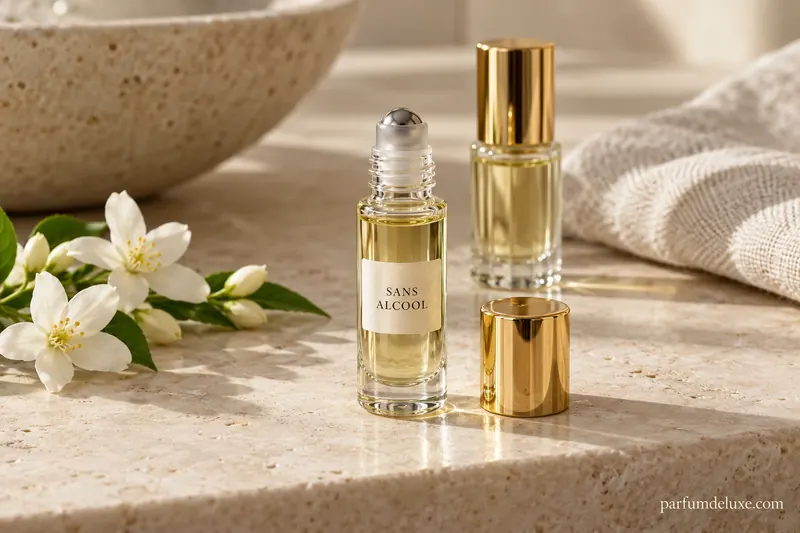
Perfume oil versus spray: a different way to wear scent
Spraying a perfume and placing an oil do not tell the same story. A sprayer disperses liquid in fine droplets; an oil is set on a precise spot of skin, by fingertip or applicator. A perfume oil often appeals to people who want an intimate presence that is noticed mostly at close range.
The format is not a single category. It covers concentrated perfume oils, traditional preparations and contemporary creations from niche houses. The container alone never predicts the sensation: only the composition, read on the product sheet, tells you what you are really buying.
The perfume oil versus spray question is therefore less about strength than about behaviour. A spray lifts scent into the air around you; an oil stays where you put it and warms with the skin. Neither is superior, and many collectors own both, reaching for the oil on quiet days and the spray when they want to be noticed from across a room.
What Amouage’s sheet says: 100 percent perfume oil
Amouage presents its attar collection as the house’s expression of an ancient and highly revered form of perfumery, with the wording 100% perfume oil. The bottles are 12 ml, and the range includes Oud Ulya, Rose Aqor, Vanilla Barka, Santal Sohar, Leather Sadah and Luban Al Akhdar.
The collection filters sort the oils into woody, floral, amber, leather and spicy families, with six references tagged as universal. The sheet read here, however, describes neither the manufacturing process, nor the ingredient list, nor the application method. Those details belong on the packaging or with the house. As a point of reference, the 100% claim should not be confused with the 53 percent oil concentration the same house states for its Interlude 53 Man extrait, which is a different kind of product.
Nasomatto’s oils: three 4 ml bottles to compose
Nasomatto offers a custom set of three 4 ml perfume oils, chosen among twelve creations: Absinth, Baraonda, Black Afgano, Blamage, Duro, Fantomas, Micodelirio, Narcotic V, Nudiflorum, Pardon, Sadonaso and Silver Musk. The sheet gives no concentration, ingredient list or application instruction.
The appeal of the set is exploration: three small volumes let you live with different compositions before committing to one. The house does state that a shipped set is neither returnable nor refundable, so it is wise to choose the three oils knowingly.
A sample-sized trio also suits the way oils are worn: you need only a touch each time, so even 4 ml can accompany you for a long while. Keep the bottles closed, away from heat and light, as you would with any fragrance, and follow the storage notes given by the house.
Attar, the oil-based heritage behind high-end perfume oil
To understand a high-end perfume oil, start with attar. According to English-language Wikipedia, attar is an oil-based fragrance, as opposed to perfumes built on alcohol. Aromatic oils are distilled into a wood base such as sandalwood and then aged for one to ten years.
The most common methods are hydrodistillation and steam distillation. The traditional deg-bhapka technique, with its copper still, is still practised in Kannauj, India. The same source describes seasonal habits: warm attars such as musk or amber in winter, cooler ones such as rose or jasmine in summer. Contemporary luxury houses work in this lineage without necessarily reproducing its methods.
This history explains why oils are sometimes called traditional, and why a modern perfume oil from a luxury house is better read as a reinterpretation than as a copy of the old craft.
Perfume oil for scent or scented body oil: telling them apart
A perfume oil is designed to perfume: it is used in small amounts and its value lies in the olfactory composition. A scented body oil aims first to nourish or soften the skin, and its fragrance is secondary. The two can look alike in the bottle but not in use.
Read the full name: perfume oil, huile de parfum or attar on one side; dry oil or body oil on the other. Also check whether you are buying the complete product or a refill, which does not always come with its bottle or applicator.
Applying a perfume oil: the gesture and the closeness
The gesture is part of the pleasure. A small amount placed on warm points such as the wrists or the hollow of the neck is generally enough to dress the skin; precise instructions remain the house’s own, to be read before first use. Start with very little and adjust, because an oil is harder to take back than a mist.
Many wearers describe a result that sits closer to the skin than a spray, but that is a personal impression rather than a rule. On clothing an oily material may leave a mark, so a discreet test on a hidden area avoids unpleasant surprises.
If you hesitate over perfume oil or spray for an evening out, remember that an oil can be applied discreetly in advance, then topped up with a single touch later, without the cloud a spray may create.
Perfume oil and skin: reading ingredients before you buy
An oily formula is not automatically natural, nor suited to every skin. Any perfume oil contains aromatic materials that can trigger a reaction in some people, like any fragrance. Diptyque’s product sheets, for example, list declared allergens such as linalool, eugenol and geraniol, and the same reading habit applies to an oil.
Test on a small patch of skin, wait, and stop at the first discomfort. None of this replaces a health professional’s advice if you are in doubt. If the sheet shows no ingredient list, ask the house or the retailer for it before deciding.
Choosing between a perfume oil and a spray
The choice depends on how you plan to wear it. An oil suits someone who enjoys a slow gesture and a discreet presence; a sprayer stays more practical for broad, quick application. Nothing prevents alternating, or layering a perfume oil under a spray from the same house if the notes answer each other. The perfume oil or spray decision can also change with the season, the dress code and the people you will be sitting beside.
To decide, request a sample or build a small set, record your impressions over several days and compare the prices shown by the retailer, to be checked before purchase. In the end, the pleasure of the gesture, the texture and the harmony with your skin count for more than the format itself.