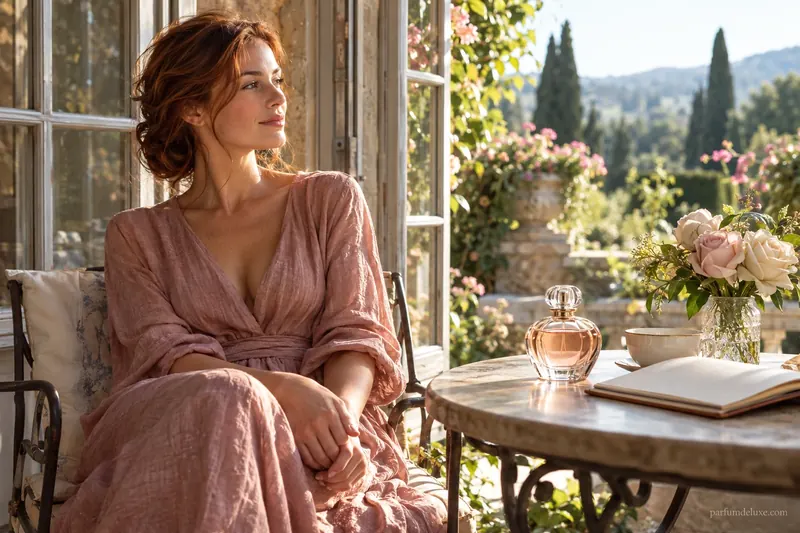
Damask rose perfume: what the name tells you, and what it does not
A damask rose perfume refers to Rosa damascena, a cultivated rose that is not found in the wild. The species name means "from Damascus", a city once known for its steel, its fabrics and its roses. For a perfumer, the flower is above all a raw material: the source of rose oil, one of the central ingredients of fine fragrance.
The name is not a recipe, though. Two bottles that both advertise a damask rose can smell very different, because the flower may be surrounded by fruit, musk, wood or incense, and because the material itself may be an essential oil or an absolute. Think of a damask rose fragrance as a family of possible readings rather than a single scent.
Rosa damascena perfume: a hybrid with a debated past
Every Rosa damascena perfume starts from a hybrid of Rosa gallica and Rosa moschata, and genetic tests also point to a contribution from Rosa fedtschenkoana. The same evidence suggests an origin in the foothills of central Asia or Iran, so Damascus is better read as a trade name than as proof of a birthplace.
A popular story credits the French Crusader Robert de Brie with bringing the rose from Syria to Europe after the siege of Damascus in 1148. It is sometimes repeated, but it comes with caveats, and it is safer to treat it as tradition.
Commercial growing today is concentrated in Bulgaria, around Kazanlak and Karlovo in the so-called Valley of Roses, in Turkey, notably the Isparta region, and in Iran, where the rose is the national flower. Picking is done by hand and lasts roughly 16 to 20 days in hot weather, up to a month in cooler conditions.
From petal to oil: rose otto, absolute and the main producers
Steam distillation of the petals produces rose otto, also called attar of roses. The water that comes off is redistilled, a step known as cohobation, to recover water-soluble components that make up about 80 percent of the oil. Solvent extraction with hexane yields instead a deep reddish-brown absolute. Perfumers treat the two as different ingredients, and a Rosa damascena perfume built on otto reads differently from one built on absolute.
A handful of molecules dominate the oil: citronellol at 20 to 34 percent, geraniol at 15 to 22 percent and nonadecane at 8 to 15 percent. Beta-damascenone, found only in traces (0.01 to 1.85 percent), is described as the marker of quality. Most compounds present below 1 percent carry slightly more than 90 percent of the odor, which is why a damask rose perfume owes so much to tiny details.
Bulgaria (sold as Bulgarian rose), Turkey (Turkish rose) and Saudi Arabia (Taif rose) together account for over 70 percent of the rose oil market. Rosa centifolia, grown mainly in Morocco, Egypt and France, gives no rose oil at all; perfumers use its absolute.
Damask rose fragrance in practice: Kurkdjian and Diptyque
Houses often pair the two roses. For À la rose, Maison Francis Kurkdjian lists Rosa damascena as an essence in the top, with pear and lychee tones, and Rosa centifolia as an absolute in the base, with honeyed, warm facets. According to the house, one bottle takes about 150 damask roses for the essence and 250 centifolia roses for the absolute.
Diptyque takes a similar route with Eau Rose. Its official page names damascena and centifolia roses, worked as absolute and extract, completed by Firad rose essence with a lychee-like fruitiness, plus chamomile and artichoke. The house calls the result "fantasque, exubérante", whimsical and exuberant.
A useful habit: trust the house that names the variety and the form of the material over one that only writes "rose". In both cases above, the page does not state where the damask rose was grown, so the flower's name should never be read as a guarantee of origin.
Damask rose perfumes for women: bright, honeyed or dark
Damask rose perfumes for women can wear very different clothes depending on what surrounds it. Official pages give three clear directions.
Juicy and clear
Lychee and pear, as in À la rose and Eau Rose, give a rose that feels dewy and almost crisp. It suits wearers who find classic roses too heavy.
Musky and honeyed
Kurkdjian describes a musky floral with honeyed, warm facets in the base. Here the rose is soft and skin-like, and the effect ranges from subtle to generous.
Herbal or smoky
Chamomile at Diptyque lifts the rose out of the romantic cliché, while incense and patchouli, as in the next section, push it toward something resinous and nocturnal.
A darker damask rose perfume for women: Portrait of a Lady
Portrait of a Lady, composed by Dominique Ropion for Frédéric Malle, sits at the opposite end. The house describes a Turkish rose in extravagant proportions, supported by woody, amber and incense notes in a reinterpretation of the chypre family. A reference listing puts patchouli, ylang-ylang and a very large dose of rose at the heart, over benzoin, sandalwood, musk and incense.
One caution: the house says Turkish rose and does not name the species on the page consulted. It would be unwise to call it a damask rose perfume with certainty, even though Turkey is one of the main growers of Rosa damascena. The published note lists also differ between pages, including on the house's own site, so check the sheet for the exact version you buy.
Wearing a damask rose perfume: concentration, time and allergens
Common ranges put parfum or extrait at 15 to 30 percent aromatic compounds, eau de parfum at 15 to 20 and eau de toilette at 5 to 15. Houses set their own thresholds, so compare the concentration printed on the box rather than the name. Damask rose perfumes in eau de toilette and in extrait will not have the same presence.
Give the fragrance several hours before judging it. Base notes usually become noticeable about thirty minutes after application, and dry skin holds a scent for a shorter time than oilier skin. The rose you smell at the start is rarely the one you wear at dinner.
On safety, the ingredient list for À la rose names linalool, geraniol, citral, farnesol and vanillin among others, substances European rules require to be declared on the label. If you know you are sensitive, read that list before buying and try the fragrance on a small patch of skin first. This is not medical advice; a lasting reaction is a matter for a health professional.