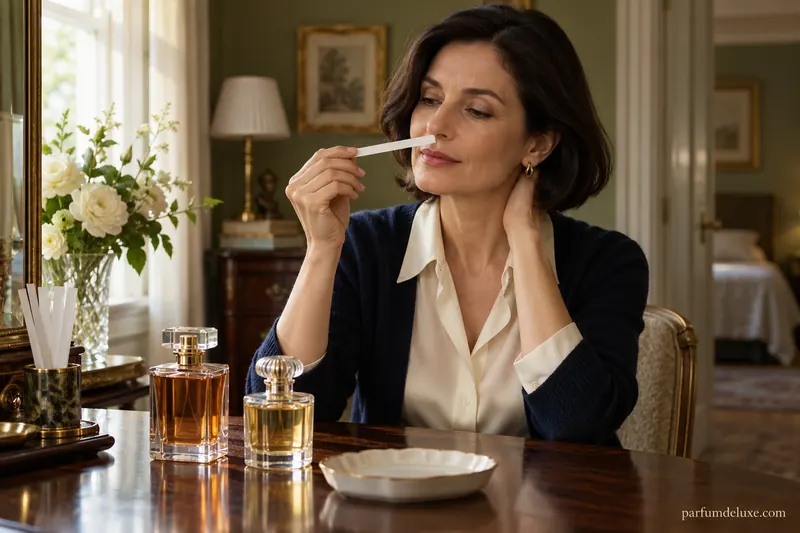
What makes classic perfumes for women classic
A classic is a fragrance whose name has crossed the decades, usually wrapped in cultural history and personal memories that come before the first sniff. The word promises neither a style nor a level of quality. It says only that a composition lasted and stayed available, sometimes in a changed form. Reading classic perfumes for women in this light, a name is a lineage, not a promise of quality.
Classic perfumes for women do not all belong to one family. An abstract aldehydic floral, an amber accord or a structured rose can stay stimulating without you sharing anyone else's memories. The task is to separate the narrative from the olfactive experience: one is read, the other is lived on skin. A classic perfume for women need not be old, and an old perfume is not automatically a classic.
Chanel No. 5: a classic perfume for women born in 1921
According to Chanel, Gabrielle Chanel asked Ernest Beaux in 1921 for a woman's perfume, a scent of a woman. Beaux's samples made unprecedented use of aldehydes, and she chose the fifth, which became No. 5. A reference source adds that it was launched on 5 May 1921 to select clients of the rue Cambon boutique, with bottles produced from 1922.
The same source reports, citing Chanel, that the formula has changed little since 1921, apart from dropping natural civet and certain nitro-musks. Jasmine and tuberose are said to have come from the Grasse region. It is a documented story, yet the scent you smell today is a formula adapted to the rules of its time.
Shalimar by Guerlain: an iconic perfume for women built on amber
Guerlain ties Shalimar to the love story of Emperor Shah Jahan and Princess Mumtaz Mahal and calls it the first amber fragrance in perfumery. That is the house's own claim and should be read as such. According to a reference source, Jacques Guerlain created it in 1921; it was renamed No. 90 during a naming dispute, re-released in 1925 and has been in continuous production since.
The same source reports that Guerlain reportedly added ethyl vanillin to Jicky, his 1889 perfume, to build the base of Shalimar. It lists bergamot and lemon at the top, iris, jasmine and rose at the heart, vanilla and tonka bean in the base, while the house itself mentions the Guerlinade, its signature accord. For a full list, check the sheet of the exact version you are considering. For a classic women's perfume this age, that caution matters.
Portrait of a Lady: a newer icon of rose and incense
Not every iconic perfume for women dates from between the wars. Portrait of a Lady, composed by Dominique Ropion for Frédéric Malle, is described by the house as a Turkish rose in extravagant proportions, supported by woody, amber and incense notes in a reinterpretation of the chypre. The official page says it entered the Fragrance Foundation Hall of Fame.
A reference listing calls it an oriental chypre with woody accents named after the Henry James novel. Note lists differ from page to page, including on the house's own site, so treat them as indications rather than an exact formula. A classic perfume for women is therefore defined not by its birth date but by the length of its presence.
Same name, different bottles: concentrations, flankers and reformulations
Here is the main trap of a classic women's perfume: an emblematic name sometimes covers concentrations, reinterpretations and editions that do not resemble each other. For No. 5, the eau de parfum is presented as a different fragrance from the parfum and the eau de toilette. Chanel also launched No. 5 Eau Première in 2008, Jacques Polge's reinterpretation, which the house calls a light, airy, luminous version.
Shalimar tells a similar tale: Shalimar Light, launched in 2004, was withdrawn and replaced by Eau de Shalimar in 2008, and many flankers exist, such as Shalimar Légère and the Millésime series. Before you compare or give one as a gift, note the exact reference: name, concentration and the version printed on the box. Classic perfumes for women call for that precision more than most.
Wearing timeless women's fragrance without copying an era
Approaching a classic does not mean reproducing a period. You may love it for its present texture, for the contrast with what you usually wear or for how it fits your daily life. A timeless women's fragrance is judged in use: wear it for a day, note what it becomes after an hour, then at night.
Leave room for the story, then look for your own relationship with the scent. If a perfume's history moves you but its smell leaves you cold, that is perfectly normal: a famous name is no substitute for pleasure. To choose among classic perfumes for women, compare two versions of the same name side by side, for instance an eau de parfum and a lighter variant: the gap shows your taste for density and texture. If you are shopping for a gift, favour the reference the person already wears, or a small discovery size, rather than betting on a memory. Conversely, a lesser-known composition may become, for you, an iconic perfume for women in the personal sense. Trust the pleasure you feel after several hours of wear over the prestige of the label, and give any classic at least two wearings before you decide whether it belongs in your own wardrobe.
Finding and buying a classic: formula memory and authenticity
The Osmothèque in Versailles describes itself as a place devoted to the memory of scents: it gathers existing perfumes and revives major ones that have disappeared. According to a reference source, the original 1925 Shalimar formula is preserved there, a good reminder that perfumes change over time and that every classic perfume for women is the product of an era and its materials. Keep the bottle away from light and heat to preserve what you chose.
When you buy, favour recognised retailers and the houses' own boutiques, and check the reference, concentration and batch number. Counterfeits are illegal and risky, not least because their composition is not controlled. If your skin is sensitive, read the ingredient list and try a small patch first; this is not a substitute for a health professional's advice.