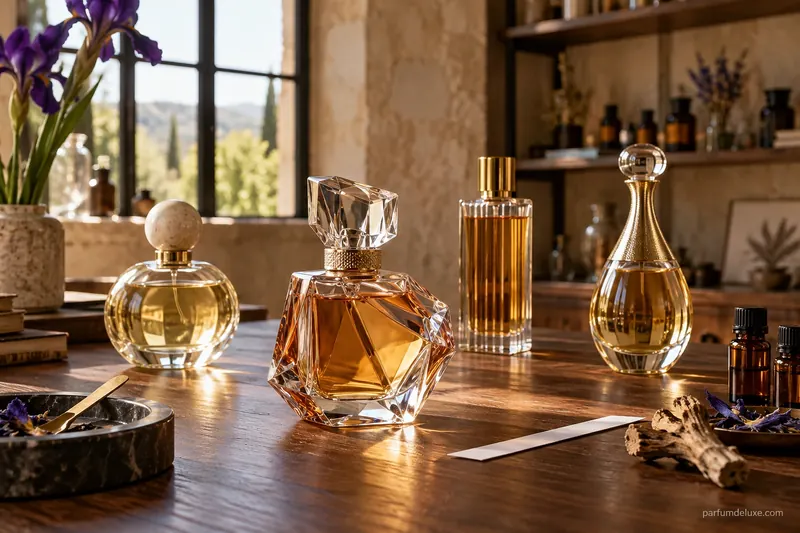
What perfume accords are and how perfume accords create balance
An accord blends several materials to obtain a single impression, different from any of them alone. Perfumers speak of an ambery accord, a woody accord, a musky accord; accords are the sentences of a perfume, and the whole fragrance is the text they compose.
Balance comes from the relationship between those sentences, and perfume balance is read from that relationship. It does not require everything to be heard at the same level: some elements support a dominant sensation, others add a discreet contrast, others give depth to the background. A successful balance is not neutrality; it is a hierarchy that works.
In a luxury fragrance, balance reads on several levels: between two neighbouring accords, between the opening and the base, and between the announced intention and the result on skin. Perfume accords are never isolated; they alter one another, and coherence comes from that mutual influence. Fragrance accords that look clumsy on paper can work in the bottle, and the reverse is just as common.
How a balanced perfume is built: contrasts at work
A balanced perfume rarely plays on a single dimension. An aromatic freshness may answer a soft base, a luminous flower may gain relief beside drier woods, a sweet note may be held in check by a bitter or smoky touch. These tensions give movement and stop the fragrance from turning flat.
Too much contrast, on the other hand, tires the nose: if one material crushes all the others, the whole reads like a demonstration. Between those extremes lies the zone often called fragrance harmony, a coherence that stays alive.
At the bench, accords are most often assembled in the reverse order of evaporation, base first, then heart, then top. Specialist guides describe this method for fragrance accords, which helps set each level before judging the whole, but the indicative proportions sometimes quoted remain a starting point, not a scale.
To appreciate perfume balance, picture an orchestra: a main melody, supporting voices, a low rhythm. If the brass covers everything, the balance is broken; if nothing stands out, there is no music left. The image helps you talk about fragrance harmony without jargon, by asking simply who is singing and who is accompanying.
Gabrielle Chanel: balance built on four flowers
The page for Gabrielle Chanel eau de parfum describes a floral, luminous and airy interpretation composed around four flowers: jasmine, called exotic and intense, ylang-ylang, radiant and fruity, orange blossom, fresh and sparkling, and Grasse tuberose, creamy and feminine. The house calls it a pure floral.
The interest for an observer is to see how four flowers of different temperament live together: the brightness of some tempers the roundness of others. The page, however, gives no top, heart or base breakdown, so the real balance of this perfume on skin is something to check yourself over the hours.
Sartorial by Penhaligon’s: contrasts between spice, leather and sweetness
Penhaligon’s presents Sartorial as inspired by the smells of the workroom at Norton & Sons, bespoke tailors at No. 16 Savile Row. The house evokes cardamom and leather, steam and lavender, vanilla with tonka bean, and lists cardamom, lavender and patchouli among the key notes.
The pairing illustrates a balance built on juxtaposition: aromatic freshness, a dry leather, then a gourmand warmth. Each element answers the other, which lets you test your own taste by asking whether you like the passage from one to the next or only one of them.
Ambre Sultan by Serge Lutens: balance in a dense amber perfume
Serge Lutens describes Ambre Sultan as an amber eau de parfum with notes of vanilla and patchouli, inspired by a fragment of amber resin found in the souks of Marrakech and kept for years in a thuja wood box. The page presents the creation as a return to unique ingredients within the Collection Noire.
A perfume this dense poses the question of balance differently: the aim is no longer to multiply contrasts but to keep movement alive inside an enveloping material. Such a composition can delight an amber lover and feel too smooth to someone else, a reminder that balance depends on the wearer.
Judging perfume balance on skin and over time
Tensions between perfume accords are judged on skin, over time. A blotter shows the opening, not how the base answers the top a few hours later. Note what first catches your attention, what gives relief around it, and what remains at the end.
Run the test in three stages: at the moment of spraying, after half an hour, after four to eight hours. Limit yourself to three or four perfumes per session so the nose does not saturate. A decant or small size lets you repeat the test in different conditions.
The balance of perfume accords changes during those hours: it is normal for a perfume to seem lopsided ten minutes after spraying and find its footing later. Give a balanced perfume the time to settle before concluding anything about it.
- Spot what dominates the opening.
- Look for what answers it in depth.
- Check whether one element crushes the others.
- Note whether the transition feels natural.
- Retest after a few hours.
Setting your own criteria for fragrance harmony
A very harmonious blend for one person may feel too smooth to another; a dissonance that charms one wearer will seem messy to the next. Before declaring a perfume unbalanced, ask what you expect: comfort, surprise, precision, depth?
A good habit is to put the criterion in one sentence: I want a clear flower that does not turn sweet, I want an amber base without heaviness. That sentence then becomes the grid for comparing two perfumes, and it spares you from judging at random.
For a perfume balance that suits your criteria, the same sentence will serve on every test occasion. It keeps you from confusing a balanced perfume with a crowd-pleasing one, since the first is a quality of construction and the second merely a level of acceptance.
When balance breaks: common imbalances to recognise
A few signs reveal a less controlled composition. Sugar that dominates without counterweight becomes cloying. A dry wood without softness feels austere. A dazzling opening followed by an unrelated base gives the impression of two perfumes stuck together. These observations do not condemn a fragrance, because some creators seek rupture, but they help name the sensation.
Remember finally that skin, heat and concentration shift the balance: the same fragrance as an eau de toilette and as an extrait does not show exactly the same balance of forces. Comparing several versions gives a fuller idea of the perfumer’s work.