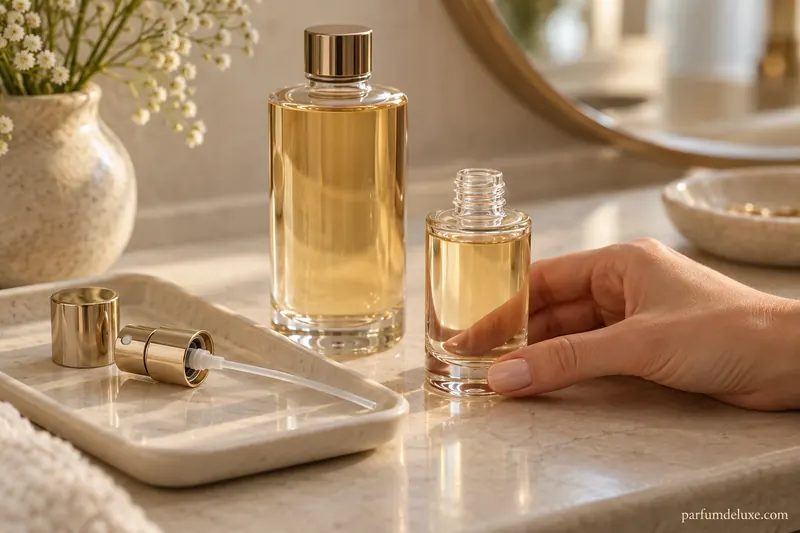
Start by asking which part of the perfume is sustainable
A perfume leaves a footprint in several places. There are the raw materials, grown or synthesised; the manufacture and filling; the packaging, made of glass, cap, carton and sometimes film; and finally transport and whatever becomes of the bottle once it is empty.
Perfume and the environment meet at every stage, and each stage raises its own question, and a gain in one tells you nothing about the rest. A recyclable carton does not describe how readily the molecules break down, and a carefully designed formula says nothing about the journey of the bottle to your door.
To judge a sustainable perfume without getting lost, and to keep perfume and the environment in proportion, take the stages one by one, then ask which stage each sentence of a brand's communication actually refers to.
Natural is not the same as eco-friendly perfume
Sustainable perfume is often equated with natural perfume, and people equate natural and eco-friendly, but the two ideas do not coincide. A natural material may demand a lot of resources to farm or extract, while a well-designed synthetic molecule can replace a rare or hard-to-obtain ingredient.
Guerlain describes its eco-formulation approach through a measuring tool, the IFE index, built on six criteria: natural ingredients, traceability, environmental impact (biodegradability and ecotoxicity), sustainability, substitution of controversial ingredients and the number of ingredients used. The house sets a goal of 90 percent natural-origin ingredients and cites, for example, Aqua Allegoria reformulated to between 90 and 95 percent natural-origin content.
For fragrance, the house qualifies its own goal: aiming for 90 percent natural-origin ingredients is not always relevant, because it can narrow the perfumer's palette, raise allergen risks or harm the sustainability of some formulas. It then turns to synthesis, for instance to recreate so-called silent flowers. That is a house position rather than a scientific verdict, yet it captures the debate well.
Environmental impact of perfume packaging
Diptyque's sheet for the Eau Duelle eau de toilette states a glass bottle and a cardboard box described as recyclable, plus manufacture in France. That is real information about packaging, phrased without a sweeping promise, and it fits the wider environmental impact of perfume only in part, since a bottle is one element among several.
It says nothing, however, about growing vanilla or extracting cypriol, nor about transport emissions. Lighter packaging, certified carton or recyclable glass is progress at one stage, not a full account of the product.
Look at real recyclability too, because the environmental impact of perfume packaging depends on what happens after use: a material that is recyclable in theory is recycled only if you sort it and a collection channel exists near you. Local sorting rules decide.
Sustainable perfume claims: results versus targets
A sentence such as we are reducing our impact does not carry the weight of a dated figure. Look for scope (which products, which ranges), measure (which indicator), period and whether anyone outside the company checks it. Then separate what is achieved from what is merely announced for later.
European law points the same way. According to summaries of Directive 2024/825, known as the Empowering Consumers directive, generic environmental claims without proof, such as eco-friendly or green, and climate-neutral claims based only on offsetting are banned in communication to consumers from 27 September 2026. Claims must be specific and verifiable.
For sustainable perfume, a precise, bounded commitment is therefore more credible than a general slogan. It can be modest and still honest: a small documented scope beats a vast vague one.
Refills and solid perfume: concrete choices with limits
Le Labo's refill programme refills an empty 50 ml or 100 ml bottle with the same scent at about 20 percent below retail; online, the bottle is posted back, refilled by a lab technician and returned, usually within 5 to 10 business days, with a label showing the refill date. Conditions (undamaged bottle, same scent, same size) and eligible collections should be confirmed with the house.
Diptyque offers Fleur de Peau as a refillable solid perfume, presented as refillable indefinitely and alcohol-free, in a 3 g case with refills sold as two 3 g units. Its ingredient list nevertheless includes paraffin and synthetic waxes, which shows that a refill answers the packaging question, not the formula question.
Both cases illustrate the principle for sustainable perfume: a refill system cuts packaging waste if you really use it, but it does not assess ingredients or the transport of the refills.
What you can do yourself for a sustainable fragrance
A large part of a bottle's footprint depends on use, so sustainable perfume starts with the wearer. Wearing the perfumes you already love, instead of piling up more, is a concrete choice. Likewise, limiting purchases you will rarely wear, or sampling before taking a large size, reduces waste.
Store your bottles away from heat and light so you can finish them, which is the simplest gesture of an eco-friendly perfume routine, and check the date printed on the packaging. A well-kept perfume that gets used up beats a flawless one forgotten in a drawer.
A sustainable fragrance is therefore not just a label but a practice, which each person adjusts to budget, habits and the availability of refill systems.
Why a full environmental impact of perfume needs more than good intentions
A complete assessment requires measuring the whole life cycle: farming or synthesis, processing, manufacture, transport, use and end of life. Public information on perfume and the environment almost always concerns one link, and it is tempting to add the links up and draw a conclusion.
Resist that. A refillable bottle, a traced ingredient and a recyclable carton do not together amount to a balance sheet. Each describes a limited scope. Compare the information available, note the gaps and remember that missing figures are not a confession, only missing information.
If a data point matters to you, ask customer service for the date, the scope and the source. A serious house will reply by stating what it measures and what it does not.
Questions to ask about an eco-friendly perfume
These questions turn an impression into information. They work as well for a large house as for a niche one, for a bottle as for a gift set.
Keep the replies in writing. Commitments evolve, and a promise made some years ago may have been met, changed or dropped.
- Which stage is concerned: ingredients, formula, packaging or transport?
- Is it an observed result or a future target?
- Which products and which period does the measure cover?
- Does an independent party verify it, and which one?
- Is the refill system available near you?