Why no single detail settles perfume authenticity
A well-made imitation, which is the opposite of an authentic perfume, can copy the shape, colour and logo of a flacon. A tidy cellophane wrap, a fine engraving or a printed batch code therefore prove nothing on their own, since each can be reproduced. Perfume authenticity is built by crossing several independent clues.
The reverse also holds: an unusual detail does not by itself demonstrate a fake. An older batch, a slightly different carton from one market to another or a refilled bottle can explain a variation. Le Labo, for instance, says its refilled bottles receive a new label showing the refill date, so a flacon that does not look brand new is not automatically suspect.
The sound habit is to trace the purchase back to its source, then test the coherence of everything else. Provenance outweighs appearance because it is harder to falsify.
Seller provenance: the first test for an authentic perfume
Perfume provenance is the first thing to establish, because an authentic perfume comes through a channel you can name: the house's own boutique, its official website, a department store or a perfumery whose status is easy to confirm. A genuine perfume has a paper trail, so ask for a receipt or order confirmation and keep it with the exact product reference.
France's intellectual property office, INPI, advises caution about prices that look too low and adverts showing 80 or 90 percent off, a check of a website's legal notices (company status, address, contact details) and no trust in logos or pictures, which counterfeiters copy. It adds that terms of sale are not a reliable test because they are often copied from legitimate shops.
French customs add their own advice: make sure the website and seller are reliable, confirm with the brand that the product exists, prefer official shops, insist on a receipt and read payment, return and refund terms before buying online.
Counterfeit perfume: what French customs report
The figures show the scale of the threat to perfume authenticity. According to French customs, more than 3.8 million counterfeit-related perfume items (bottles, caps, labels, packaging) were intercepted in 2024. During its Fragrance operation in November 2025, more than 82,000 counterfeit perfume items were taken off the market, says its press release.
The same release flags a precise clue: the 33 ml bottle, which is absent from the legal trade of major brands. It also mentions analyses that found unregulated solvents, phthalates and butylated hydroxytoluene, which can cause allergies, burns or breathing problems.
Counterfeiting is illegal and carries real risk: the composition of a fake is not controlled and any allergens are not reliably declared. That alone is a good reason to stay with identified channels.
Spotting a fake perfume: warning signs on the box and the flask
Customs list several warning signs to examine one by one, then together, because a genuine perfume rarely shows several of them at once. None is final proof, but when they pile up, caution is justified.
On the bottle itself they cite poor glass with bubbles, misaligned lettering and a loose-fitting cap. Comparing with a sample of certain origin remains the most telling method.
- Loosely folded plastic film or rough seals around the box.
- Spelling mistakes, distorted logos or poor-quality cardboard.
- Batch numbers that differ between flask and box.
- Loose cap, misaligned lettering, uneven glass.
- Heavy discount outside sales or an official clearance.
Mandatory markings and batch codes: what they are for
In the European Union, the label of a cosmetic, perfume included, must carry the address of the responsible person established in the Union, a batch number or reference, a minimum durability date or the period-after-opening symbol, the function of the product if not obvious, the ingredient list and precautions. Ireland's regulator HPRA summarises these duties under Regulation (EC) No 1223/2009.
These markings serve safety and follow-up: a batch number ties a flacon to a production run. A counterfeiter, however, can print plausible markings. They become a useful clue only when they match between carton and flask, and only the house can confirm that a batch matches a genuine production.
To verify perfume authenticity from a batch code, or if a batch worries you, photograph the bottle, the box and the receipt and send them to the brand's customer service. That is more reliable than trusting an anonymous online checker.
Manufacture stories versus the bottle in your hand
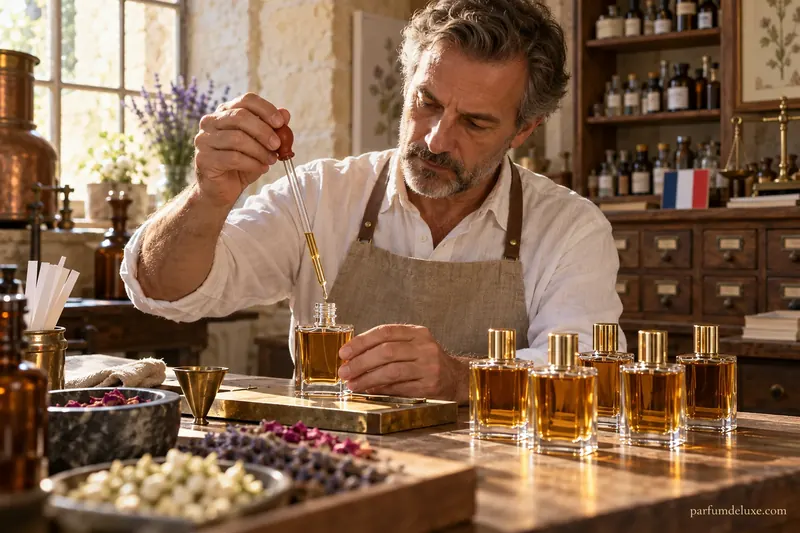
Houses like to tell how they make their perfumes, and the provenance of a perfume often begins with that story: a workshop in Grasse, a creation laboratory, hand filling. Such stories give context and have value for judging the provenance of a perfume in general, but they describe production in general, not the specific unit you hold.
Diptyque's sheet for Eau Duelle shows the nuance: it states manufacture in France and a glass bottle and cardboard box described as recyclable. That qualifies the house's product, not a box bought from an unknown reseller. To verify perfume authenticity for one particular unit, only the seller, the receipt, the batch and material consistency matter.
An authentic perfume can also smell different from one day to another. Concentration (eau de toilette or eau de parfum), storage in heat or light and your own perception change the impression. A scent that surprises you does not demonstrate a fake.
What to do if you doubt a perfume you have bought
Stop using the product, even if it was bought in good faith and even if you believed it to be an authentic perfume, especially if you notice redness, itching or breathing discomfort. For a skin reaction, a healthcare professional is the right contact.
French customs then advise asking the seller or platform for a refund while stating your doubts, alerting the platform's customer service and the rights holder's, reporting illegal content on the PHAROS platform and calling Info Escroqueries on 0 805 805 817 (free, Monday to Friday).
Perfume provenance is ultimately shown on paper. Keep every proof: the advert, messages, receipt and photos of the flask and packaging. They help both the brand and the seller handle your request.
Buying an authentic perfume with less risk
The method comes down to a few habits, and each one makes it easier to verify perfume authenticity and buy a genuine perfume. To protect perfume authenticity before you pay, pick an identifiable seller, compare the price with official channels, check that the markings agree and keep the receipt. If an offer seems too good to be true, customs recommend being wary.
To try a scent before committing, go through the house or a recognised retailer: a sample obtained that way follows the same channel as the bottle and reduces the chance of a bad surprise.
Finally, stay factual, whether you are a collector or a first-time buyer wanting a genuine perfume for daily wear. Perfume authenticity is demonstrated by documents and observations, not by one olfactory impression.