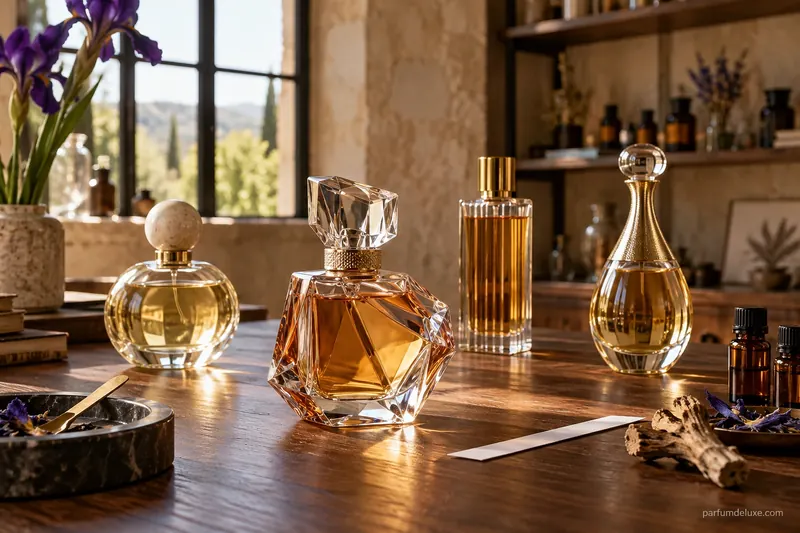
Perfume from Oman: the country, the house and the materials
When people say perfume from Oman, three things overlap: the country where the house stands, the countries its ingredients come from, and the place where the juice is composed. They do not always coincide. A house can be Omani, work a resin gathered in the mountains of Dhofar, pair it with Assam oud from India, and have some pieces composed by perfumers based abroad.
That distinction is the thread running through the whole subject. It separates what belongs to the history of the sultanate, what belongs to one house, and what belongs to a given fragrance’s technical sheet. It also avoids the misleading idea that an Omani perfume must contain only Omani ingredients.
Frankincense in Oman: a trade route on the UNESCO list
In 2000 UNESCO inscribed Oman’s Land of Frankincense as a World Heritage property. It has four components: Khor Rori, a port active from the 4th century BC to the 5th century AD; Al-Baleed, a port used from the 8th to the 16th century; Shisr/Wubar, an oasis and caravan site; and Wadi Dawkah, where frankincense trees, Boswellia sacra, still grow and are harvested today.
According to UNESCO, frankincense was among the most important luxury goods of the ancient and medieval world, and these sites show how the resin was produced inland, carried to coastal ports and traded onward. That is the historical bedrock for any thinking about Omani perfume. Perfume from Oman, in other words, begins with a resin before it reaches a bottle.
Frankincense in Oman today: varieties, souks and bukhoor
National Geographic reports that Boswellia sacra resin is gathered by cutting the bark, and that the trees are protected. The same piece mentions Salalah’s Al-Hafa Souq, nicknamed the Old Frankincense Market; Salalah is noted for bukhoor, scented wood chips burned like incense; and Nizwa’s souk has long sold rosewater.
Premium Beauty News adds that the Dawkah valley yields the Najdi variety, one of four main types, that Najdi and Hojari also have traditional uses and that the others serve mostly as incense. The same piece says Amouage manages the reserve under a 2022 partnership and that oil extraction is still done in France. Tree counts differ between sources, from four to five thousand, so it is wiser to keep no figure. Frankincense in Oman remains a living material, hand-harvested, not just a legend.
Amouage, an Omani perfume house founded in 1983
The house of Amouage places its founding in 1983, in the Sultanate of Oman, by the Albusaidi family, with the ambition of being « The Gift of Kings ». National Geographic adds that the house was commissioned at the time by the late Sultan Qaboos bin Said; its name comes from the Arabic word for waves. Sayyid Khalid is chairman today, succeeding his brother Sayyid Badr, the founding chairman, in 2003.
The house says it offers more than fifty perfumes in over eighty countries through twelve standalone boutiques and about a thousand partners, and that its perfumers work in Paris, Grasse, Geneva and New York. Gold and Reflection are among its best-regarded works according to the house. These figures come from a presentation page, so confirm them with Amouage. For anyone exploring an Omani perfume house, it is the best-known reference.
Amouage Silver Oud: a precise reading of oud
Amouage Silver Oud is presented as a woody, ambery eau de parfum inspired by Stendhal’s novel The Red and the Black and its ambitious hero Julien Sorel. The official page lists patchouli, cypriol essence and Virginia cedar essence at the top, Assam oud essence and Madagascar vanilla absolute in the heart, and Ambrarome, birch, guaiac wood and castoreum in the base.
The house states a 20 percent oil concentration and six weeks of ageing, three of maceration and three of maturation. The scent is credited to perfumer Cécile Zarokian, an ISIPCA graduate. The page gives no launch year, and it names Assam oud, which underlines a useful point: Silver Oud is a perfume from Oman whose oud does not come from Oman. Compare Amouage Silver Oud with other woody, ambery fragrances rather than with oud oils.
House origin or material origin: reading a fragrance sheet
To judge an Omani perfume, look for the ingredient and its provenance in the house’s own sheet instead of deducing geography from the country. A frankincense note may point to Dhofar and a rose note to the Jabal Akhdar mountains, where National Geographic places the damask rose bloom between late March and April, but an oud, a cedar or a patchouli can come from elsewhere.
Be wary of loose phrases too: « Omani oud » is not a guaranteed label, and the word Oman on a bottle does not replace a statement about materials. When origin matters to you, ask the house for the answer. Perfume from Oman is read like any other: by its sheet.
Visiting the Amouage manufacture in Muscat
Amouage’s Muscat manufacture houses a visitor centre. According to the house, visitors take a guided tour of key moments in its artistic history, see treasures from its vaults that have never been displayed, and view temporary exhibitions. The architecture blends modern design with local Omani touches.
The official page lists no opening hours, prices or booking steps; it points to an article in the house’s help centre. Check the official terms before planning a visit. It adds context to trying a scent, but your olfactive choice still rests on the composition and on how it feels to you.
Seen from outside, the visit is also a reminder that a perfume house is a workplace as much as a brand: extraction, blending, ageing and finishing all take time. Whatever you learn there, the fragrance on your skin is still the final judge.
Choosing an Omani perfume: testing, skin, authenticity
With any Omani perfume, try a blotter first, then your skin, and let it develop for several hours: resins, oud and amber reveal themselves over time. Perfumes rich in natural materials and alcohol may contain allergens; the ingredient list appears on the packaging, and a patch test on a small area of skin is prudent.
Buy from the house or an authorised retailer. Counterfeits are illegal and may contain uncontrolled components. No price is quoted here: tariffs vary by country, size and concentration, and should be checked with the seller. For frankincense burned at home, follow the maker’s instructions and ventilate the room.