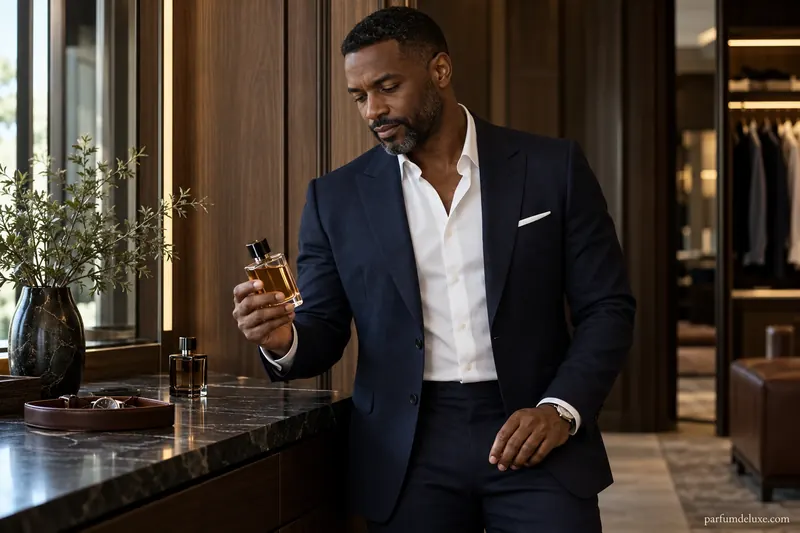
What Arabian fragrances for men actually include
The phrase Arabian fragrances for men is not a single scent family. It covers perfumes from Gulf houses, whether family-run like Rasasi, Riyadh-born like Arabian Oud, or Omani like Amouage. What they share is less a formula than a way of composing: generous accords, dark or resinous materials, a real place for oud, and a presence many wearers find more enveloping than the European tradition tends to be.
Rasasi, for instance, was founded in 1979 in the Murshid Bazar market in Deira, Dubai, by Abdul Razzak Kalsekar, and is still run by the family. It began as one small shop and opened its first factory in the Jebel Ali free zone in 1986, initially focused on oud oil perfumes. That history explains why its range still mixes sprays, oils and attars.
Masculine is a catalogue label
Shops sort bottles into men's and women's, but the split is mostly a retail habit. A leather and saffron composition may suit a woman as easily as an amber rose may suit a man. With Middle Eastern fragrances for men as with any other, treat the category as a way to narrow the search, never as a rule.
Rasasi La Yuqawam: leather as the common thread
According to the official Rasasi store page, the name means irresistible in Arabic. It belongs to a series of six fragrances that try to blend a classic spirit with a modern hand in oriental perfumery, with the ambition of appealing beyond its original Arab audience.
That same page lists rose, geranium and blue flowers in the top, Yemeni olibanum and French jasmine in the heart, and Italian leather, Indian agarwood and amber in the base. The house describes an earthy, spicy, bittersweet opening, with saffron adding a more refined touch, then a more sensual drydown where leather and oud are warmed by amber.
For this Arabian perfume for men the page gives no release year, and it is better not to guess one. What matters is the logic: a dark, animalic leather softened by flowers and a bright resin. It is the profile to try among Arabian fragrances for men if you like smoking-room, saddlery and warm-wood atmospheres.
Arabian Oud's Arabian Knight: woods, musk and tonka
Arabian Oud is a Saudi fragrance brand and retailer whose store network has grown widely. According to Wikipedia it began in Riyadh in 1982 and counts more than 1,200 stores in 37 countries; those figures move over time and should be confirmed with the company.
Its official page presents Arabian Knight as a signature scent with bold spicy and woody notes. It lists bergamot on top, tonka bean in the middle, compared to cinnamon and vanilla, and warm woods with velvety musk underneath. Among Arabian fragrances for men, the result is less smoky and less animalic than La Yuqawam: rounder, easier to approach, with a sweet warmth that hints at gourmand without becoming dessert-like.
The page does not state the concentration and lists only the word fragrance among its ingredients, with no percentage. Ask the retailer instead of guessing from the price or the bottle.
Amouage Interlude Man: a smoky Arabian perfume for men that divides
Amouage, the Omani house, launched Interlude Man in 2012 according to the community database Basenotes, which credits perfumer Pierre Negrin. The pyramid on that source reads bergamot, oregano and allspice on top; amber, opoponax, incense and cistus in the heart; leather, oud, patchouli and sandalwood underneath. It is a collaborative database, so cross-check the notes with the house before buying.
Reviewer opinions there are sharp. Some hear an opulent monolith with ceremonial smoke, like a fire catching in a forest of resin trees; others find the herbal, incense-heavy accord overpowering. That split is useful: an ambitious Arabian fragrance for men does not always try to please everyone, and it is judged over hours rather than in the first minute.
Amouage sits in the same family of thought as the other two houses, yet its writing is denser, darker and costlier. Among Middle Eastern fragrances for men, Amouage is the dense one, and set beside the brighter, softer Arabian Knight it shows how much the label Arabian perfume covers.
Reading a fragrance pyramid without being misled
A three-tier pyramid is a guide, not a recipe. Top notes such as rose, bergamot or oregano fade first. The heart follows, then the base, where leather, wood, amber and musk sit, and it is the base you will wear for hours. With an Arabian cologne for men, look at the base first: it is where a dry leather, a creamy wood and a smoky oud part ways.
Be careful with words too when reading Arabian fragrances for men. Leather can mean a dry, tarry note or a soft suede. Oud can point to a rare natural material, a synthetic accord or a blend of both. Houses do not all use these terms with the same precision, and only skin testing settles it.
- Look at the base first: leather, wood, amber or musk.
- Note whether the top is spicy, floral or citrus.
- Compare two fragrances at a time, not five.
- Wait an hour before judging the trail.
Oud perfume for men: what to expect
Oud is agarwood, a resinous heartwood produced by some trees of the genus Aquilaria. A FAO report notes it has been used for centuries in traditional medicine, perfume and incense. Aquilaria malaccensis has been listed in CITES Appendix II since 1995, and the genera Aquilaria and Gyrinops since 2005, which regulates international trade in the raw material.
In a bottle, an oud perfume for men never looks the same twice. La Yuqawam pairs it with leather and amber; Interlude Man sets it beneath incense smoke and resins; Arabian Knight keeps it in the background in favour of warm wood. Oud can smell of damp wood, leather, cheese or smoke depending on dose and quality, so give it several wears before deciding.
Wear time, season and skin: adapting your choice
An Arabian perfume for men is often more concentrated and heavier than a typical eau de toilette. In the first warm days one spray is enough, on skin or on a fabric that can take fragrance. In winter or in the evening, leather, amber and oud accords sit more naturally, because the cold tempers their roundness and makes the trail less heavy.
Skin changes the reading. Dry skin holds woody notes less well and shortens the base; oilier skin lifts resins and spices. Do not expect twenty-four hours of wear: duration depends on the wearer, the climate and the amount applied, not on the reputation of the house.
Testing Arabian cologne for men and avoiding counterfeits
Arabian fragrances for men reward a trial on a blotter and then on skin, revisited after a few hours, before you commit to a large bottle. If the house offers small sizes or discovery sets, use them: a 100 ml bottle is a bigger commitment, especially for a strong style.
Counterfeits are illegal and may contain uncontrolled substances; buy from recognised retailers or the house's own store, and read the ingredient list, which names regulated allergens. If you worry about a skin reaction, a test on a small patch of forearm is the minimum precaution, and a health professional answers a medical question better than any article can.