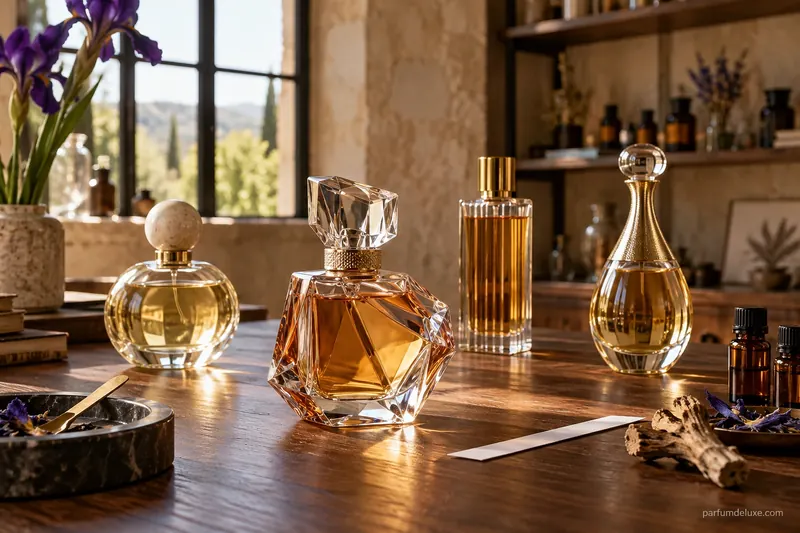
What oud means in a unisex oud perfume
Oud is the name given to agarwood and to the oil distilled from it. In perfumery the word covers the natural material, laboratory reconstructions and a whole family of woody, smoky, resinous accords, sometimes leathery or animalic. Within a unisex oud perfume it can be the headline or merely a touch.
The word therefore predicts neither character nor strength. Two bottles labelled oud can be opposites, one dry and austere, the other round, rosy and nearly sweet. The whole composition is what counts, not the mention of a single material, so unisex oud perfumes are best judged by texture rather than by name.
Texture is the useful word here. Some oud accords feel dry and papery, others creamy, medicinal, smoky or almost fruity. Describing the texture you like before you shop narrows the field far better than asking for the strongest oud. A salesperson, a friend or a review can then point you to comparable bottles, and you can ask for a sample of each before committing to a full size.
No gender code is attached to the material. In the Middle East and the Arab world oud is a traditional aromatic, burned as chips and worked into perfume. A gender-neutral oud scent simply continues that shared use, and a unisex oud fragrance is a natural fit for the material.
How agarwood forms: a tree defending itself
Agarwood forms in the heartwood of Aquilaria trees after infection by a mould. The tree secretes a defensive resin that makes the wood dense and dark. That biological origin is why the material cannot be produced at will.
The genus has seventeen species, nine of them known to produce agarwood. Aquilaria malaccensis was the primary source, while Aquilaria crassna and Aquilaria sinensis are also commonly harvested. Trees of the related genus Gyrinops can produce it too.
The oil is obtained by steam distillation. According to published figures, seventy kilos of wood will not yield more than twenty millilitres of oil. Such a small yield goes a long way towards explaining why a unisex oud perfume made with natural oil stays a prestige product.
Natural, diluted or reconstructed: why oud misleads
Few perfume houses use real oud in their creations. It usually works as a base note, often paired with rose, and diluting it with patchouli or synthetic components is common. Artificially inoculated, plantation or very young wood sells at prices far from those of exceptional material.
That gap shows on the market: genuine oud oil and a reconstructed accord can appear under the same name, and an official product sheet does not always say what the material is. It is one more reason to trust your nose over the word on the label.
Plantations exist in India, Bangladesh and Bhutan, and the tree was reintroduced as a commercial crop in Malaysia and Sri Lanka. Their success depends on inoculation techniques, which have given mixed results.
A protected wood: what CITES says about agarwood
Aquilaria malaccensis was first listed in CITES Appendix II at the 1994 conference, effective 16 February 1995. In 2004 the Parties adopted the listing of all Aquilaria and Gyrinops species, effective 12 January 2005.
From 2011 to 2020, recorded trade was mostly wood chips (43 percent), oils and extracts (27 percent), timber and logs (11 percent) and powder (8 percent). The document states that finished Aquilaria and Gyrinops products are exempt from CITES regulation, whereas wood, oils and extracts upstream appear in the trade statistics.
For a buyer this makes a simple question legitimate: where does the material come from? A unisex oud perfume sold as natural oud at a very low price deserves more caution than a bottle accompanied by precise explanations.
Oud perfume for men and women in three readings: wood, amber, rose
In a gender-neutral selection, unisex oud perfumes reveal oud through its pairings, and a gender-neutral oud scent is often defined more by its companions than by the wood itself. Some compositions stress wood and smoke; others add the roundness of rose or amber; others seek an unexpected brightness through citrus or spice.
The house of Ormonde Jayne illustrates the amber route. Its founder, Linda Pilkington, says that Ormonde Man, launched in 2004, made the house the first Western one to weave oud into a fine fragrance, which is the house's own account. Nawab of Oudh, from the Four Corners of the Earth collection, is filed under amber and oud: according to the house, a potent blend of amber and rose with a soft oudh edge, in which no single ingredient stands out.
Its sheet names cardamom, rose, pimento, ambergris and musk, with oudh among the base notes. The example is enough to show that a unisex oud fragrance can read like a floral amber rather than a plain wood.
Eau de parfum, extrait, intensivo: pin down the exact reference
An eau de parfum and an extract with similar names do not balance the same way. The extract is often more concentrated and denser in the base, yet its opening can differ as well. For any unisex oud perfume, and for any oud perfume for men and women, identify the exact reference and its concentration before testing.
Versions carrying the word intense or intensivo are full variants. Ormonde Jayne added an Intensivo edition of Nawab of Oudh in 2015; it does not replace the original but offers a second reading of it.
When you compare on blotters, note the date and the reference, since one name can cover several sizes and batches.
Choosing a unisex oud perfume to share, without the same effect on two skins
Oud is a powerful material that reacts to skin, warmth and humidity. For a shared bottle, look for a common pleasure that lasts, without expecting the fragrance to tell the same story on both skins.
Let each person form an opinion separately, at different moments of the day, then compare by describing sensations: smoky, soft, round, dry, resinous. Avoid calling the scent masculine or feminine, which distorts judgement; an oud perfume for men and women is described by what it feels like.
Respect other people's space as well, since oud, even refined, often projects. A modest application is enough. Start with a small amount of your unisex oud perfume on a limited area, because regulated allergens are declared on the packaging; if you feel discomfort, stop using it. This caution does not replace advice from a health professional.