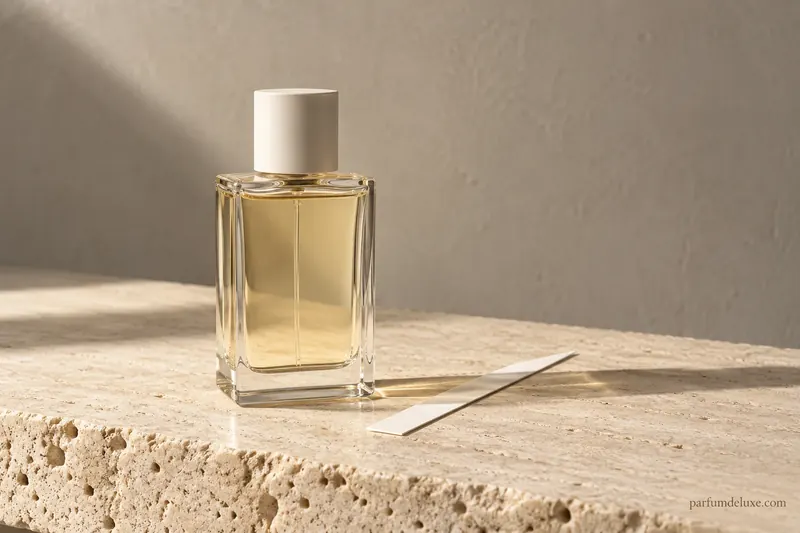
What a luxury shower gel really is
A luxury shower gel is, first of all, a wash: it cleans, rinses and leaves skin feeling fresh. What sets it apart is the fragrance, borrowed from a perfume house's universe, and the care given to the bottle, texture and lather. It belongs with scented body products such as lotions, oils and soaps, not with fragrances you wear.
The difference matters. Contact time with skin is short, water carries most of the scent away and the formula aims at cleansing. Expecting the staying power, sillage or evolution of a perfume from a rinsed product leads to avoidable disappointment.
Many buyers meet a luxury shower gel as part of a gift set or a collection built around one fragrance. That is a pleasant way to discover a house, but the individual product still has to earn its place on the bathroom shelf through how it washes and how its scent behaves under running water.
Texture, lather and rinse: what counts in practice
Texture shapes the experience. Jo Malone London describes its foaming gels as refreshing gels that clean and soften skin and work as a hand and body wash. Diptyque presents a cleansing gel that, according to its FAQ, can be used on both body and hair, along with perfumed soaps.
To compare, watch the lather, the rinse and how your skin feels afterwards: tight, comfortable or simply fresh. A scent that seems strong in the bottle can feel discreet under the shower, and the other way round. Size helps too: Jo Malone lists its gels in 100 ml, 200 ml, 250 ml and 500 ml depending on the reference, so you can start small before committing to a large bottle.
A scented foaming wash is also judged in daily use: how much you need, how easily it spreads and how the lather rinses on skin already sensitive to hard water or cold. A scented foaming wash that needs a large amount each time will empty faster, so test the quantity on the first few uses.
Luxury body wash and eau de parfum: a pairing, not a copy
A luxury body wash often sits beside a fragrance of the same collection. The pairing can be coherent without being identical: the rinsed product echoes the spirit of the scent, not necessarily its base notes or its development. Houses speak of rituals, meaning sets of gestures, rather than replicas.
If you then add a perfume or a scented lotion, enjoy the whole without chasing maximum layering. Two neighbouring scents can blend or blur. A shorter routine, say a luxury shower gel followed by a fragrance from a different family, may suit your habits better than the full gift set.
A scented shower ritual is not measured by the number of products but by how well their fragrances agree. One gel, properly smelled, beats three products from different families competing in the bathroom.
Fragrance families in perfumed shower gels
Fragrance families give a first compass. At Jo Malone London, the foaming gel category spreads across warm and amber, warm and woody, floral, light floral, fresh and citrus, fresh and woody, and fruity, with names that hint at notes, such as Cypress & Grapevine, Lime Basil & Mandarin or Oud & Bergamot.
Think about the time of day. A fresh citrus note often suits a morning; a warm or woody one an evening bath. These are habits, not rules, and perception shifts with season and water temperature. A perfumed shower gel chosen from its name alone may surprise you, so smell it before buying whenever you can.
Seasonality plays a part. In winter, a warm and amber note can feel comforting in a steamy bathroom, while the same note in summer heat may seem heavy. Rather than owning one perfumed shower gel for the whole year, some people keep a fresher one and a warmer one and alternate.
Ingredients, allergens and sensitive skin
A scented product contains aroma compounds that can trigger a reaction in some people. In Europe, according to the European Commission, 26 fragrance allergens are subject to individual labelling under annex III of the cosmetics regulation, and discussions continue about extending the list. In practice, read the INCI list printed on the packaging rather than relying only on the product page.
Houses do talk about ingredients: Jo Malone mentions natural-origin glycerin and limnanthes seed oil, while Diptyque states that its Les Rituels de Soin range has formulas with up to 100 % ingredients of natural origin, suitable for all skin types including sensitive skin under normal use, and that allergens appear in the INCI list on the packaging. These are brand statements. Natural origin does not mean free of allergy risk: if you notice redness or itching, rinse, stop using the product and seek medical advice.
With any luxury shower gel, a patch test on a small area is a simple precaution, especially for reactive skin.
Comparing high-end houses without chasing prices
A luxury body wash is compared less on price than on what it offers: formats, refills, the range around it and the clarity of information. Diptyque says its hand washes are refillable, that it offers travel sizes of 100 ml or less and that all its body care is fragranced. Jo Malone London stresses a wide palette of scents and several bottle sizes.
Do not compare prices from one page to another without checking with the retailer, because they change with country, size and period. Favour the house whose fragrance you truly like and whose packaging shows its composition clearly.
Before any purchase, check the stated use, the volume and whether a legible ingredient list appears on the packaging.
Building a routine without forced layering
A scented shower ritual does not need to be complete. One well-chosen product may be enough: the gel, the body lotion or the perfume. If you combine them, start with a pair rather than the entire collection, and wait a few days before judging.
Think of other people as well. A shared bathroom, an office at lunchtime or an enclosed space does not always tolerate gel, lotion and perfume stacked together. Finally, use a luxury shower gel for its stated purpose: not near the eyes, not on broken skin and always with a thorough rinse. For a child or very sensitive skin, an unscented product is often simpler.
A short routine also makes it easier to notice a reaction. If you add several scented products at once and your skin reacts, you cannot tell which one is responsible, whereas one new product at a time makes the cause obvious.