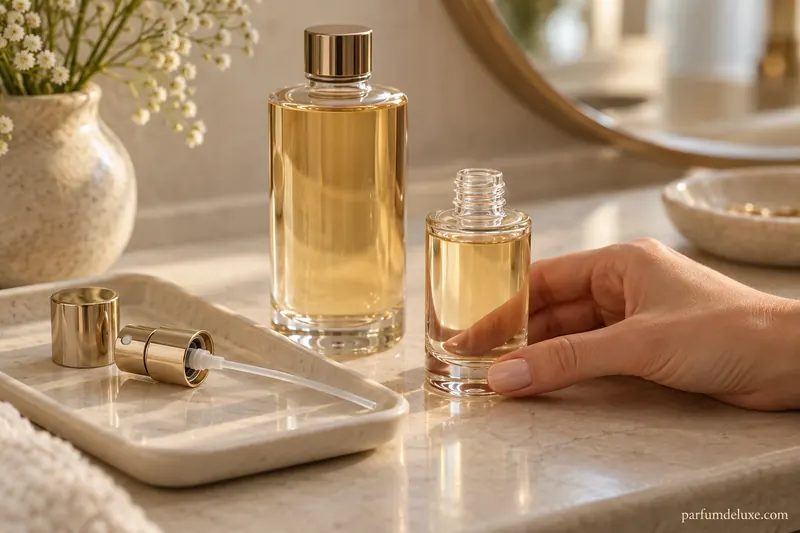
Why an empty perfume bottle means different things to different buyers
A buyer of an empty perfume bottle may be a collector, who sees shape, period, signature and condition. Someone who loves a particular scent sees a vessel already matched to that fragrance. A founder developing a line sees a catalogue reference with a neck size, a capacity and a pump. The glass can be identical in all three cases while the questions to ask are completely different.
Write down your goal before you buy or keep an empty perfume bottle. It sounds obvious, yet the most common misunderstanding is assuming that a beautiful bottle from a famous house can be washed out and refilled with any liquid. It usually cannot, and the sections below explain why.
Collecting: condition, completeness and provenance
For a collectible perfume bottle, such as a discontinued empty luxury perfume bottle, completeness matters as much as beauty. Look for an original stopper that seats properly, an intact label or etched mark, no chips at the neck and, where possible, the box. An empty perfume bottle sold with its packaging is easier to date and to resell, while an over-cleaned vintage piece with a worn marking loses credibility fast.
Resale platforms are full of every kind of empty perfume bottle described as collector’s items without proof of origin. Ask for sharp photos of the base, the neck and any markings, compare them with the house’s known editions, and treat unusual finishing with suspicion. Counterfeit bottles are illegal, and buying one, even only as décor, supports that trade.
Display dummies are not production bottles
Oversized store display bottles, often filled with tinted liquid, were made for shop windows and do not hold the commercial fragrance. If you are offered one, ask the seller exactly what the liquid is and whether it was ever sold to the public.
The refillable perfume bottle: what the houses officially offer
A refillable perfume bottle is designed from the start to take the original formula again. At Guerlain, the L’Art & La Matière bottles can be refilled only in a Guerlain boutique, by online appointment and where regulations allow; the house adds that the bottle has contained some recycled glass since 2021. Personalised or engraved items are excluded from the free-returns offer.
Dior sells a 300 ml aluminium refill for its Sauvage range that fills a 100 ml bottle in a single step, and operates a Refill Station in certain stores. By the house’s own life-cycle assessment, one bottle plus one refill uses markedly less glass, metal and cardboard than four separate bottles. Those figures are the brand’s calculations and should be read as such.
Why you cannot simply reuse perfume bottles with another formula
Many people assume they can reuse perfume bottles by rinsing them and pouring in a cheaper fragrance. In practice most sprayers are crimped on and cannot be removed without damage, old residues mix with the new liquid, and nobody has tested whether the plastics and gaskets tolerate a different composition.
Filling an empty perfume bottle from a famous house with another liquid and then selling or giving it as the original can amount to deception or counterfeiting. For personal use, a travel atomiser designed to be filled is the sensible option, rather than trying to repurpose a crimped luxury bottle.
Sourcing a new empty luxury perfume bottle for your own brand
Brand creators who need an empty luxury perfume bottle do not work from salvaged objects; they order from component catalogues. Coverpla, which supplies bottles, closures and pumps to the perfume and cosmetic sectors, lists models such as Boston, Neo and Verdi and lets customers mix bottles, caps and pumps freely. It reports serving more than 500 clients each year and also lists lightweight glass and refillable options.
For a new empty perfume bottle, collect three essentials: capacity, neck type and compatible pump. Then ask for samples and test them with your actual formula, because a finished product rich in oils or alcohol can interact with parts that looked fine empty. Component catalogues sell new containers; they do not certify the authenticity of branded bottles resold as collectibles.
Reading a glass bottle’s technical sheet
A good data sheet answers practical questions. Verescence describes its Atom bottle as refillable with a screw neck and made with 20 percent recycled glass, in 30, 50 and 100 ml versions weighing between 94 and 201 grams. The listing states made-to-order production in South Korea and a minimum order of 20,000 pieces.
That minimum is a reminder that many industrial catalogues are built for volume buyers. A small brand may need a reseller with smaller quantities, accepting a less exclusive shape in return. Whatever you choose, ask about decoration options such as screen printing, engraving, frosting or lacquer.
A short checklist before you buy any empty perfume bottle
Ask five questions. Is the bottle meant to be refilled, and by whom? Is it new, vintage or a store display piece? Can the seller show the original box, batch marking or catalogue reference? Which cap, neck and pump fit it? And what will you put inside, if anything? A seller who cannot answer the first four is giving you a decorative object, not a technical component.
Keep the answers with the purchase. If you ever resell a collectible perfume bottle, a short record of where it came from, what condition it was in and what it contained turns a vague listing into a credible one. Reuse perfume bottles only within the manufacturer’s own refill scheme, and treat any other filling as outside the product’s intended use.
After the last spray: emptying and cleaning safely
An empty perfume bottle that has run dry still carries traces of alcohol and aromatic materials. Empty it in a ventilated room away from flames, and separate glass, pump and cap where possible, since local recycling rules often treat them differently.
For decorative reuse, a finished bottle can hold a single stem, display a miniature or sit in a cabinet. Do not store food or medicine in it, and keep it away from young children while it still smells of scented alcohol.
Where to train your eye on historic bottles
Handling or viewing authentic pieces is the best preparation for the resale market. The Musée International de la Parfumerie in Grasse, founded in 1989, shows precious containers in alabaster, earthenware, ceramic and blown glass, including Renaissance examples, within a wider history of perfumery from antiquity onward.
Spending time with reference objects makes it easier to spot an anachronistic shape, an unnaturally even glass or a vague engraving when you later browse listings for an empty perfume bottle.