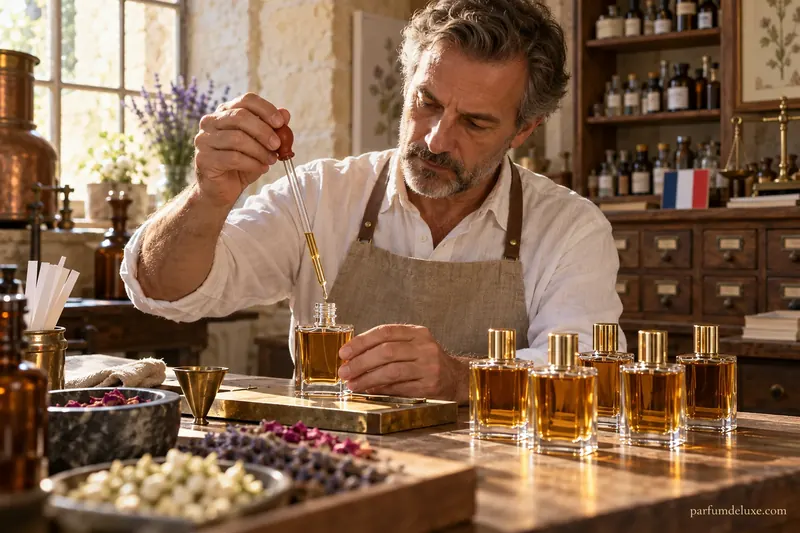
Where the French perfume tradition begins
The word perfume comes from the Latin per fumum, meaning through smoke. According to Tendance Parfums, France began building its own tradition from the fourteenth century, and in 1533 Catherine de’ Medici brought the Florentine perfumer René to the French court. He set up on the Pont au Change in Paris and sold scented waters and perfumed gloves.
Under Louis XIV, Versailles became a hub of fragrance use, and the glove-makers who scented their leather gained formal recognition as a trade. Perfumery therefore started in France as a craft guild activity, long before it became an industry of authors and brands.
That inheritance explains why luxury perfume in France is still linked with craft: buyers expect a perfumer’s hand, a house story and rigour about materials well before they expect a high price.
Grasse: from tanneries to flower fields
Grasse was a tanning town from the twelfth century. Wikipedia credits the tanner Jean de Galimard with the idea of scented gloves offered to Catherine de’ Medici, and notes that in 1614 the crown recognised the corporation of glover-perfumers. When leather declined, local growers turned to rose centifolia, jasmine, tuberose and orange blossom, the crops the Société Française des Parfumeurs associates with the town.
Merchant families such as Chiris and Roure-Bertrand supplied Europe in the eighteenth century, and Grasse helped refine enfleurage, steam distillation and solvent extraction, the three methods still taught when natural materials are explained.
What the UNESCO listing actually covers
In 2018, at its thirteenth session, UNESCO inscribed the skills related to perfume in the Pays de Grasse on its Representative List of the Intangible Cultural Heritage of Humanity. The entry has three strands: growing perfume plants, knowing and processing natural raw materials, and the art of composing a perfume.
UNESCO notes that these practices have existed since at least the sixteenth century and that knowledge is mostly passed on through long apprenticeship inside perfumeries, with the Association du Patrimoine Vivant du Pays de Grasse bringing the communities together. The listing honours a living skill, not a brand.
Modern French perfumery: Jicky to Eau de Dior
Chemistry widened the palette. Coumarin was synthesised in 1868 and vanillin in 1874, and Aimé Guerlain’s Jicky of 1889 is generally regarded as the first modern perfume because it mixed natural materials with synthetic molecules.
The Société Française des Parfumeurs then lists a run of landmarks: L’Heure Bleue in 1912, Shalimar in 1925, L’Air du Temps in 1948 and Eau de Dior in 1966. The pattern is clear. French luxury perfume is as much about composition and signature as about the price of the ingredients.
French perfume houses: heritage labels and independents
French perfume houses fall into two broad camps. The heritage names, often owned by large luxury groups, trade on archives, bottles and boutiques. In Grasse, Galimard states that it was founded in 1747, while Molinard describes itself as a perfumer-creator in the town since 1849, with five generations behind it.
The second camp is made of independent authors. The Société Française des Parfumeurs mentions Serge Lutens, Etat Libre d’Orange and Liquides Imaginaires as examples. Their catalogues are narrower and their style is more personal, so they reward a side-by-side test: smell a heritage floral and an independent floral on the same afternoon and note what differs.
Either way, luxury perfume in France is best judged by the match between a house’s story and what you smell. French luxury perfume does not need grand speech to defend itself; the structure of the composition and the quality of the trail do that work.
Perfumery in France as a trip: visiting and composing
A factory tour, a museum, a composition class and a finished bottle are four different purchases. Fragonard presents itself as the perfumer of Grasse, with factories and shops. Galimard runs a Studio des Fragrances where guests blend a scent from 126 notes, with sessions advertised from 65 euros, a figure worth checking when you book.
Molinard offers workshop formats from forty-five minutes to two hours in Grasse, and the brand also lists Paris, Nice and Cannes. Grasse perfume workshops differ in how much guidance you get, so ask before paying what the bottle size is, how many materials you can choose from and whether the formula is saved for a reorder. Booking one of the Grasse perfume workshops early in a trip also leaves time to test your blend on skin for a few days.
- Length of the session and meeting point
- Volume of the bottle you take home
- Number of materials you can combine
- Cancellation and rescheduling terms
- Whether your blend can be reordered
How to tell genuine French production from a story
A bottle that mentions Paris, Grasse or heritage has not proved where its liquid was composed, made or filled. Flowers may be grown in one country, the formula written in another and the filling done elsewhere, and none of that is unusual or dishonest if the label is clear. That is why a label reading made in France deserves a look at the details, not blind trust.
Read the packaging and the product sheet, look for the responsible company’s address, and judge the explanation the house offers about its materials. Serious brands describe their process plainly; if answers stay vague, ask. Counterfeits are illegal, and nothing guarantees what is inside a fake bottle.
Buying luxury perfume in France: a testing routine
Shops and brand boutiques let you try several fragrances on paper strips, then on skin. Keep to two or three per visit because the nose tires quickly, and let each one develop for hours so the move from top notes to base is visible. Anyone planning luxury perfume in France as a purchase should also check the ingredient list on the box, since fragrance materials can trigger allergies; a small patch test is a sensible habit.
Compare one French luxury perfume in two concentrations when the house sells both, because an eau de parfum and an extract rarely behave alike on the skin. For a first purchase of luxury perfume in France, a small sample or a travel size is a cautious step.
Where to try French luxury perfume before you commit
Three settings complement each other. A brand boutique shows the whole range and sometimes limited extracts, with advisers trained in the house style. A multi-brand perfumery lets you compare rival signatures within an hour. A Grasse workshop teaches you the vocabulary of materials before you choose.
Write your taste in one sentence, such as creamy white flower or dry smoky wood, then look for neighbours across several French perfume houses. This habit avoids paying for a famous name when what you want is a style, and it helps you ask sharper questions when you later visit perfumery in France in person.