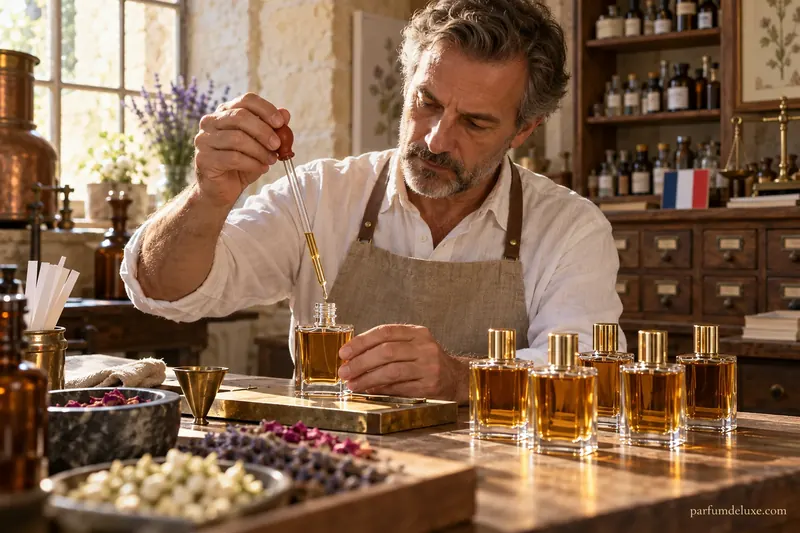
Le Labo perfume houses start with a New York workshop idea
The story of any Le Labo perfume begins in 2006 with two founders, Fabrice Penot and Eddie Roschi. Public sources place the first boutique at 233 Elizabeth Street in Nolita, New York, and Fragrantica notes that the house started with ten fragrances. Some presentations also mention Grasse as a birthplace, but the brand took root in New York, and that urban, almost industrial setting shaped its image from the start.
The laboratory spirit shows in the staging of every Le Labo perfume: plain labels, workshop vocabulary, and shops that feel closer to a place of work than a luxury counter, where the emphasis falls on explaining the range and letting you test it. The house now belongs to the Estée Lauder group, which acquired it in 2014 according to public information.
Its core range sits in what the house calls the Classic Collection, the shelf where Santal 33 and Another 13 both belong, offered depending on the product as eau de parfum, body lotion, shower gel or liquid balm. Enthusiast databases list several dozen scents, city-exclusive editions included.
Le Labo Santal 33, a woody scent that became a landmark
Launched in 2011 and credited to perfumer Frank Voelkl, Santal 33 is the house’s most quoted creation. The official Le Labo Santal 33 page gives no note pyramid; it offers a mood text instead: an open fire, the soft drift of smoke, sensuality rising after the light has gone. Encyclopedic sources and specialist blogs list sandalwood, cardamom, iris, violet, cedar, ambrox and a leather accord.
Two levels need separating here. What the house writes is intention. What reviewers list is an interpretation, sometimes contradictory from one source to another. Neither replaces a test of Le Labo Santal 33 on skin, where the creamy, smoky or dry side of the scent can change from person to person.
This Le Labo perfume has been so successful that some observers now resent its ubiquity, and a Vogue writer argued that its popularity weakened its value as a personal signal. The debate says nothing about quality; it shows that a collective reputation weighs on individual perception.
Le Labo Another 13, a fragrance born from a commission
Another 13 has a precise origin: in 2010 AnOther Magazine asked the house for an exclusive scent, hence the name. The official page calls it hypnotically elusive and unique, an addictive, dirty potion with spike and shine. It lists no notes and names no perfumer, and it is wiser not to fill that gap with guesses.
Le Labo Another 13 works well as a comparison with Santal 33. One speaks of fire and smoke, the other of an abstract shine. Worn a week apart, they show the gap between a woody atmosphere and a construction that is harder to put into words, with no technical diagram needed.
A number in the name: a house code, not a recipe
The house’s names pair a main ingredient with a number. According to public presentations the number refers to how many elements go into the composition; Fragrantica speaks of notes, while an online encyclopedia mentions ingredients. That difference shows the explanation varies between sources, and only the house can settle it.
In any case the number cannot be used to rebuild the scent at home. A fragrance is assembled from dozens of materials and molecules in precise doses, and the name keeps only an idea. Santal 33 means neither thirty-three ingredients to buy nor a sandalwood content of 33 per cent.
Keeping expectation apart from the real experience
A name conjures pictures before the first spray. The risk is trying to find those pictures at any price, and expecting a Le Labo perfume to match a mental image it never promised. Smell first, then compare the impression with what the name suggested: the gap is instructive and teaches more than any product sheet.
Preparing a visit to a Le Labo store
The house’s official store locator helps you find the nearest Le Labo store and ask for advice there. When it was read, the page only displayed a loading message; if that happens again, retry later or use the site’s catalogue, which also mentions a discovery programme and a refill programme.
Before walking into a Le Labo store, note two or three sensations you are after: a creamy wood, a smoky warmth, something more abstract. These are cues for talking to the advisor, not demands. No name guarantees what you will feel, which is exactly why the test remains the best judge.
Ask to test each Le Labo perfume on skin, wait for the scent to develop rather than deciding at the first whiff, and avoid comparing more than two or three references in one visit so your nose does not tire.
Building a personal vocabulary around Le Labo fragrances
With each trial you collect sensations that standard categories name badly. Write them in your own words: dry or creamy, smoky or luminous, close to the skin or enveloping. That private lexicon will serve you in every house, and it makes any later conversation with a sales advisor shorter and more precise, well beyond Le Labo fragrances alone.
If a preference emerges, test it over a full week and at different times: a morning in cold air, an afternoon indoors, an evening out, and note which moment flatters it most. A scent that pleases in a heated shop does not behave the same way in a cool office or outdoors.
Authenticity, allergies and care when buying
The more popular a scent, the more imitations circulate. Buy from a house boutique, its official website or a recognised retailer, and be wary of unusually low prices. Counterfeits are illegal and may contain uncontrolled substances.
Like any perfume, a creation from this house contains regulated allergens listed on the packaging. If your skin is sensitive, try a small amount on a limited area and read the ingredients. That care does not replace advice from a health professional if a reaction appears.
Finally, remember that a Le Labo perfume, like any other, is a matter of taste. The fame of a Santal 33 or an Another 13 is a clue, not a guarantee: only your skin decides.