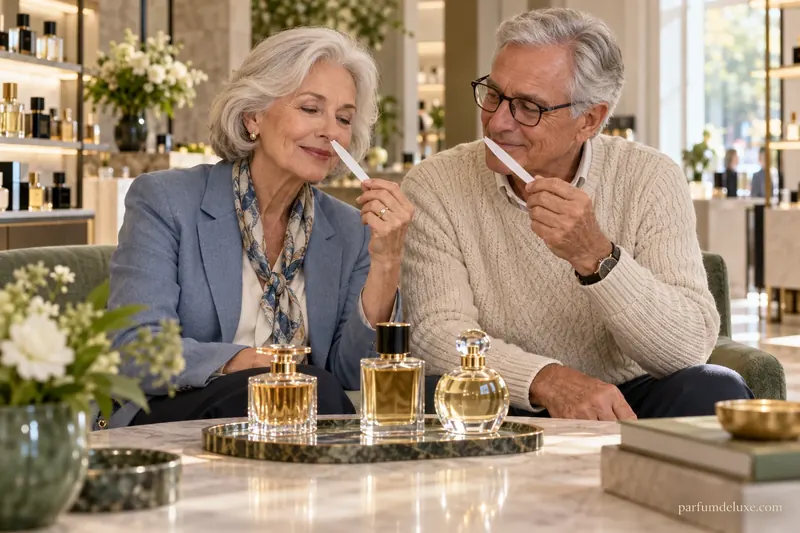
Perfume for older adults: why age does not pick the fragrance family
Linking powdery florals or strong classics to old age is a stereotype. Nothing stops an eighty-year-old from loving a burst of citrus, a crisp wood or a gourmand note, and nothing forces a man of seventy to keep the cologne of his youth.
Choosing perfume for older adults therefore works like any other choice: start from what the person likes, rejects and remembers. Two attitudes are common. Some want to rediscover a familiar signature; others would enjoy something new without always daring to ask. Your task is to work out which one is speaking. A remark such as ‘I haven’t worn anything for years’ does not close the door: it often means nobody has offered them a scent that felt like them. A successful perfume for older adults sometimes rests on one good question, asked patiently and without judgement.
Perfume for seniors starts with a life story, not a stereotype
Begin with a conversation rather than a shop visit. Which fragrances marked their life: a wedding, a parent, a journey? Which can they no longer bear? An open question beats a ready-made suggestion. If they name a perfume, track down the exact version, because houses sometimes reformulate creations over the years and today’s bottle may differ from the one they wore. Never promise an identical copy. Mention that a favourite from decades ago may have been discontinued, and treat that news gently, since it can feel like losing a small piece of personal history.
Write down the materials they already mention fondly, such as rose, lavender, vetiver or vanilla. These words become a thread for the trials. For perfume for seniors, a sample worn for a whole day tells you more than any long description. Ask them to describe it in their own words: ‘like my mother’s garden’ is worth more than any note list.
Smell and ageing: what the research institute says
The NIDCD, a US institute within the National Institutes of Health, states that problems with the sense of smell increase with age and are more common in men than in women. It cites a study in which nearly one quarter of men aged 60 to 69 had a smell disorder, against about 11 percent of women in the same range. These figures describe a group, not an individual, and many older people smell perfectly well.
Two precautions follow. First, let the person say what they perceive, since over-spraying to compensate may bother people around them. Second, if their sense of smell seems to have changed suddenly, that is a question for a health professional, not for a fragrance adviser. Bear in mind too that a softer scent is not a failed scent. A close, almost intimate trail often suits a living room, a bedroom or a care home where people share the same spaces, and it keeps perfume for seniors pleasant for everyone nearby.
Choosing a perfume gift for an older person: familiar or new
A perfume gift for an older person can answer two opposite wishes. To revive memories, buy yesterday’s fragrance again after checking the concentration and the version. To offer a discovery, pick a composition close to the materials they love but more recent, and present it as a trial, not a replacement.
A small size or discovery set reduces the risk of a mistake. It also lets the person decide without feeling obliged to wear what they were given. Include the exchange receipt if the shop allows it, and make clear that the gift matters mostly for the attention paid to their taste.
Practical comfort: bottle weight, sprayer and labels
With perfume for older adults, the container matters as much as the composition. A heavy bottle, a stiff pump or a tight cap can make the gesture hard when hands lack strength or flexibility. With perfume for older adults, handle the bottle before giving it: weight, grip, effort needed at the sprayer.
Legibility counts too. Tiny print, a name that is hard to read or clear glass without a landmark can be a nuisance. Diptyque notes that some of its boutiques can refill the bottle, which spares anyone from pouring scent between containers. For safety, keep the flacon within reach but away from heat.
Perfume for the elderly: leaving clichés behind
Buying perfume for the elderly often means examining the picture you hold of them. The risk is giving what you find appropriate instead of what pleases. Ask yourself whether the gift speaks about them or about you. A grandmother faithful to one scent for thirty years may value that constancy, while another dreams of a change.
The same applies to men. A grandfather may prefer a fresh summer scent, a classic eau de Cologne or nothing at all, and that choice deserves equal respect. Fragrance must never become a way of telling someone how they ought to smell. Ask what they would like to be reminded of, a garden, a clean shirt, a spice cupboard, and let that answer lead the search for perfume for the elderly, with their consent at every stage.
Perfume for older women and men: tools for trying without pressure
Several houses provide ways to try. Guerlain advertises consultations and masterclasses along with engraving and bottle personalisation. Dior offers a finder for La Collection Privée and a fragrance appointment service with an ambassador. Hermès presents seven Jardins as eaux de toilette, among them Un Jardin sur le Nil, Le Jardin de Monsieur Li and Un Jardin sur la Lagune, different enough to start a discussion.
None of these suits every taste, but each opens a dialogue. Trying on skin, ideally with the person present, remains the deciding step. For perfume for older women who cannot travel to a shop, bring two or three samples home and let them compare, one day after another, in peace. A fragrance is judged by wearing it over several days, not by the first spray in a noisy department store. Let them say no without explanation, and keep the receipt.
Skin sensitivity: patch tests, ingredients and alcohol
Fragrance should feel comfortable on skin that can be more fragile with time. Patch-test a small area before adopting a new bottle and space out the trials. If skin reacts, spraying from a distance on clothing, after checking that the fabric will not stain, is an alternative.
The ingredient list names the regulated allergens, so reread it if the person has reacted before. For lasting redness or breathing discomfort, ask a health professional rather than testing more bottles.