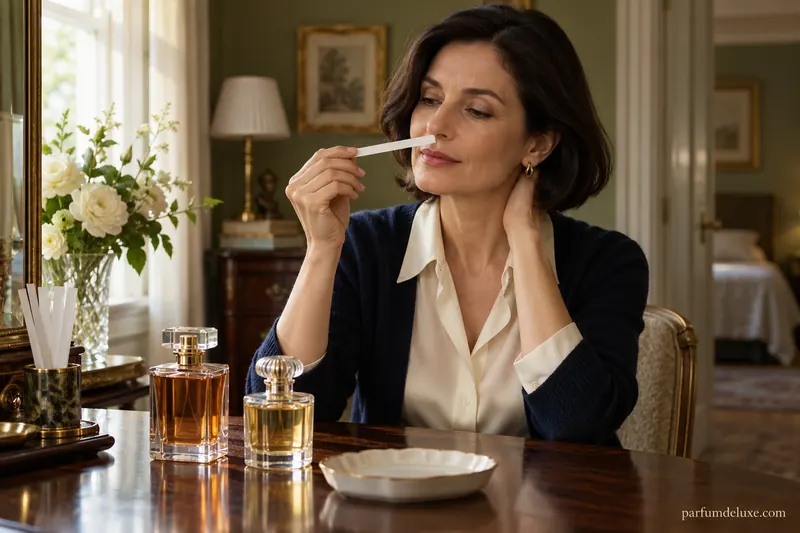
What makes a perfume for a classic woman feel classic
Nobody regulates the word classic in perfumery. In practice it describes a composition whose outline stays legible across decades: a firm structure, a signature you identify within seconds and a reputation larger than any season. A perfume for a classic woman may be floral, aldehydic, chypre or amber, as long as it keeps that sharpness of design. What reassures people about a perfume for a classic woman is usually restraint: nothing jars, everything holds together, and the scent accompanies the day without dominating it.
Part of the label comes from collective memory. Some fragrances became classics because generations wore them; others because the house keeps retelling and extending them. So separate two questions before buying: is this scent historically established, and do you enjoy it today? Only the second one should decide your purchase.
Chanel N°5 and the aldehyde signature of a classic feminine perfume
Chanel’s official page explains that Gabrielle Chanel asked Ernest Beaux to create the original N°5, which dates back to 1921, and that the composition made unprecedented use of aldehydes. Those materials lend floral bouquets a sparkling, slightly abstract brightness, far from the smell of a cut flower. That is why N°5 is the usual starting point for anyone exploring a classic feminine perfume. Used with care, a timeless perfume for women of this kind gives a fixed point from which to compare newer interpretations.
The house also sells N°5 Eau Première, described as a light, airy and luminous version of the fragrance. According to the page, Jacques Polge, then the house perfumer, reinterpreted it in 2008 with aldehydes, ylang-ylang from the Comoros, May rose, jasmine, vanilla and musky notes. Wearing both side by side proves that one name can cover very different sensations.
Shalimar and the amber side of perfume classics
Guerlain, which describes itself as born in Paris in 1828, presents Shalimar as the first amber of perfumery. Its official page names bergamot, vanilla and iris as the main accents around the Guerlinade, the signature of the house, and links the story to the romance of Emperor Shah Jahan and Princess Mumtaz Mahal.
For a newcomer, Shalimar shows another face of perfume classics: less aldehydic than N°5, more enveloping, with vanilla warmth and a balsamic shadow. If that wake intrigues you, judge it after an hour rather than on the first spray, once the bright opening has stepped back and the base has settled. That is where an amber wins or loses you. Trying Shalimar next to a floral aldehyde also clarifies your own taste, since the contrast between warm amber and bright flowers tells you quickly which direction feels like you.
Chanel Les Exclusifs: a classic wardrobe sorted by family
Chanel presents Les Exclusifs as a way of telling the story of the house through perfume, with subtle tributes to Mademoiselle. The official page sorts the collection by family: florals such as Gardénia, N°22 or Misia, ambers such as 1957, Coromandel or Cuir de Russie, woods such as Bois des Îles, and hesperidic or aromatic compositions such as Bel Respiro or Jersey.
That organisation helps when you love tradition but cannot tell which branch to follow. A lover of powder and white flowers might start with the florals, while someone drawn to leather and resin would begin with the ambers. The names evoke places and memories, which appeals to history lovers, yet no name replaces a proper trial.
Powdery perfume explained: iris, musk and soft flowers
A powdery perfume owes its softness to materials such as iris, certain vanillas and musks, which create a dry, almost cosmetic texture. In traditional compositions that powder rests on a floral heart of rose, jasmine or ylang-ylang. The result feels rounded and controlled rather than sugary.
To recognise these accords, listen to the texture more than the note list. One rose can seem fresh, candied, spicy or amber depending on what surrounds it. When a description announces vanilla, ask whether it feels creamy, woody or smoky. Paying attention to texture makes each trial more precise and each choice longer lasting. A good perfume for a classic woman often rewards this slow listening, because its charm lies in how smoothly the layers connect rather than in any single dramatic note.
- Write down your first impression, then the one after thirty minutes
- Compare two concentrations of the same reference
- Smell your own sleeve between two trials
- Return to the scent the next day before deciding
Family memory versus present pleasure
Many women connect a classic scent with a mother, a grandmother or a particular chapter of life. That bond is precious, but it can cloud judgement: the smell stored in memory is often softer, larger and more emotional than what the current bottle delivers. Remembered scents and today’s perception rarely overlap perfectly.
Accept that a reference’s history and your enjoyment may diverge. You can love a grandmother’s wake and still prefer a lighter reading of it. Equally, a bottle you never considered, met by chance on a testing card, could become your signature. A timeless perfume for women is a doorway, not an obligation. Keeping a notebook of references you liked, with the concentration and the date, makes later comparisons far easier than relying on a vague impression.
Concentrations, versions and reformulations: test the exact bottle
A historic line often exists as eau de toilette, eau de parfum, parfum and lighter interpretations such as Eau Première. They share a name but seldom the same feeling. Always try the precise reference you are considering, even if the name has followed you for years, because concentration changes duration, roundness and projection. This matters particularly for classic bottles, where the same title may point to a recent interpretation as easily as to an older silhouette.
Formulas also move. Ingredients can be adapted over time, notably to respect the safe-use standards of IFRA, the international trade association, which publishes a library of standards on fragrance materials. To smell vanished or older creations, the Osmothèque in Versailles is devoted to preserving and recreating great perfumes.
Giving a perfume for a classic woman without missing the mark
Choosing a perfume for a classic woman as a gift calls for caution, because a prestigious name does not guarantee she will enjoy it. If you know her habits, spot what she already wears; if not, a small bottle or discovery set leaves more freedom than a large flacon. A perfume for a classic woman also deserves a gift note that leaves room for exchange, because tastes within one tradition can differ a great deal.
Remember too that fragrances can trigger skin reactions in some people. Regulated allergens appear on the packaging or product sheet, and a patch test on a small area is a simple habit. Finally, buy from recognised retailers to avoid counterfeits, which are illegal and sometimes irritating.