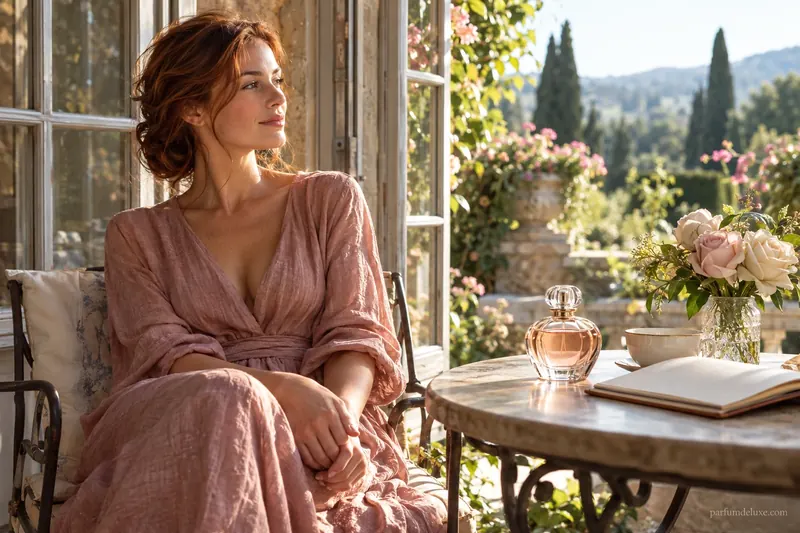
Jasmine perfume: one name, two flowers, grandiflorum and sambac
Several species hide behind the word jasmine. Jasminum grandiflorum, known as Spanish jasmine, originated in West Asia, the Indian subcontinent and North-East and East Africa. Jasminum sambac, called Arabian jasmine, is the national flower of Indonesia and the Philippines.
Houses increasingly name the species. On Guerlain's Jasmin Bonheur page, grandiflorum comes from Grasse in France, Calabria in Italy and India, while sambac comes from India. Dior's J'adore Eau de Parfum combines grandiflorum with sambac. That detail is worth more than a bare mention of jasmine on a bottle.
For a buyer who compares, the species is a first clue: a jasmine perfume built on grandiflorum will not carry itself like one that leans on sambac, even if the official page does not always spell out the difference.
Where jasmine grows: Grasse, Egypt and India
Jasmine appeared in the countryside around Grasse around 1650 and became one of the region's flagship crops. Picking, however, is the largest share of the cost of making perfume, which pushed cultivation toward Egypt and then southern India. Around 40 hectares of perfume plants were still grown in the Grasse area in 2000.
Reference accounts say that the Egyptian village of Shubra Beloula grows most of the jasmine used by the global perfume industry. Dior mentions, for J'adore, a grandiflorum from the Grasse estate completed by a jasmine harvested in Egypt.
The gardens of the International Perfume Museum in Mouans-Sartoux still grow jasmine alongside tuberose, iris and May rose. The skills of the Grasse region, from cultivating the plants to composing the scent, have been inscribed since 2018 on UNESCO's list of intangible cultural heritage.
Jasmine absolute: picked by hand at dawn
Jasmine flowers do not wait, and a perfume built on jasmine absolute depends on that speed. They are picked by hand at dawn and processed quickly. For Jasmin Bonheur, Guerlain explains that only an absolute is extracted. Jasmine absolute is therefore one of the central materials of floral perfumes, and the flower contains, among other things, benzyl acetate, benzyl benzoate and linalool, which contribute to its scent.
Techniques keep evolving. For its Jasmin Grandiflorum extrait, the house cites low-temperature CO2 extraction at 30 °C, combined with other techniques and a so-called micro liquid extraction, which it presents as a first for this jasmine heart.
Whatever the method, the official product page is the right starting point for any jasmine perfume: it shows whether the jasmine is treated solo, with which companions and at what concentration. A jasmine perfume that names its species and its origins gives you far more to compare than one that only prints the word jasmine.
Guerlain's Jasmin Grandiflorum: the flower alone at 30 percent
In the L'Art & La Matière collection, Guerlain offers Jasmin Grandiflorum as a 30 percent extrait, presented as the most accomplished expression of jasmine at the house. The flower is worked as a "communelle", a blend of different origins and harvests, so there is no single geographic source.
The heart is described as a jasmine with candied strawberry facets, softened by a milky sandalwood. The intensity is marked strong, and the bottle, refillable in selected boutiques, takes its inspiration from the Flacon Carré of 1870.
The page names no perfumer, only "the Guerlain perfumers". When consulted, the product was listed as out of stock, one more reason to check availability with the house before falling for a particular bottle.
Jasmin Bonheur: a jasmine in Matisse colours
Jasmin Bonheur is an eau de parfum signed by Delphine Jelk, Guerlain's creative director for perfumes. The house describes a colourful jasmine, tinted with joyful shades inspired by the palette of Henri Matisse.
The jasmine stays central, but the page also highlights apricot, tied to orange, powdery iris, tied to violet, and rose. It gives no olfactive pyramid, a reminder that a high-end jasmine perfume is not summed up by a list of top, heart and base notes.
Setting this bottle against the Grandiflorum extrait, two creations from one house, clarifies the gap between a shared theme and a composition: the name of the flower does not predict the result. Sizes offered are 50, 100 and 200 ml.
Dior J'adore: a bouquet where no flower prevails
Dior presents J'adore Eau de Parfum as a luminous floral whose bouquet is designed so that no single flower prevails, evoking an ideal flower. The bottle keeps the range's emblematic amphora, with a redrawn collar.
Materials named include ylang-ylang, damascena rose from Turkey and Bulgaria, and both grandiflorum and sambac jasmine. Francis Kurkdjian, creative director of Dior perfumes, signs the perfumer's note on the page, which also mentions violet and lily of the valley.
Here the jasmine note, rather than leading the way, takes part in an ensemble instead of conducting it. It sits at the opposite pole from the Guerlain extrait: a jasmine glimpsed inside a collective floral impression, to be enjoyed without hunting for a freshly picked flower.
Choosing a jasmine note: frank flower or bouquet
Start by asking whether you want a clearly recognisable jasmine or a more collective floral impression. That distinction gives your tests a useful direction and stops you from judging a composition solely on how closely it resembles a freshly picked flower.
For the first wish, Jasmin Grandiflorum or Jasmin Bonheur put the flower at the centre. For the second, J'adore shows a bouquet in which several flowers talk to each other. Concentration matters as well: a 30 percent extrait does not have the presence of an eau de parfum.
Try any jasmine fragrance on skin, let it develop for several hours and note whether the jasmine fades, thickens or sharpens. The right high-end jasmine perfume for you is the one whose evolution you still enjoy at the end of the day.
Precautions, allergens and buying with confidence
Jasmine contains molecules such as linalool and eugenol, which belong to the allergens cosmetics must declare above regulatory thresholds. Anyone choosing a jasmine perfume who is sensitive can begin with a test on a small area of skin, and any health concern deserves a professional's advice.
Do not judge a jasmine fragrance on promises of longevity or seduction: these are impressions that change with skin, season and the amount applied. Reliable information means the concentration, the declared notes and the sizes given by the house.
Finally, counterfeit perfume is illegal and risky. For a luxury bottle, go through the house's own boutique or an established retailer.