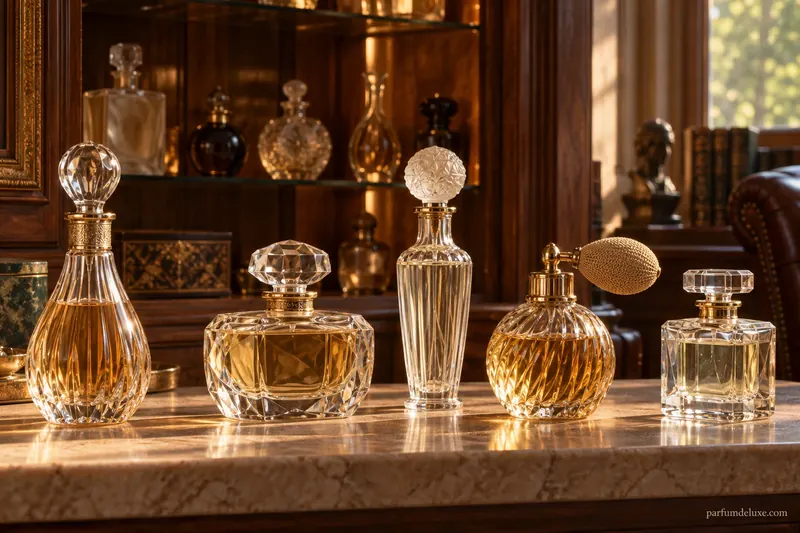
Luxury and prestige perfume: two words, several meanings
In everyday conversation, luxury and prestige perfume both describe an upmarket bottle, priced high and presented with care. In the trade, each word shifts meaning with the speaker. Luxury tends to point to a house, a craft tradition, sometimes handwork. Prestige points more readily to a distribution channel and a level of presentation.
No law fixes a definition of either for perfume. A house can call itself luxury; a retailer can sort its range into prestige. That is why vocabulary alone proves nothing, and why you need to look at what the product concretely offers.
For luxury and prestige perfume alike, keep to one method: replace adjectives with observable facts. Where is the fragrance sold? Who created it? In what bottle? With which services around the purchase?
Prestige perfume as market researchers see it: a channel first
Measurement firms use a more technical definition of luxury versus prestige perfume, built on where products are sold. In Circana’s annual data, reported by BeautyMatter, prestige covers sales made in department stores and beauty specialists, as opposed to mass retail. The criterion is the place of sale, not what is inside the bottle.
In the same figures, luxury brands made up 12 per cent of US prestige fragrance sales in 2024 and grew faster than the category overall. On that reading, luxury looks like a subset of prestige: luxury brands are counted within prestige sales, though not every prestige brand is luxury.
That hierarchy in luxury vs prestige perfume belongs to an American market split, and it is only one way to define the terms. Another research firm or another country may draw the line elsewhere, and nothing makes it a universal norm.
Luxury versus prestige perfume as defenders of luxury see it
On the luxury side, the Comité Colbert gives the view of French professionals. Founded in 1954 by Jean-Jacques Guerlain, it lists 119 members on its website: 98 French houses, 15 cultural institutions and 6 European houses, across 14 trades. It describes itself as the voice of French luxury and states a mission to promote and pass on savoir-faire.
For perfumery, its dedicated page highlights fourteen members, among them Caron, Diptyque, Guerlain, Hermès, Maison Francis Kurkdjian and Yves Saint Laurent Beauté. The criterion here is not a sales channel but membership of a family of houses with history and creative work.
The difference between luxury and prestige can be put briefly: where prestige speaks of place, luxury speaks of house and craft. The two coexist: a house can belong to a luxury committee and sell through prestige perfumeries.
A fact table to compare a prestige perfume and a luxury one
To compare a prestige perfume with a luxury one, build a table of facts. Each line is an observable criterion that you fill in for every candidate before making any judgement.
- Distribution: brand boutique, department store, specialist perfumery, online shop.
- Creation: described formula, named perfumer, house history.
- Presentation: bottle, box, refillability, personalisation.
- Services: advice, engraving, samples, discovery routes.
- Price and sizes: displayed prices, volumes, trial sets.
Do not infer quality from vocabulary
A range that uses more exclusive words is not better by principle. Decide what matters to you before giving higher value to a collection merely because its communication sounds rarer.
A luxury house in practice: the Clive Christian collections
The website of Clive Christian, a London house based in Mayfair, arranges its offer in five collections: Original, presented as loved globally since 1999; Noble, since 2016; Addictive Arts, since 2018; Private, since 2010; and Crown, which since 2020 reimagines archive fragrances from the Crown Perfumery Company. Those dates and taglines come from the house.
Each collection tells a different story: historical references, literary inspiration, exploration of a brand universe. Bottles are mostly 50 and 100 ml. The page states neither concentrations nor manufacturing methods, a reminder that luxury storytelling does not remove the need to read the detailed product sheets.
With any luxury and prestige perfume of this kind, the useful move is to tie each collection’s story to verifiable details, and to test the fragrance before buying.
Creation, presentation and services: three areas of difference
On creation, check whether the house describes its formula, names its perfumer and explains its materials. A detailed sheet, whether for a luxury and prestige perfume or a simpler one, helps you understand what you are buying, without proving you will enjoy the result.
On presentation the range is wide: a spectacular object for a collector’s piece, a restrained refillable bottle for daily use, a gift box designed to impress. Presentation can influence price without changing the liquid.
On services, count in-store advice, samples, discovery sets and sometimes personalisation or engraving. A well-designed discovery route, lowers the risk of a purchase you regret, whatever positioning the label claims.
Why one is never automatically better than the other
Nothing proves that a luxury fragrance beats a prestige perfume, or the reverse, and the difference between luxury and prestige says little about enjoyment. A prestige bottle bought at a perfumery may please you more than a collector’s piece with exclusive communication, and a luxury scent may disappoint on your skin.
In luxury vs prestige perfume debates, some buyers want an experience, others a liquid that suits them, others a collector’s object. These expectations are not ranked; they are distinguished, and the right hierarchy is the one built from your own criteria.
Many reviewers describe the luxury versus prestige perfume difference they feel between such ranges in terms of pleasure or originality, but those are impressions, not measurements. Keep that nuance in mind when reading a comparison.
Adjusting your choice and protecting yourself from fakes
Once your criteria are set, test before you buy: paper strip, then skin, then several days of wear. If you are sensitive to certain ingredients, patch-test a small area and check the list on the packaging; if in doubt, ask a healthcare professional.
When buying a luxury and prestige perfume, favour the house, a major perfumery or a recognised retailer. Counterfeit branded perfume is illegal and can carry risks for skin. A price far below usual tags, rough packaging or a seller who will not say where the bottles come from all justify a check.
Displayed prices change and should be verified with the retailer. Keep proof of purchase, note the batch code and compare what you receive with the official product sheet.